QUESTION IMAGE
Question
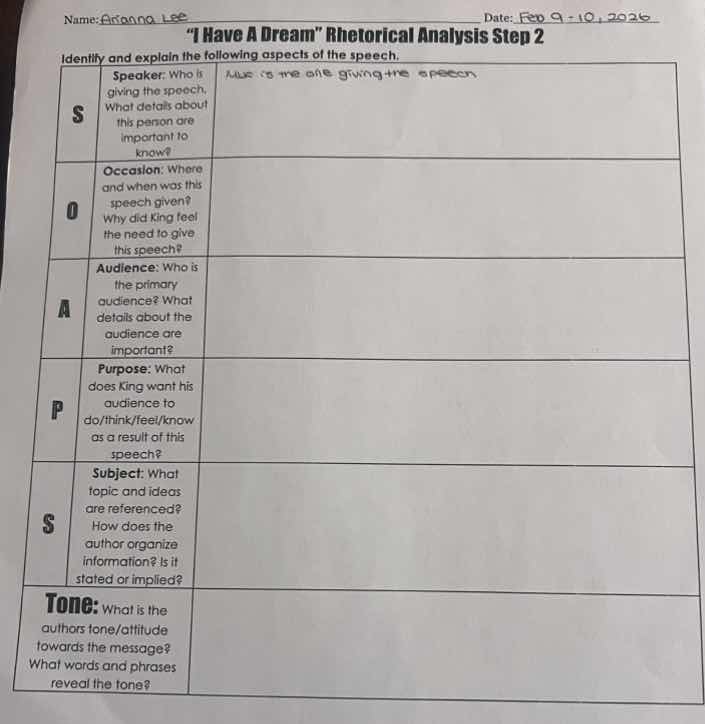
name: arianna lee date: feb 9-10, 2026
\i have a dream\ rhetorical analysis step 2
identify and explain the following aspects of the speech.
s speaker: who is giving the speech. what details about this person are important to know?
o occasion: where and when was this speech given? why did king feel the need to give this speech?
a audience: who is the primary audience? what details about the audience are important?
p purpose: what does king want his audience to do/think/feel/know as a result of this speech?
s subject: what topic and ideas are referenced? how does the author organize information? is it stated or implied?
tone: what is the authors tone/attitude towards the message? what words and phrases reveal the tone?
Speaker:
Martin Luther King Jr., a prominent Baptist minister and leader of the U.S. civil rights movement. His identity as a respected, faith-based advocate for nonviolent resistance gave him moral authority for the speech.
Occasion:
Delivered on August 28, 1963, at the Lincoln Memorial in Washington D.C., during the March on Washington for Jobs and Freedom. King gave the speech to address the unfulfilled promises of racial equality from the Emancipation Proclamation, amid ongoing systemic racism, segregation, and disenfranchisement of Black Americans.
Audience:
Primary audience: 250,000+ in-person civil rights supporters (Black and white activists, labor leaders, religious figures). Secondary audience: U.S. policymakers, white Americans across the country, and global observers. Many in the in-person audience had experienced racial violence and discrimination, making them receptive to calls for justice.
Purpose:
King wanted the audience to demand and work toward full racial equality and justice (ending segregation, securing voting rights, economic equity). He aimed to inspire nonviolent action, unite diverse groups, and pressure the U.S. government to uphold its promises of freedom for all.
Subject:
Core topic: Racial justice and the realization of the American Dream for Black Americans. King references the Emancipation Proclamation, the U.S. Constitution, and Declaration of Independence as unfulfilled promises. He organizes ideas by first highlighting the failure of racial equality, then sharing his vision of a just future, using stated, direct claims paired with implied calls for action.
Tone:
Passionate, hopeful, urgent, and righteous. Phrases like "I have a dream" (hopeful), "the fierce urgency of now" (urgent), and "the content of their character" (righteous, idealistic) reveal his tone, balanced between condemnation of injustice and optimism for a unified future.

Snap & solve any problem in the app
Get step-by-step solutions on Sovi AI
Photo-based solutions with guided steps
Explore more problems and detailed explanations
Speaker:
Martin Luther King Jr., a Baptist minister and leading U.S. civil rights movement figure; his moral authority as a nonviolent advocate was critical to the speech's impact.
Occasion:
August 28, 1963, at the Lincoln Memorial (Washington D.C.) during the March on Washington for Jobs and Freedom. King gave it to address unmet racial equality promises amid systemic racism and segregation.
Audience:
Primary: 250,000+ in-person civil rights supporters (Black/white activists, labor/religious leaders). Secondary: U.S. policymakers, national white audiences, global observers. Key detail: Many in-person attendees faced racial discrimination, making them receptive to calls for justice.
Purpose:
To inspire the audience to demand full racial equality (end segregation, secure voting rights, economic equity), unite diverse groups, and pressure the U.S. government to uphold equal freedom for all.
Subject:
Racial justice and the fulfillment of the American Dream for Black Americans. King references the Emancipation Proclamation, U.S. Constitution, and Declaration of Independence. Ideas are organized by first highlighting unfulfilled equality, then sharing a hopeful vision; most claims are stated directly, with implied calls for action.
Tone:
Passionate, hopeful, urgent, and righteous. Revealed by phrases like "I have a dream" (hopeful), "the fierce urgency of now" (urgent), and "content of their character" (righteous/idealistic).