QUESTION IMAGE
Question
name:
class: c
date:
goal: identify a function or not a function using different representations, including a set of ordered pairs, a table, a graph, and a mapping.
do now
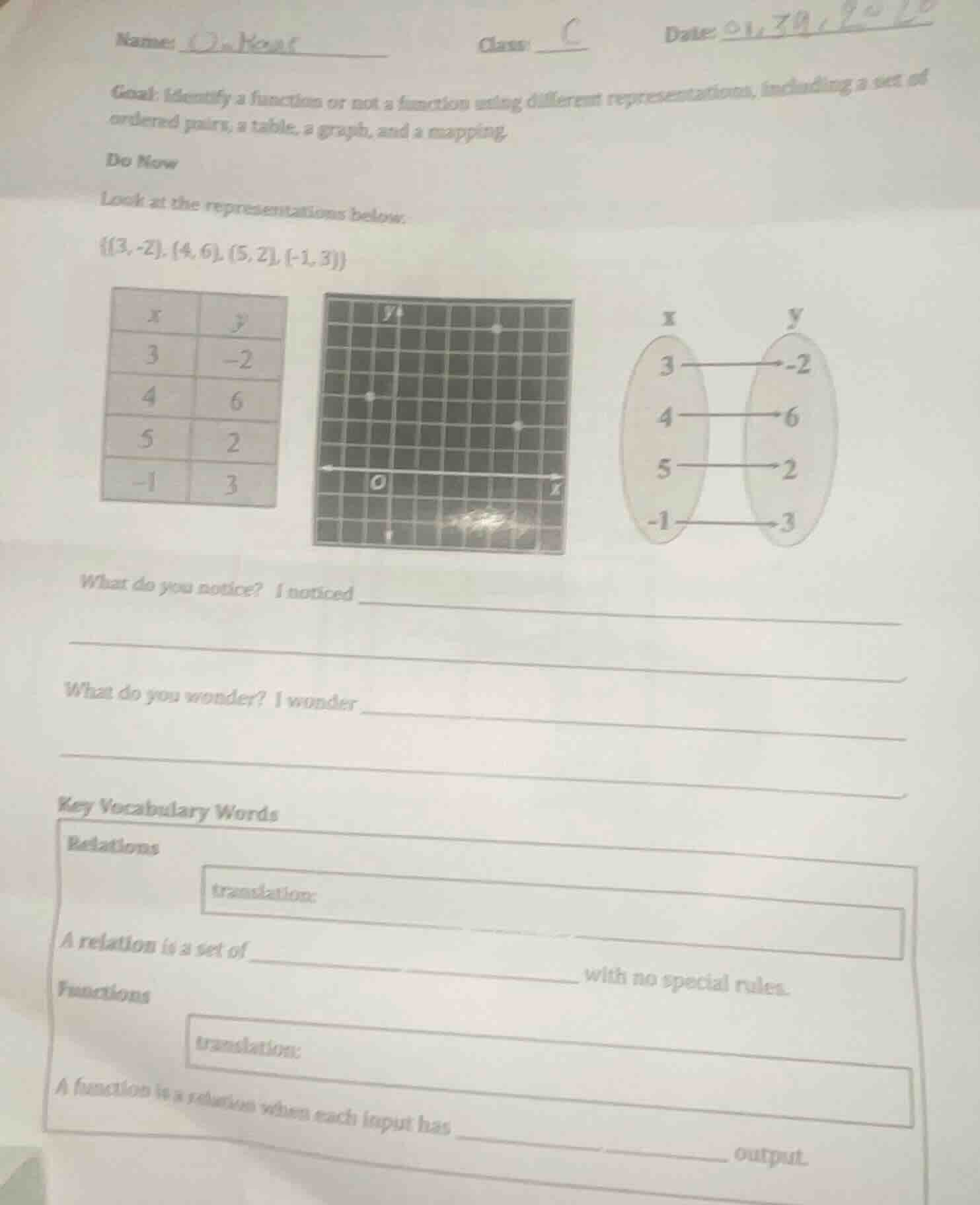
look at the representations below.
{(3, -2), (4, 6), (5, 2), (-1, 3)}
what do you notice? i noticed
what do you wonder? i wonder
key vocabulary words
relations
translation:
a relation is a set of with no special rules.
functions
translation:
a function is a relation when each input has output.
For the "What do you notice?" part:
Looking at the set of ordered pairs \(\{(3, -2), (4, 6), (5, 2), (-1, 3)\}\), the table, the graph, and the mapping, we can see that all these representations are showing the same relationship between \(x\)-values (inputs) and \(y\)-values (outputs). Each \(x\)-value (3, 4, 5, -1) is associated with exactly one \(y\)-value, and the data is consistent across the set of ordered pairs, table, graph (where each \(x\) has one point), and mapping (where each \(x\) maps to one \(y\)). Also, we can notice that each \(x\)-value is unique in the domain (the set of \(x\)-values: \(\{3, 4, 5, -1\}\) has no repeated \(x\)-values).
For the "What do you wonder?" part:
One might wonder if this relation is a function (since we are learning about functions and relations). Given the definition of a function (a relation where each input has exactly one output), since each \(x\)-value here has only one \(y\)-value, we can wonder if this is a function (and it actually is, because of the unique \(x\)-values mapping to one \(y\) each). Also, we might wonder if there are other representations of this relation, or if we can find a rule (like an equation) that defines this relation between \(x\) and \(y\).
For the "Relations" fill - in:
By definition, a relation is a set of ordered pairs with no special rules (unlike a function which has the rule that each input has exactly one output). So we fill in "ordered pairs" in the blank for the definition of a relation.
For the "Functions" fill - in:

Snap & solve any problem in the app
Get step-by-step solutions on Sovi AI
Photo-based solutions with guided steps
Explore more problems and detailed explanations
s:
- For "What do you notice?": I noticed that the set of ordered pairs, table, graph, and mapping all represent the same relationship, and each \(x\)-value has exactly one \(y\)-value (no repeated \(x\)-values in the domain).
- For "What do you wonder?": I wonder if this relation is a function (and if we can find a rule for it, or other representations).
- For "Relations" blank: ordered pairs
- For "Functions" blanks: exactly one