QUESTION IMAGE
Question
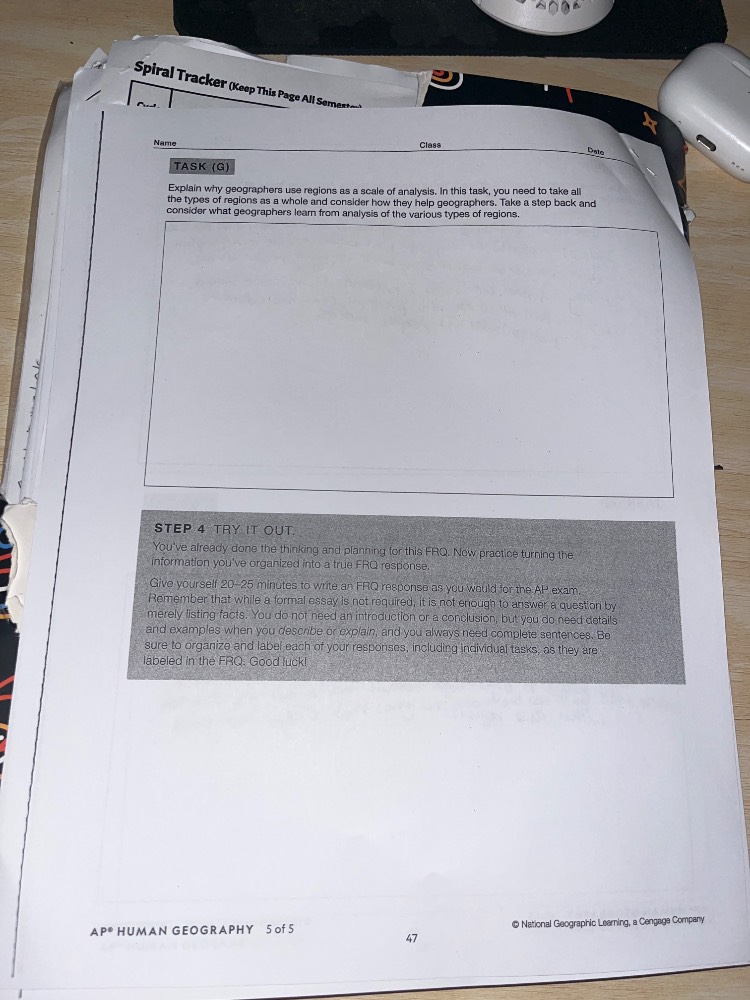
name class date task (3) explain why geographers use regions as a scale of analysis. in this task, you need to take all the types of regions as a whole and consider how they help geographers. take a step back and consider what geographers learn from analysis of the various types of regions. step 4 try it out. youve already done the thinking and planning for this frq. now practice turning the information youve organized into a true frq response. give yourself 20 - 25 minutes to write an frq response as you would for the ap exam. remember that while a formal essay is not required, it is not enough to answer a question by merely listing facts. you do not need an introduction or a conclusion, but you do need details and examples when you describe or explain, and you always need complete sentences. be sure to organize and label each of your responses, including individual tasks, as they are labeled in the frq. good luck! ap® human geography 5 of 5 47 © national geographic learning, a cengage company
- Simplification & Pattern Identification: Regions break down large, complex geographic spaces into manageable units, making it easier to spot and study consistent spatial trends or differences.
- Spatial Interaction Insight: Functional regions clarify how places connect through flows (people, goods, services) and the hierarchy of central places.
- Cultural & Behavioral Context: Perceptual regions uncover the human-centered, socially constructed nature of place, while formal regions provide objective data on shared environmental, cultural, or economic characteristics. Together, these region types give geographers a holistic view of both physical and human spatial dynamics.

Snap & solve any problem in the app
Get step-by-step solutions on Sovi AI
Photo-based solutions with guided steps
Explore more problems and detailed explanations
Geographers use regions as a scale of analysis to simplify complex spatial data, identify spatial patterns, understand spatial interactions, and compare geographic phenomena across areas. From analyzing different region types, they learn:
- Formal (Uniform) Regions: Shared homogeneous traits (e.g., language, climate) reveal cultural, environmental, or economic uniformity, and how these traits shape spatial cohesion.
- Functional (Nodal) Regions: The reach and influence of central nodes (e.g., a city's metro area, a hospital's service zone) show how spatial connections and interdependencies work.
- Perceptual (Vernacular) Regions: Subjective regional definitions (e.g., "the American South") highlight how cultural identity and collective spatial perception shape human behavior and place attachment.