QUESTION IMAGE
Question
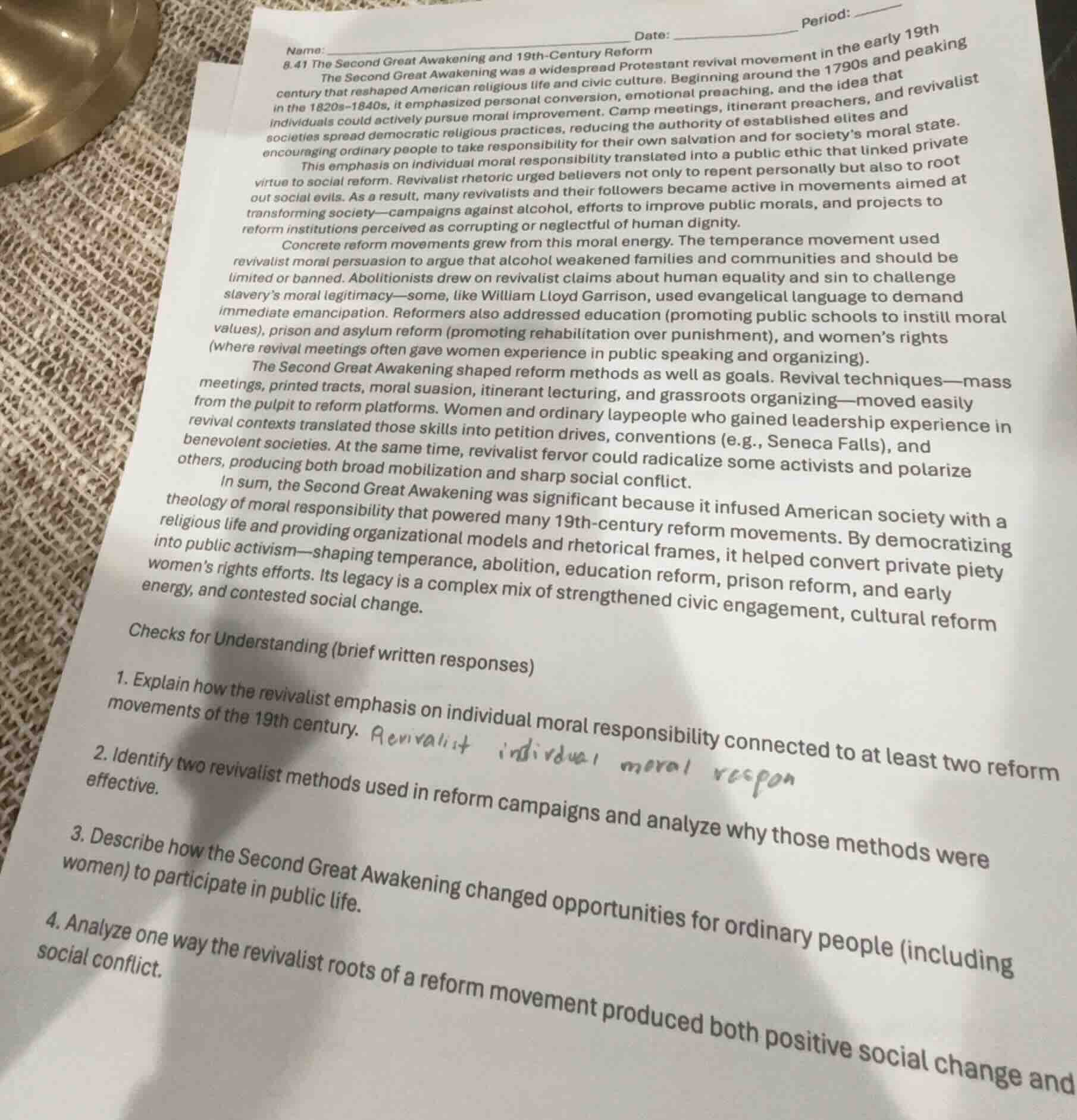
name:date:period:8.41 the second great awakening and 19th-century reformthe second great awakening was a widespread protestant revival movement in the early 19th century that reshaped american religious life and civic culture. beginning around the 1790s and peaking in the 1820s-1840s, it emphasized personal conversion, emotional preaching, and the idea that individuals could actively pursue moral improvement. camp meetings, itinerant preachers, and revivalist societies spread democratic religious practices, reducing the authority of established elites and encouraging ordinary people to take responsibility for their own salvation and for societys moral state.this emphasis on individual moral responsibility translated into a public ethic that linked private virtue to social reform. revivalist rhetoric urged believers not only to repent personally but also to root out social evils. as a result, many revivalists and their followers became active in movements aimed at transforming society—campaigns against alcohol, efforts to improve public morals, and projects to reform institutions perceived as corrupting or neglectful of human dignity.concrete reform movements grew from this moral energy. the temperance movement used revivalist moral persuasion to argue that alcohol weakened families and communities and should be limited or banned. abolitionists drew on revivalist claims about human equality and sin to challenge slaverys moral legitimacy—some, like william lloyd garrison, used evangelical language to demand immediate emancipation. reformers also addressed education (promoting public schools to instill moral values), prison and asylum reform (promoting rehabilitation over punishment), and womens rights (where revival meetings often gave women experience in public speaking and organizing).the second great awakening shaped reform methods as well as goals. revival techniques—mass meetings, printed tracts, moral suasion, itinerant lecturing, and grassroots organizing—moved easily from the pulpit to reform platforms. women and ordinary laypeople who gained leadership experience in revival contexts translated those skills into petition drives, conventions (e.g., seneca falls), and benevolent societies. at the same time, revivalist fervor could radicalize some activists and polarize others, producing both broad mobilization and sharp social conflict.in sum, the second great awakening was significant because it infused american society with a theology of moral responsibility that powered many 19th-century reform movements. by democratizing religious life and providing organizational models and rhetorical frames, it helped convert private piety into public activism—shaping temperance, abolition, education reform, prison reform, and early womens rights efforts. its legacy is a complex mix of strengthened civic engagement, cultural reform energy, and contested social change.checks for understanding (brief written responses)1. explain how the revivalist emphasis on individual moral responsibility connected to at least two reform movements of the 19th century.2. identify two revivalist methods used in reform campaigns and analyze why those methods were effective.3. describe how the second great awakening changed opportunities for ordinary people (including women) to participate in public life.4. analyze one way the revivalist roots of a reform movement produced both positive social change and social conflict.
1.
The revivalist focus on individual moral duty linked personal piety to fixing societal harms. For the temperance movement, this meant individuals took responsibility to fight alcohol's damage to families. For abolitionism, it meant believers saw ending slavery as a moral obligation to uphold human equality, framing enslavement as a sin individuals must act against.
2.
- Mass meetings: These gathered large groups to build collective fervor, spread moral messages widely, and mobilize ordinary people quickly, creating a sense of shared purpose that drove sustained action.
- Grassroots organizing (petition drives, conventions): This let ordinary people (including women) take leadership, directly pressure authorities, and build broad, community-based support that made reform demands hard to ignore.
3.
Revival meetings gave ordinary people, especially women, spaces to practice public speaking and organizing skills that were previously barred to them. For example, women gained experience leading discussions and planning events at camp meetings, which they later used to organize events like the Seneca Falls Convention for women's rights. This broke down barriers to public participation and created pathways for marginalized groups to engage in civic life.
4.
The abolitionist movement's revivalist roots pushed for immediate, uncompromising emancipation, which radicalized activists. This created sharp conflict with Southern slaveholders and even Northern moderates who favored gradual abolition or status quo. While it achieved the positive change of ending slavery, it deepened sectional divides that contributed to the Civil War, a major violent social conflict.

Snap & solve any problem in the app
Get step-by-step solutions on Sovi AI
Photo-based solutions with guided steps
Explore more problems and detailed explanations
- For temperance: Revivalist individual moral responsibility framed alcohol as a personal/societal sin, leading believers to campaign against it to fix family/community harm. For abolitionism: The emphasis on moral duty led activists to view ending slavery as a personal obligation, using the idea of human equality (rooted in revivalist theology) to challenge slavery's legitimacy.
- - Mass meetings: Gathered large crowds to build collective moral fervor and mobilize quick, broad action, uniting people around reform goals.
- Grassroots organizing (petitions, conventions): Empowered ordinary people to take leadership, directly pressure officials, and build community support that sustained reform efforts.
- Revival events provided ordinary people (including women) with spaces to practice public speaking and organizational skills. Women, in particular, gained experience leading discussions and planning meetings, which they translated into organizing for women's rights and other reforms, opening new pathways to public civic participation.
- The revivalist-driven abolitionist movement pushed for immediate emancipation, which radicalized activists and polarized society. This led to positive change (the end of slavery) but also deepened sectional conflict between the North and South, contributing to the Civil War, a devastating social and violent conflict.