QUESTION IMAGE
Question
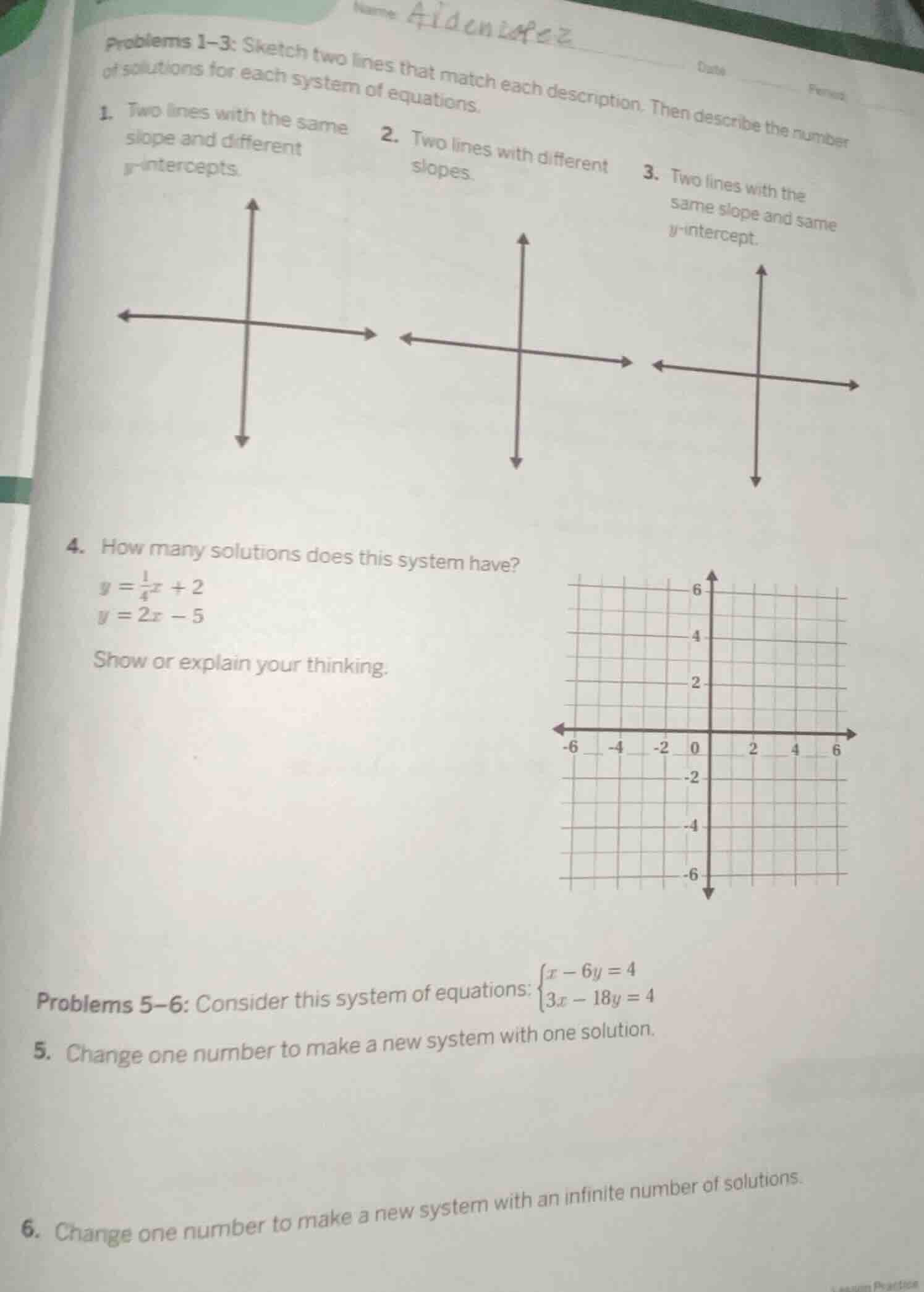
name:dateperiodproblems 1-3: sketch two lines that match each description. then describe the number of solutions for each system of equations.1. two lines with the same slope and different y-intercepts.2. two lines with different slopes.3. two lines with the same slope and same y-intercept.4. how many solutions does this system have?$y = \frac{1}{4}x + 2$$y = 2x - 5$show or explain your thinking.problems 5-6: consider this system of equations: $\
$5. change one number to make a new system with one solution.6. change one number to make a new system with an infinite number of solutions.
Step1: Sketch parallel lines (same slope)
Draw two lines with the same steepness, crossing the y-axis at different points (e.g., $y=2x+1$ and $y=2x-3$). These are parallel, never intersecting.
Step2: Describe solution count
Parallel lines (same slope, different intercepts) have no intersection points, so 0 solutions.
---
Step1: Sketch non-parallel lines
Draw two lines with different steepness (e.g., $y=2x+1$ and $y=-x+3$). These lines cross at one point.
Step2: Describe solution count
Lines with different slopes intersect exactly once, so 1 solution.
---
Step1: Sketch coinciding lines
Draw a single line (since same slope and intercept means the lines are identical, e.g., $y=3x-2$ and $2y=6x-4$).
Step2: Describe solution count
Identical lines overlap completely, so infinite solutions.
---
Step1: Compare slopes of the system
The system is $y=\frac{1}{4}x+2$ and $y=2x-5$. The slopes are $\frac{1}{4}$ and $2$, which are different.
Step2: Determine solution count
Lines with different slopes intersect exactly once. To verify, solve algebraically:
Set $\frac{1}{4}x+2=2x-5$
$\frac{1}{4}x - 2x = -5 - 2$
$-\frac{7}{4}x = -7$
$x=4$
Substitute $x=4$ into $y=2x-5$: $y=2(4)-5=3$
The lines intersect at $(4,3)$, so 1 solution.
---
Step1: Analyze original system slopes
Rewrite the system in slope-intercept form:
- $x-6y=4 \implies y=\frac{1}{6}x-\frac{2}{3}$
- $3x-18y=4 \implies y=\frac{1}{6}x-\frac{2}{9}$
The slopes are equal ($\frac{1}{6}$), so lines are parallel (0 solutions). To get 1 solution, make slopes different.
Step2: Adjust one coefficient
Change the coefficient of $x$ in the second equation to a non-multiple of 1, e.g., change $3x$ to $2x$. The new system is:
Now the slopes are $\frac{1}{6}$ and $\frac{1}{9}$ (different), so the system has 1 solution.
---
Step1: Analyze for infinite solutions
For infinite solutions, the two equations must be scalar multiples (identical lines). The first equation is $x-6y=4$. Multiply it by 3: $3x-18y=12$.
Step2: Adjust the constant term
Change the constant 4 in the second equation to 12. The new system is:
The second equation is 3 times the first, so they are the same line, with infinite solutions.

Snap & solve any problem in the app
Get step-by-step solutions on Sovi AI
Photo-based solutions with guided steps
Explore more problems and detailed explanations
- (Sketch: two parallel lines) Number of solutions: 0
- (Sketch: two intersecting lines) Number of solutions: 1
- (Sketch: one single overlapping line) Number of solutions: Infinite
- Number of solutions: 1 (intersection at $(4,3)$)
- Example new system:
(changed $3x$ to $2x$)
- Example new system:
(changed 4 to 12 in the second equation)