QUESTION IMAGE
Question
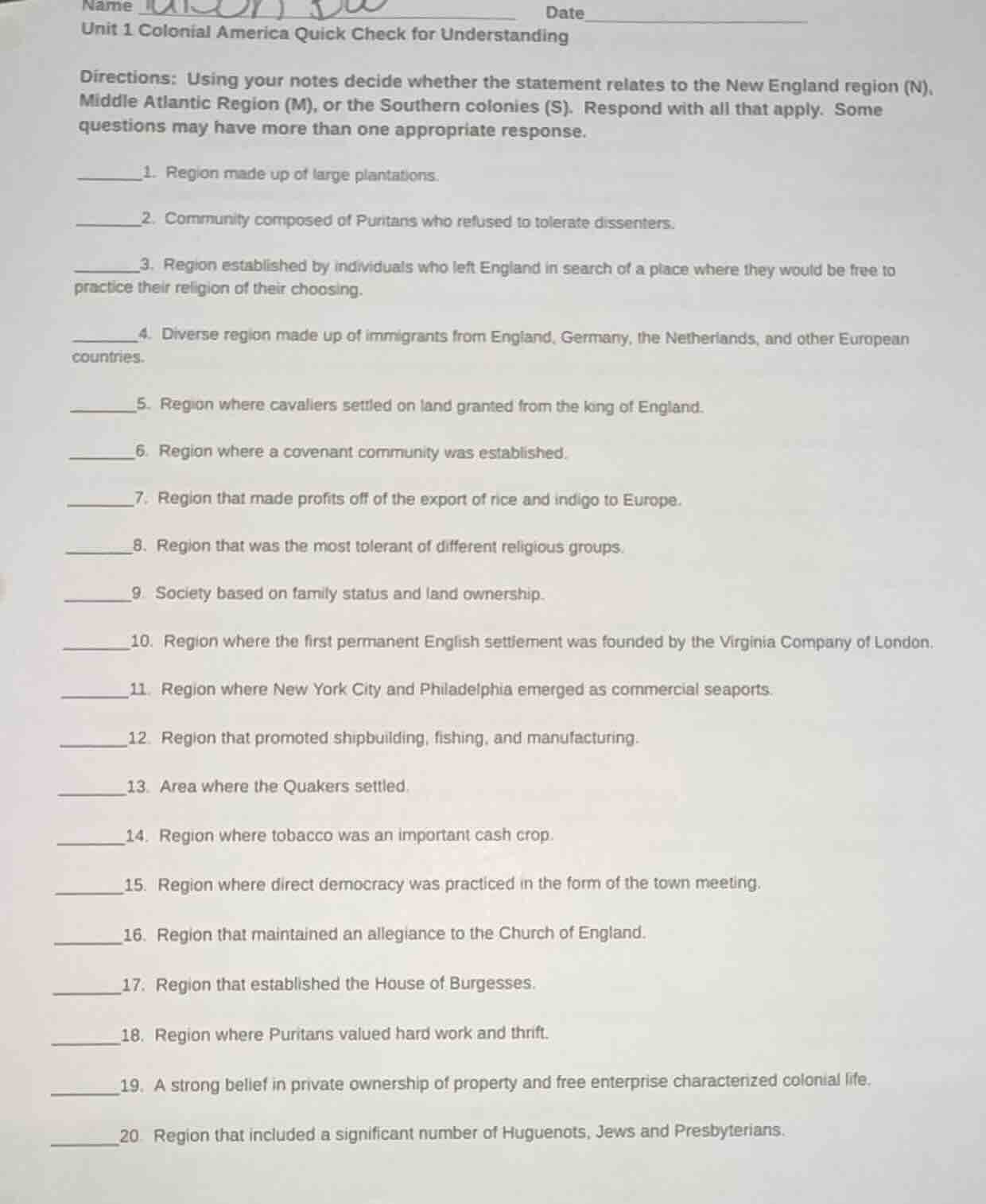
name dateunit 1 colonial america quick check for understandingdirections: using your notes decide whether the statement relates to the new england region (n), middle atlantic region (m), or the southern colonies (s). respond with all that apply. some questions may have more than one appropriate response.1. region made up of large plantations.2. community composed of puritans who refused to tolerate dissenters.3. region established by individuals who left england in search of a place where they would be free to practice their religion of their choosing.4. diverse region made up of immigrants from england, germany, the netherlands, and other european countries.5. region where cavaliers settled on land granted from the king of england.6. region where a covenant community was established.7. region that made profits off of the export of rice and indigo to europe.8. region that was the most tolerant of different religious groups.9. society based on family status and land ownership.10. region where the first permanent english settlement was founded by the virginia company of london.11. region where new york city and philadelphia emerged as commercial seaports.12. region that promoted shipbuilding, fishing, and manufacturing.13. area where the quakers settled.14. region where tobacco was an important cash crop.15. region where direct democracy was practiced in the form of the town meeting.16. region that maintained an allegiance to the church of england.17. region that established the house of burgesses.18. region where puritans valued hard work and thrift.19. a strong belief in private ownership of property and free enterprise characterized colonial life.20. region that included a significant number of huguenots, jews and presbyterians.
Each answer is matched to the colonial region based on key historical characteristics of New England (N), Middle Atlantic (M), and Southern (S) colonies.

Snap & solve any problem in the app
Get step-by-step solutions on Sovi AI
Photo-based solutions with guided steps
Explore more problems and detailed explanations
- S
- N
- N, M, S
- M
- S
- N
- S
- M
- S
- S
- M
- N
- M
- S
- N
- S
- S
- N
- M, N, S
- M