QUESTION IMAGE
Question
name: david date: hour:
functions - 8.f.5 hw9
answer the following questions:
- what does it mean when a graph of speed starts at (0, 0)?
- if distance is represent on the y - axis and time on the x - axis, what does a line with an upward slope represent?
- if speed is on the y axis and time on the x - axis, what does a line with a slope of zero represent?
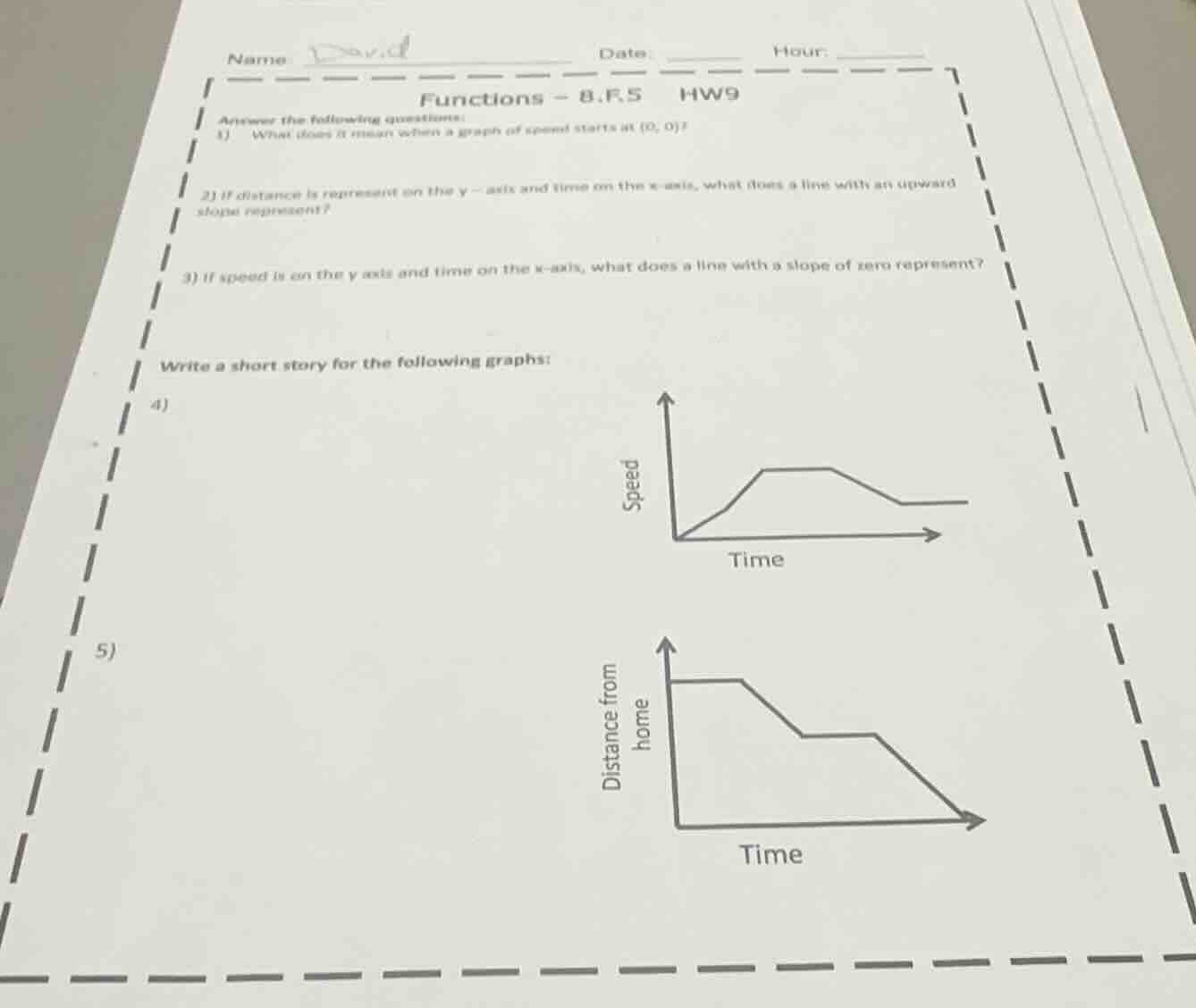
write a short story for the following graphs:
- graph with speed on y - axis and time on x - axis: starts at (0,0), increases, plateaus, decreases, then plateaus
- graph with distance from home on y - axis and time on x - axis: starts at a non - zero y - value, plateaus, decreases, plateaus, then decreases to zero
Question 1
When a speed - time graph starts at \((0,0)\), it means that at time \(t = 0\) (the start of the observation), the speed of the object is \(0\). In other words, the object is at rest initially, or its initial speed is zero.
We know that the slope of a line in a distance - time graph (\(y\) - axis: distance, \(x\) - axis: time) is given by the formula \(m=\frac{\Delta y}{\Delta x}=\frac{\text{change in distance}}{\text{change in time}}\). And the formula for speed is \(v = \frac{d}{t}\) (where \(d\) is distance and \(t\) is time). So the slope of the distance - time graph represents speed. An upward - sloping line means that as time (\(x\) - axis) increases, the distance (\(y\) - axis) also increases. Since slope is speed, an upward slope means the object is moving with a positive speed, i.e., the object is moving away from the starting point (or its position is changing in a positive direction) and its speed is non - zero (because the slope is non - zero and positive). In simpler terms, it represents that the object is moving and its distance from the origin (or starting point) is increasing over time, which implies the object is in motion with a constant or changing (if the slope is changing) speed (but in the case of a straight line, it's constant speed).
In a speed - time graph (\(y\) - axis: speed, \(x\) - axis: time), the slope of the line is given by \(m=\frac{\Delta y}{\Delta x}=\frac{\text{change in speed}}{\text{change in time}}\). A slope of zero means that \(\frac{\text{change in speed}}{\text{change in time}} = 0\), which implies that the change in speed (\(\Delta y\)) is zero for any change in time (\(\Delta x\)). So the speed of the object remains constant over time. In other words, the object is moving at a constant speed (or if the speed is zero, it's at rest, but since the slope is zero, if the initial speed is non - zero, it stays non - zero and constant; if initial speed is zero, it stays zero).

Snap & solve any problem in the app
Get step-by-step solutions on Sovi AI
Photo-based solutions with guided steps
Explore more problems and detailed explanations
It means the object has an initial speed of 0 (is at rest initially).