QUESTION IMAGE
Question
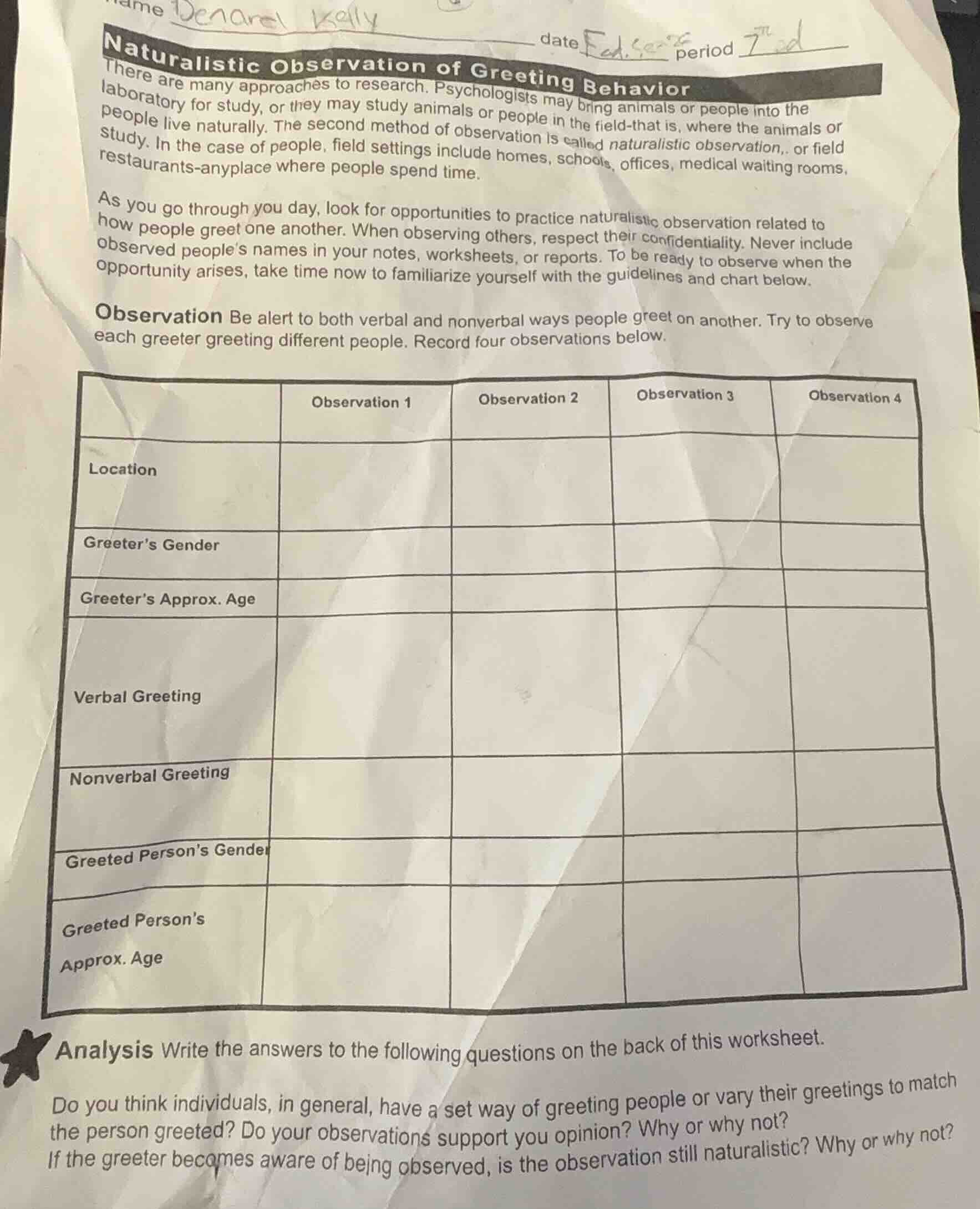
name denarel kelly date fed. 5 period 2nd
naturalistic observation of greeting behavior
there are many approaches to research. psychologists may bring animals or people into the laboratory for study, or they may study animals or people in the field - that is, where the animals or people live naturally. the second method of observation is called naturalistic observation, or field study. in the case of people, field settings include homes, schools, offices, medical waiting rooms, restaurants - anyplace where people spend time.
as you go through your day, look for opportunities to practice naturalistic observation related to how people greet one another. when observing others, respect their confidentiality. never include observed people’s names in your notes, worksheets, or reports. to be ready to observe when the opportunity arises, take time now to familiarize yourself with the guidelines and chart below.
observation be alert to both verbal and nonverbal ways people greet one another. try to observe each greeter greeting different people. record four observations below.
chart with columns: observation 1, observation 2, observation 3, observation 4; rows: location, greeter’s gender, greeter’s approx. age, verbal greeting, nonverbal greeting, greeted person’s gender, greeted person’s approx. age
analysis write the answers to the following questions on the back of this worksheet.
do you think individuals, in general, have a set way of greeting people or vary their greetings to match the person greeted? do your observations support your opinion? why or why not?
if the greeter becomes aware of being observed, is the observation still naturalistic? why or why not?
To complete the naturalistic observation of greeting behavior, we can fill in the table with hypothetical observations (you can replace these with your actual observations):
| Observation 1 | Observation 2 | Observation 3 | Observation 4 | |
|---|---|---|---|---|
| Greeter’s Gender | Female | Male | Female | Male |
| Greeter’s Approx. Age | 16 | 30 | 45 | 25 |
| Verbal Greeting | “Hi, how are you?” | “Hey, long time no see!” | “Good morning, let's start the day!” | “Hello, beautiful day!” |
| Nonverbal Greeting | Waves hand | Hugs | Nods | Shakes hand |
| Greeted Person’s Gender | Female | Male | Female | Female |
| Greeted Person’s Approx. Age | 16 | 30 | 45 | 24 |
Analysis Answers (to be written on the back):
- Do you think individuals, in general, have a set way of greeting people or vary their greetings to match the person greeted? Do your observations support your opinion? Why or why not?
Most individuals vary their greetings. For example, in Observation 1 (school) and Observation 3 (office), the greeters used casual vs. professional tones. The hugs in Observation 2 (friend) vs. nods in Observation 3 (colleague) also show adaptation to the relationship/setting.
- If the greeter becomes aware of being observed, is the observation still naturalistic? Why or why not?
No. Naturalistic observation requires studying behavior in its natural, unaltered state. If the greeter is aware, they may change their behavior (e.g., act more formally), so the observation loses its “natural” context.

Snap & solve any problem in the app
Get step-by-step solutions on Sovi AI
Photo-based solutions with guided steps
Explore more problems and detailed explanations
To complete the naturalistic observation of greeting behavior, we can fill in the table with hypothetical observations (you can replace these with your actual observations):
| Observation 1 | Observation 2 | Observation 3 | Observation 4 | |
|---|---|---|---|---|
| Greeter’s Gender | Female | Male | Female | Male |
| Greeter’s Approx. Age | 16 | 30 | 45 | 25 |
| Verbal Greeting | “Hi, how are you?” | “Hey, long time no see!” | “Good morning, let's start the day!” | “Hello, beautiful day!” |
| Nonverbal Greeting | Waves hand | Hugs | Nods | Shakes hand |
| Greeted Person’s Gender | Female | Male | Female | Female |
| Greeted Person’s Approx. Age | 16 | 30 | 45 | 24 |
Analysis Answers (to be written on the back):
- Do you think individuals, in general, have a set way of greeting people or vary their greetings to match the person greeted? Do your observations support your opinion? Why or why not?
Most individuals vary their greetings. For example, in Observation 1 (school) and Observation 3 (office), the greeters used casual vs. professional tones. The hugs in Observation 2 (friend) vs. nods in Observation 3 (colleague) also show adaptation to the relationship/setting.
- If the greeter becomes aware of being observed, is the observation still naturalistic? Why or why not?
No. Naturalistic observation requires studying behavior in its natural, unaltered state. If the greeter is aware, they may change their behavior (e.g., act more formally), so the observation loses its “natural” context.