QUESTION IMAGE
Question
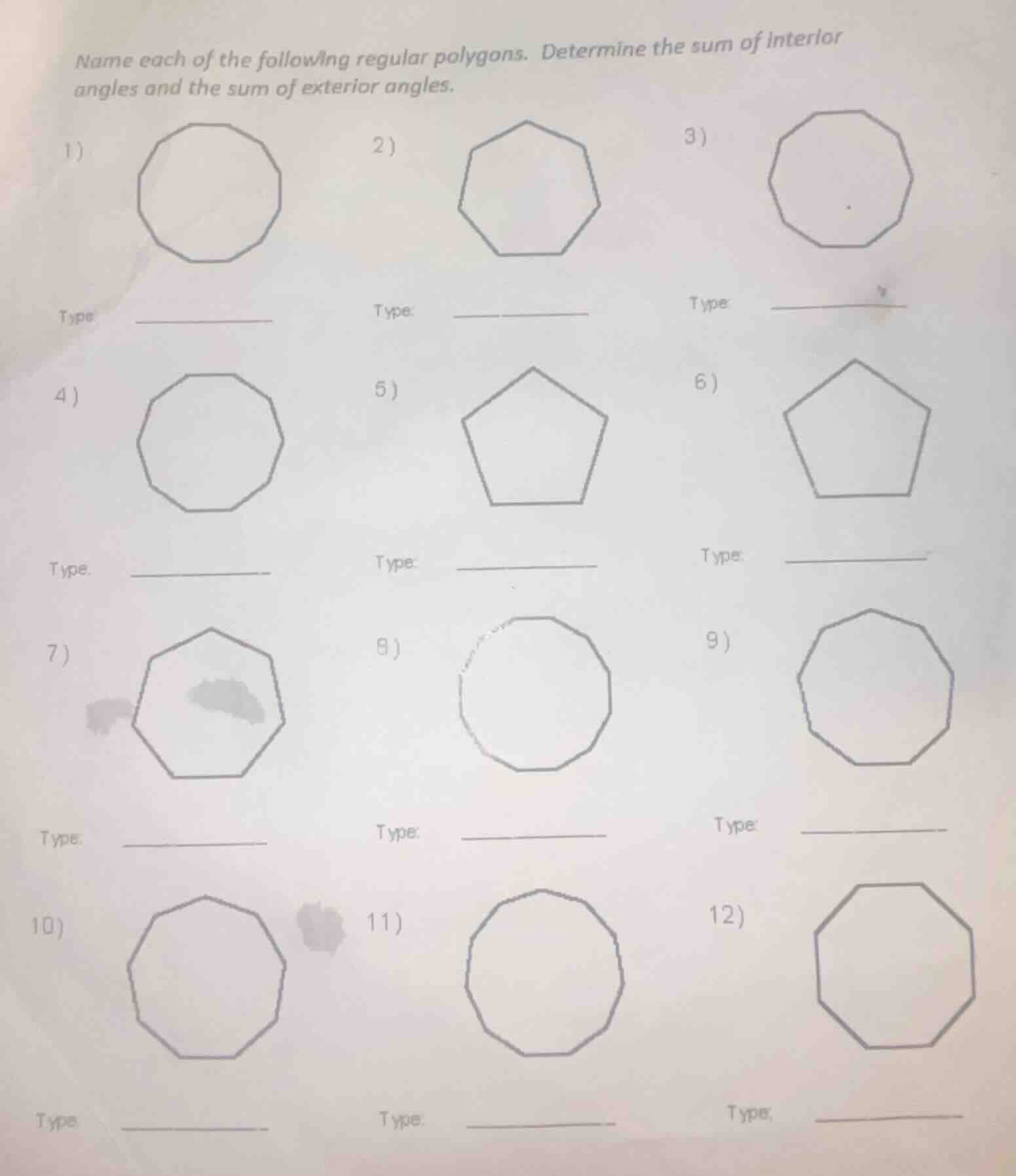
name each of the following regular polygons. determine the sum of interior angles and the sum of exterior angles.
1)
type
2)
type:
3)
type
4)
type.
5)
type:
6)
type:
7)
type:
8)
type:
9)
type:
10)
type
11)
type.
12)
type:
To solve this, we'll analyze each regular polygon by counting its sides, naming it, then using the formulas for the sum of interior angles (\(S = (n - 2) \times 180^\circ\)) and the sum of exterior angles (always \(360^\circ\) for any convex polygon).
1)
- Step 1: Count Sides
The polygon has 12 sides.
- Step 2: Name the Polygon
A 12 - sided polygon is a dodecagon.
- Step 3: Sum of Interior Angles
Using \(S=(n - 2)\times180^\circ\) with \(n = 12\):
\(S=(12 - 2)\times180^\circ=10\times180^\circ = 1800^\circ\).
- Step 4: Sum of Exterior Angles
For any convex polygon, the sum of exterior angles is \(360^\circ\).
2)
- Step 1: Count Sides
The polygon has 7 sides.
- Step 2: Name the Polygon
A 7 - sided polygon is a heptagon (or septagon).
- Step 3: Sum of Interior Angles
Using \(S=(n - 2)\times180^\circ\) with \(n = 7\):
\(S=(7 - 2)\times180^\circ=5\times180^\circ = 900^\circ\).
- Step 4: Sum of Exterior Angles
Sum of exterior angles is \(360^\circ\).
3)
- Step 1: Count Sides
The polygon has 10 sides.
- Step 2: Name the Polygon
A 10 - sided polygon is a decagon.
- Step 3: Sum of Interior Angles
Using \(S=(n - 2)\times180^\circ\) with \(n = 10\):
\(S=(10 - 2)\times180^\circ=8\times180^\circ = 1440^\circ\).
- Step 4: Sum of Exterior Angles
Sum of exterior angles is \(360^\circ\).
4)
- Step 1: Count Sides
The polygon has 9 sides.
- Step 2: Name the Polygon
A 9 - sided polygon is a nonagon (or enneagon).
- Step 3: Sum of Interior Angles
Using \(S=(n - 2)\times180^\circ\) with \(n = 9\):
\(S=(9 - 2)\times180^\circ=7\times180^\circ = 1260^\circ\).
- Step 4: Sum of Exterior Angles
Sum of exterior angles is \(360^\circ\).
5)
- Step 1: Count Sides
The polygon has 5 sides.
- Step 2: Name the Polygon
A 5 - sided polygon is a pentagon.
- Step 3: Sum of Interior Angles
Using \(S=(n - 2)\times180^\circ\) with \(n = 5\):
\(S=(5 - 2)\times180^\circ=3\times180^\circ = 540^\circ\).
- Step 4: Sum of Exterior Angles
Sum of exterior angles is \(360^\circ\).
6)
- Step 1: Count Sides
The polygon has 5 sides.
- Step 2: Name the Polygon
A 5 - sided polygon is a pentagon.
- Step 3: Sum of Interior Angles
Using \(S=(n - 2)\times180^\circ\) with \(n = 5\):
\(S=(5 - 2)\times180^\circ=3\times180^\circ = 540^\circ\).
- Step 4: Sum of Exterior Angles
Sum of exterior angles is \(360^\circ\).
7)
- Step 1: Count Sides
The polygon has 7 sides.
- Step 2: Name the Polygon
A 7 - sided polygon is a heptagon (or septagon).
- Step 3: Sum of Interior Angles
Using \(S=(n - 2)\times180^\circ\) with \(n = 7\):
\(S=(7 - 2)\times180^\circ=5\times180^\circ = 900^\circ\).
- Step 4: Sum of Exterior Angles
Sum of exterior angles is \(360^\circ\).
8)
- Step 1: Count Sides
The polygon has 11 sides.
- Step 2: Name the Polygon
An 11 - sided polygon is a hendecagon (or undecagon).
- Step 3: Sum of Interior Angles
Using \(S=(n - 2)\times180^\circ\) with \(n = 11\):
\(S=(11 - 2)\times180^\circ=9\times180^\circ = 1620^\circ\).
- Step 4: Sum of Exterior Angles
Sum of exterior angles is \(360^\circ\).
9)
- Step 1: Count Sides
The polygon has 9 sides.
- Step 2: Name the Polygon
A 9 - sided polygon is a nonagon (or enneagon).
- Step 3: Sum of Interior Angles
Using \(S=(n - 2)\times180^\circ\) with \(n = 9\):
\(S=(9 - 2)\times180^\circ=7\times180^\circ = 1260^\circ\).
- **Step 4: S…

Snap & solve any problem in the app
Get step-by-step solutions on Sovi AI
Photo-based solutions with guided steps
Explore more problems and detailed explanations
To solve this, we'll analyze each regular polygon by counting its sides, naming it, then using the formulas for the sum of interior angles (\(S = (n - 2) \times 180^\circ\)) and the sum of exterior angles (always \(360^\circ\) for any convex polygon).
1)
- Step 1: Count Sides
The polygon has 12 sides.
- Step 2: Name the Polygon
A 12 - sided polygon is a dodecagon.
- Step 3: Sum of Interior Angles
Using \(S=(n - 2)\times180^\circ\) with \(n = 12\):
\(S=(12 - 2)\times180^\circ=10\times180^\circ = 1800^\circ\).
- Step 4: Sum of Exterior Angles
For any convex polygon, the sum of exterior angles is \(360^\circ\).
2)
- Step 1: Count Sides
The polygon has 7 sides.
- Step 2: Name the Polygon
A 7 - sided polygon is a heptagon (or septagon).
- Step 3: Sum of Interior Angles
Using \(S=(n - 2)\times180^\circ\) with \(n = 7\):
\(S=(7 - 2)\times180^\circ=5\times180^\circ = 900^\circ\).
- Step 4: Sum of Exterior Angles
Sum of exterior angles is \(360^\circ\).
3)
- Step 1: Count Sides
The polygon has 10 sides.
- Step 2: Name the Polygon
A 10 - sided polygon is a decagon.
- Step 3: Sum of Interior Angles
Using \(S=(n - 2)\times180^\circ\) with \(n = 10\):
\(S=(10 - 2)\times180^\circ=8\times180^\circ = 1440^\circ\).
- Step 4: Sum of Exterior Angles
Sum of exterior angles is \(360^\circ\).
4)
- Step 1: Count Sides
The polygon has 9 sides.
- Step 2: Name the Polygon
A 9 - sided polygon is a nonagon (or enneagon).
- Step 3: Sum of Interior Angles
Using \(S=(n - 2)\times180^\circ\) with \(n = 9\):
\(S=(9 - 2)\times180^\circ=7\times180^\circ = 1260^\circ\).
- Step 4: Sum of Exterior Angles
Sum of exterior angles is \(360^\circ\).
5)
- Step 1: Count Sides
The polygon has 5 sides.
- Step 2: Name the Polygon
A 5 - sided polygon is a pentagon.
- Step 3: Sum of Interior Angles
Using \(S=(n - 2)\times180^\circ\) with \(n = 5\):
\(S=(5 - 2)\times180^\circ=3\times180^\circ = 540^\circ\).
- Step 4: Sum of Exterior Angles
Sum of exterior angles is \(360^\circ\).
6)
- Step 1: Count Sides
The polygon has 5 sides.
- Step 2: Name the Polygon
A 5 - sided polygon is a pentagon.
- Step 3: Sum of Interior Angles
Using \(S=(n - 2)\times180^\circ\) with \(n = 5\):
\(S=(5 - 2)\times180^\circ=3\times180^\circ = 540^\circ\).
- Step 4: Sum of Exterior Angles
Sum of exterior angles is \(360^\circ\).
7)
- Step 1: Count Sides
The polygon has 7 sides.
- Step 2: Name the Polygon
A 7 - sided polygon is a heptagon (or septagon).
- Step 3: Sum of Interior Angles
Using \(S=(n - 2)\times180^\circ\) with \(n = 7\):
\(S=(7 - 2)\times180^\circ=5\times180^\circ = 900^\circ\).
- Step 4: Sum of Exterior Angles
Sum of exterior angles is \(360^\circ\).
8)
- Step 1: Count Sides
The polygon has 11 sides.
- Step 2: Name the Polygon
An 11 - sided polygon is a hendecagon (or undecagon).
- Step 3: Sum of Interior Angles
Using \(S=(n - 2)\times180^\circ\) with \(n = 11\):
\(S=(11 - 2)\times180^\circ=9\times180^\circ = 1620^\circ\).
- Step 4: Sum of Exterior Angles
Sum of exterior angles is \(360^\circ\).
9)
- Step 1: Count Sides
The polygon has 9 sides.
- Step 2: Name the Polygon
A 9 - sided polygon is a nonagon (or enneagon).
- Step 3: Sum of Interior Angles
Using \(S=(n - 2)\times180^\circ\) with \(n = 9\):
\(S=(9 - 2)\times180^\circ=7\times180^\circ = 1260^\circ\).
- Step 4: Sum of Exterior Angles
Sum of exterior angles is \(360^\circ\).
10)
- Step 1: Count Sides
The polygon has 10 sides.
- Step 2: Name the Polygon
A 10 - sided polygon is a decagon.
- Step 3: Sum of Interior Angles
Using \(S=(n - 2)\times180^\circ\) with \(n = 10\):
\(S=(10 - 2)\times180^\circ=8\times180^\circ = 1440^\circ\).
- Step 4: Sum of Exterior Angles
Sum of exterior angles is \(360^\circ\).
11)
- Step 1: Count Sides
The polygon has 12 sides.
- Step 2: Name the Polygon
A 12 - sided polygon is a dodecagon.
- Step 3: Sum of Interior Angles
Using \(S=(n - 2)\times180^\circ\) with \(n = 12\):
\(S=(12 - 2)\times180^\circ=10\times180^\circ = 1800^\circ\).
- Step 4: Sum of Exterior Angles
Sum of exterior angles is \(360^\circ\).
12)
- Step 1: Count Sides
The polygon has 8 sides.
- Step 2: Name the Polygon
An 8 - sided polygon is an octagon.
- Step 3: Sum of Interior Angles
Using \(S=(n - 2)\times180^\circ\) with \(n = 8\):
\(S=(8 - 2)\times180^\circ=6\times180^\circ = 1080^\circ\).
- Step 4: Sum of Exterior Angles
Sum of exterior angles is \(360^\circ\).
Final Answers (Summarized)
| Polygon # | Type | Sum of Interior Angles | Sum of Exterior Angles |
|---|---|---|---|
| 2) | Heptagon | \(900^\circ\) | \(360^\circ\) |
| 3) | Decagon | \(1440^\circ\) | \(360^\circ\) |
| 4) | Nonagon | \(1260^\circ\) | \(360^\circ\) |
| 5) | Pentagon | \(540^\circ\) | \(360^\circ\) |
| 6) | Pentagon | \(540^\circ\) | \(360^\circ\) |
| 7) | Heptagon | \(900^\circ\) | \(360^\circ\) |
| 8) | Hendecagon | \(1620^\circ\) | \(360^\circ\) |
| 9) | Nonagon | \(1260^\circ\) | \(360^\circ\) |
| 10) | Decagon | \(1440^\circ\) | \(360^\circ\) |
| 11) | Dodecagon | \(1800^\circ\) | \(360^\circ\) |
| 12) | Octagon | \(1080^\circ\) | \(360^\circ\) |
(Note: For each polygon, the "Type" is based on the number of sides, and the sum of exterior angles is always \(360^\circ\) for convex polygons.)