QUESTION IMAGE
Question
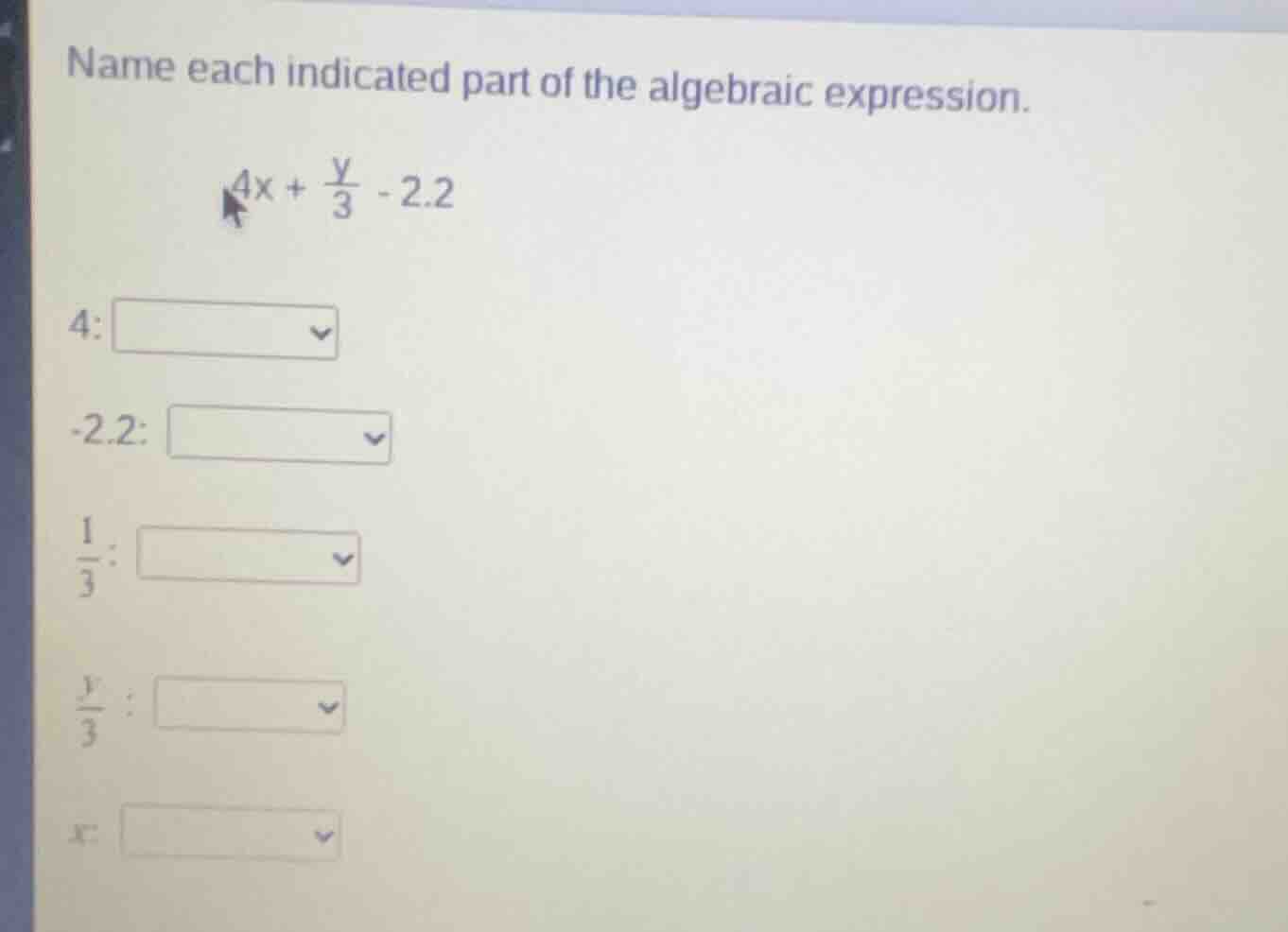
name each indicated part of the algebraic expression.
$4x + \frac{y}{3} - 2.2$
4:
-2.2:
$\frac{1}{3}$:
$\frac{y}{3}$:
x:
Step1: Analyze the coefficient of \(x\)
In the term \(4x\), the number \(4\) is the coefficient of the variable \(x\). A coefficient is a numerical factor in a term with a variable.
Step2: Analyze the constant term \(-2.2\)
The term \(-2.2\) has no variable attached to it, so it is a constant. A constant is a fixed value that does not change.
Step3: Analyze the coefficient of \(y\)
In the term \(\frac{y}{3}\), we can rewrite it as \(\frac{1}{3}y\). So \(\frac{1}{3}\) is the coefficient of the variable \(y\).
Step4: Analyze the term \(\frac{y}{3}\)
The term \(\frac{y}{3}\) (or \(\frac{1}{3}y\)) is a monomial (a single term) in the algebraic expression, consisting of a coefficient and a variable. It is also a term of the expression \(4x+\frac{y}{3}-2.2\).
Step5: Analyze the variable \(x\)
The symbol \(x\) is a variable. A variable is a symbol (usually a letter) that represents an unknown or changing quantity.

Snap & solve any problem in the app
Get step-by-step solutions on Sovi AI
Photo-based solutions with guided steps
Explore more problems and detailed explanations
- \(4\): Coefficient (of \(x\))
- \(-2.2\): Constant
- \(\frac{1}{3}\): Coefficient (of \(y\))
- \(\frac{y}{3}\): Term (or Monomial)
- \(x\): Variable