QUESTION IMAGE
Question
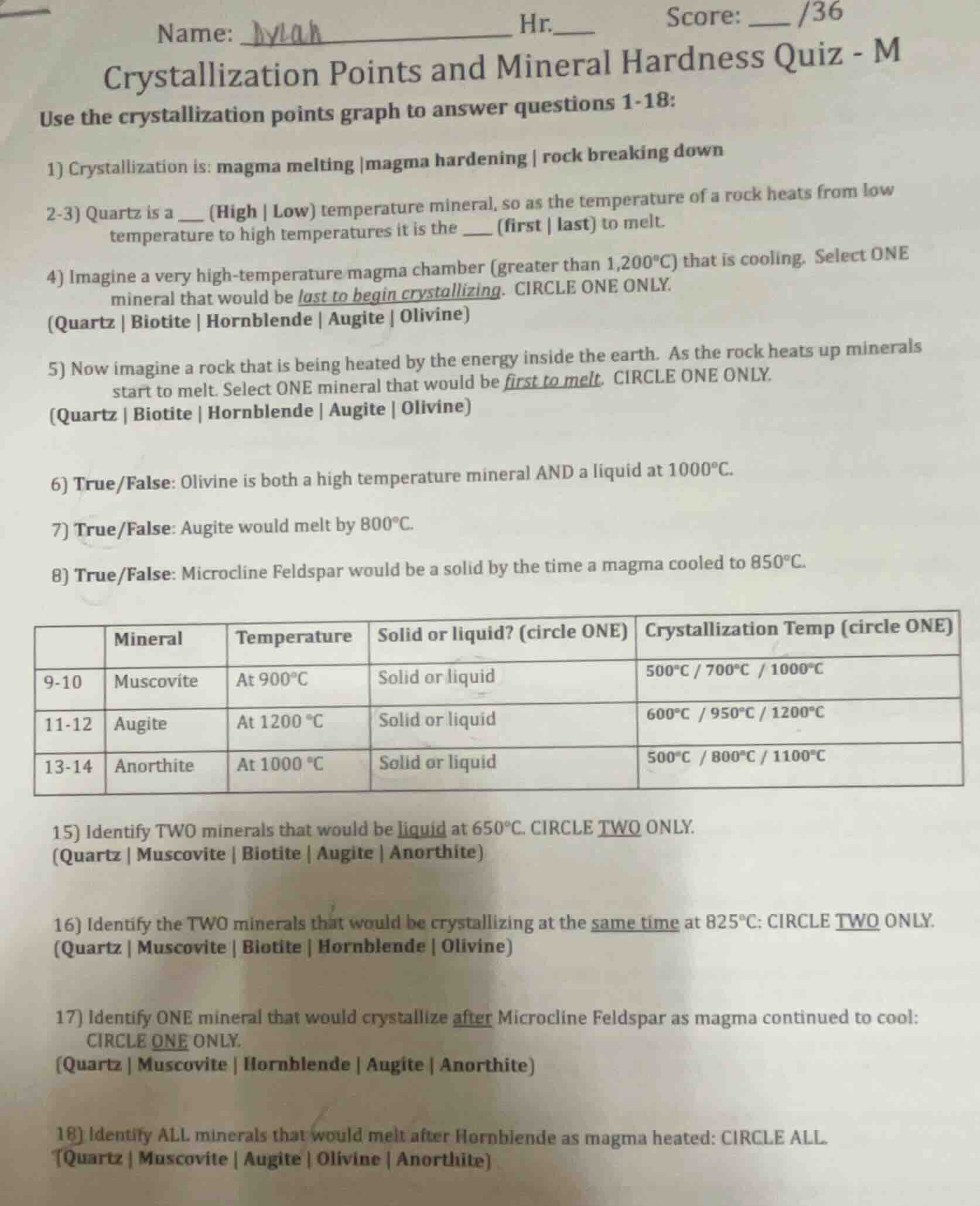
name: hr._ score: _/36
crystallization points and mineral hardness quiz - m
use the crystallization points graph to answer questions 1-18:
- crystallization is: magma melting |magma hardening | rock breaking down
2-3) quartz is a _ (high | low) temperature mineral, so as the temperature of a rock heats from low temperature to high temperatures it is the _ (first | last) to melt.
- imagine a very high-temperature magma chamber (greater than 1,200°c) that is cooling. select one mineral that would be last to begin crystallizing. circle one only.
(quartz | biotite | hornblende | augite | olivine)
- now imagine a rock that is being heated by the energy inside the earth. as the rock heats up minerals start to melt. select one mineral that would be first to melt. circle one only.
(quartz | biotite | hornblende | augite | olivine)
- true/false: olivine is both a high temperature mineral and a liquid at 1000°c.
- true/false: augite would melt by 800°c.
- true/false: microcline feldspar would be a solid by the time a magma cooled to 850°c.
| mineral | temperature | solid or liquid? (circle one) | crystallization temp (circle one) |
|---|
9-10 | muscovite | at 900°c | solid or liquid | 500°c / 700°c / 1000°c |
11-12 | augite | at 1200 °c | solid or liquid | 600°c / 950°c / 1200°c |
13-14 | anorthite | at 1000 °c | solid or liquid | 500°c / 800°c / 1100°c |
- identify two minerals that would be liquid at 650°c. circle two only.
(quartz | muscovite | biotite | augite | anorthite)
- identify the two minerals that would be crystallizing at the same time at 825°c: circle two only.
(quartz | muscovite | biotite | hornblende | olivine)
- identify one mineral that would crystallize after microcline feldspar as magma continued to cool: circle one only.
(quartz | muscovite | hornblende | augite | anorthite)
- identify all minerals that would melt after hornblende as magma heated: circle all.
(quartz | muscovite | augite | olivine | anorthite)
Step1: Define crystallization
Crystallization = magma hardening into solid rock.
Step2: Classify quartz's temp properties
Quartz: low-temp mineral, melts last when heated.
Step3: Identify last cooling mineral
Quartz crystallizes last (lowest temp threshold >1200°C).
Step4: Identify first melting mineral
Olivine: highest temp mineral, melts first when heated.
Step5: Evaluate olivine at 1000°C
Olivine solidifies >1200°C, so solid at 1000°C: False.
Step6: Evaluate augite's melt temp
Augite melts >950°C, so not by 800°C: False.
Step7: Evaluate microcline at 850°C
Microcline solidifies ~700°C, so solid at 850°C: True.
Step8: Assess muscovite at 900°C
Muscovite solidifies at 500°C, so solid at 900°C.
Step9: Assess augite at 1200°C
Augite solidifies at 1200°C, so liquid at 1200°C.
Step10: Assess anorthite at 1000°C
Anorthite solidifies at 1100°C, so solid at 1000°C.
Step11: Find liquid minerals at 650°C
Augite (>950°C) & Anorthite (>1100°C) melt above 650°C, so liquid.
Step12: Find co-crystallizing minerals at 825°C
Muscovite (500°C) & Biotite (500-700°C) crystallize near 825°C.
Step13: Find post-microcline crystallizing mineral
Quartz crystallizes after microcline (lower temp threshold).
Step14: Find post-hornblende melting minerals
Quartz, Muscovite melt at lower temps than hornblende, so melt after.

Snap & solve any problem in the app
Get step-by-step solutions on Sovi AI
Photo-based solutions with guided steps
Explore more problems and detailed explanations
- magma hardening
2-3) Low; last
- Quartz
- Olivine
- False
- False
- True
9-10) Solid; 500°C
11-12) Liquid; 1200°C
13-14) Solid; 1100°C
- Augite, Anorthite
- Muscovite, Biotite
- Quartz
- Quartz, Muscovite