QUESTION IMAGE
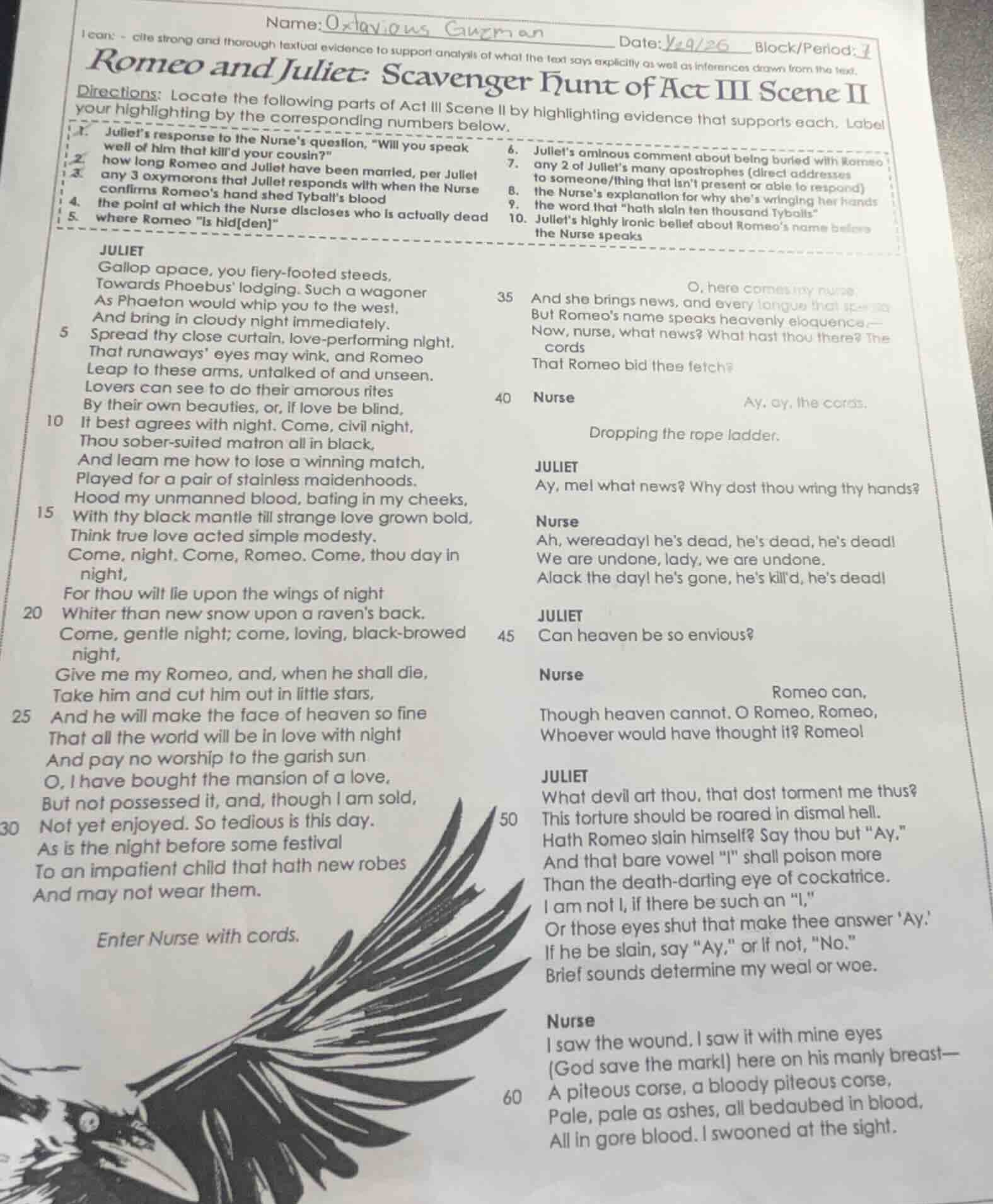
Question
name: oxlayious guzman date: 4/26 block/period: 1
i can: - cite strong and thorough textual evidence to support analysis of what the text says explicitly as well as inferences drawn from the text.
romeo and juliet: scavenger hunt of act iii scene ii
directions: locate the following parts of act iii scene ii by highlighting evidence that supports each. label your highlighting by the corresponding numbers below.
- juliet’s response to the nurse’s question, “will you speak well of him that kill’d your cousin?”
- how long romeo and juliet have been married, per juliet
- any 3 oxymorons that juliet responds with when the nurse confirms romeo’s hand shed tybalt’s blood
- the point at which the nurse discloses who is actually dead
- where romeo “is hidden”
- juliet’s ominous comment about being buried with romeo
- any 2 of juliet’s many apostrophes (direct addresses to someone/thing that isn’t present or able to respond)
- the nurse’s explanation for why she’s wringing her hands
- the word that “hath slain ten thousand tybalts”
- juliet’s highly ironic belief about romeo’s name before the nurse speaks
juliet
gallop apace, you fiery - footed steeds,
towards phoebus’ lodging. such a wagoner
as phaeton would whip you to the west,
and bring in cloudy night immediately.
5 spread thy close curtain, love - performing night,
that runaways’ eyes may wink, and romeo
leap to these arms, untalked of and unseen.
lovers can see to do their amorous rites
by their own beauties, or, if love be blind,
10 it best agrees with night. come, civil night,
thou sober - suited matron all in black,
and learn me how to lose a winning match,
played for a pair of stainless maidenhoods.
hood my unmanned blood, bating in my cheeks,
15 with thy black mantle till strange love grown bold,
think true love acted simple modesty.
come, night. come, romeo. come, thou day in night,
for thou wilt lie upon the wings of night
20 whiter than new snow upon a raven’s back.
come, gentle night; come, loving, black - browed night,
give me my romeo, and, when he shall die,
take him and cut him out in little stars,
25 and he will make the face of heaven so fine
that all the world will be in love with night
and pay no worship to the garish sun
o, i have bought the mansion of a love,
but not possessed it, and, though i am sold,
30 not yet enjoyed. so tedious is this day.
as is the night before some festival
to an impatient child that hath new robes
and may not wear them.
enter nurse with cords.
35 o, here comes my nurse,
and she brings news, and every tongue that speaks
but romeo’s name speaks heavenly eloquence—
now, nurse, what news? what hast thou there? the cords
that romeo bid thee fetch?
40 nurse ay, ay, the cords.
dropping the rope ladder.
juliet
ay, me! what news? why dost thou wring thy hands?
nurse
ah, wereaday! he’s dead, he’s dead, he’s dead!
we are undone, lady, we are undone.
alack the day! he’s gone, he’s kill’d, he’s dead!
45 juliet
can heaven be so envious?
nurse romeo can,
though heaven cannot. o romeo, romeo,
whoever would have thought it? romeo!
50 juliet
what devil art thou, that dost torment me thus?
this torture should be roared in dismal hell.
hath romeo slain himself? say thou but “ay,”
and that bare vowel “i” shall poison more
than the death - darling eye of cockatrice.
i am not i, if there be such an “i,”
or those eyes shut that make thee answer ‘ay.’
if he be slain, say “ay,” or if not, “no.”
brief sounds determine my weal or woe.
nurse
i saw the wound, i saw it with mine eyes
(god save the mark!) here on his manly breast—
60 a piteous corse, a bloody piteous corse,
pale, pale as ashes, all bedaubed in blood,
all in gore blood. i swooned at the sight.
(image of a winged figure is present but ocr text omits it)
Each item is matched to the corresponding text evidence from Romeo and Juliet Act III, Scene II, by locating the specific lines that fulfill the prompt requirements.

Snap & solve any problem in the app
Get step-by-step solutions on Sovi AI
Photo-based solutions with guided steps
Explore more problems and detailed explanations
- Juliet's response to the Nurse's question: Lines 36-38: "Now, nurse, what news? What hast thou there? The cords That Romeo bid thee fetch?"
- How long Romeo and Juliet have been married: Not present in this excerpt (this detail is revealed earlier in the play).
- 3 oxymorons from Juliet: Lines 10-11: "civil night, sober-suited matron all in black"; Line 20: "gentle night; come, loving, black-browed night" (examples: civil night, sober-suited matron [night], loving, black-browed night)
- Nurse discloses who is dead: Lines 57-62 (Nurse's false implication that Romeo is dead, before correcting later; in this excerpt, her lines about the "bloody piteous corse" initially frame Romeo as dead)
- Where Romeo is hidden: Not present in this excerpt.
- Juliet's ominous burial comment: Lines 24-27: "Give me my Romeo, and, when he shall die, Take him and cut him out in little stars, And he will make the face of heaven so fine That all the world will be in love with night" (a premonition of his death and her eventual burial-related grief)
- 2 of Juliet's apostrophes: Line 5: "Spread thy close curtain, love-performing night"; Line 20: "Come, gentle night; come, loving, black-browed night" (addressing the night directly)
- Nurse's explanation for wringing hands: Lines 42-44: "Ah, wereaday! he's dead, he's dead, he's dead! We are undone, lady, we are undone. Alack the day! he's gone, he's kill'd, he's dead!" (grief over her false report of Romeo's death)
- Word "hath slain ten thousand Tybalts": Not present in this excerpt.
- Juliet's ironic belief about Romeo's name: Line 36: "Romeo's name speaks heavenly eloquence" (ironic because she will soon believe he is dead, and his name becomes tied to grief instead of joy)