QUESTION IMAGE
Question
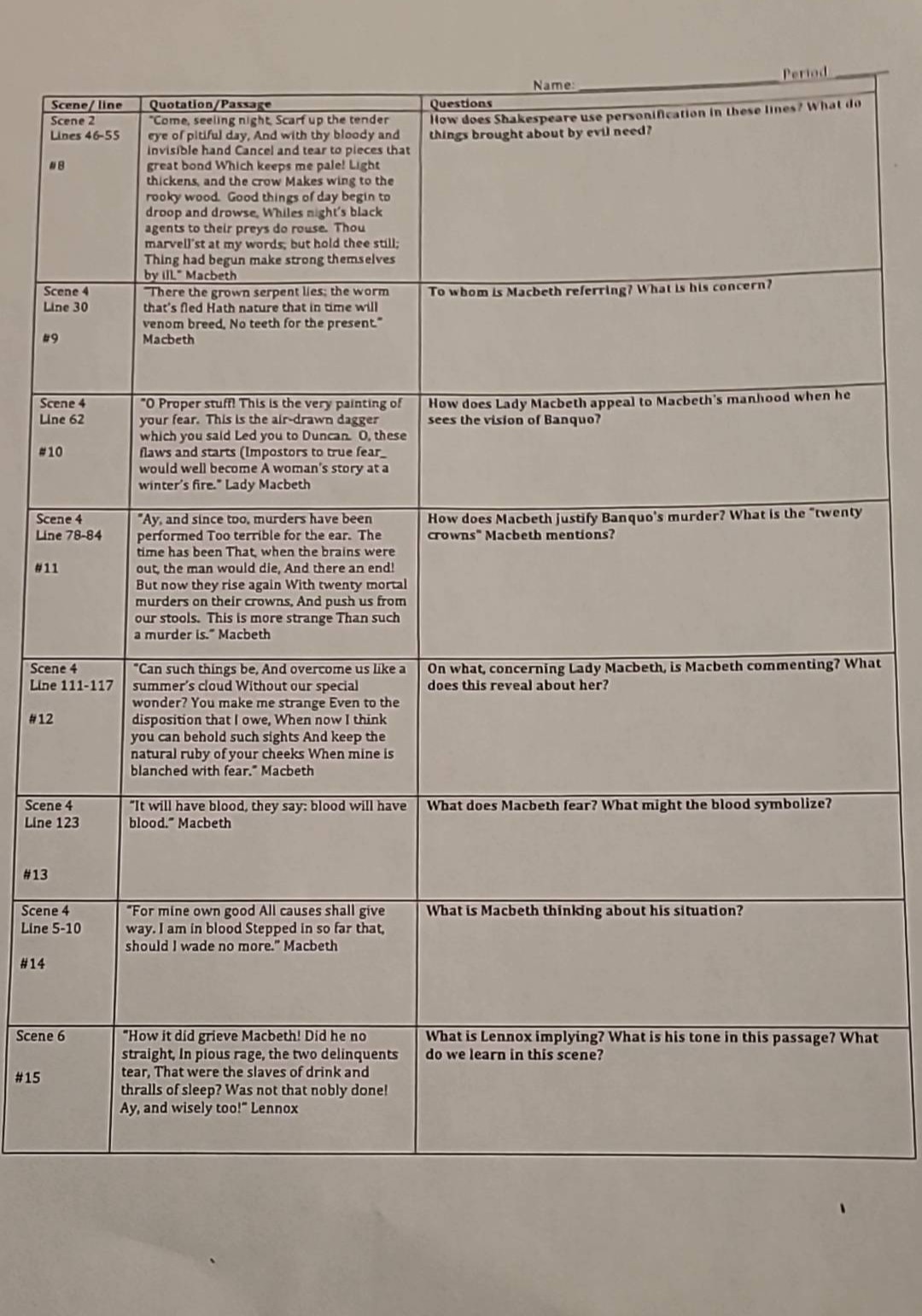
name:period#8scene/line: scene 2 lines 46-55quotation/passage: \come, seeling night, scarf up the tender eye of pitiful day, and with thy bloody and invisible hand cancel and tear to pieces that great bond which keeps me pale! light thickens, and the crow makes wing to the rooky wood. good things of day begin to droop and drowse, whiles nights black agents to their preys do rouse. thou marvellst at my words; but hold thee still; things bad begun make strong themselves by ill.\ macbethquestions: how does shakespeare use personification in these lines? what do things brought about by evil need?#9scene/line: scene 4 line 30quotation/passage: \there the grown serpent lies; the worm thats fled hath nature that in time will venom breed, no teeth for the present.\ macbethquestions: to whom is macbeth referring? what is his concern?#10scene/line: scene 4 line 62quotation/passage: \o proper stuff! this is the very painting of your fear. this is the air-drawn dagger which you said led you to duncan. o, these flaws and starts (impostors to true fear would well become a womans story at a winters fire.\ lady macbethquestions: how does lady macbeth appeal to macbeths manhood when he sees the vision of banquo?#11scene/line: scene 4 line 78-84quotation/passage: \ay, and since too, murders have been performed too terrible for the ear. the time has been that, when the brains were out, the man would die, and there an end! but now they rise again with twenty mortal murders on their crowns, and push us from our stools. this is more strange than such a murder is.\ macbethquestions: how does macbeth justify banquos murder? what is the \twenty crowns\ macbeth mentions?#12scene/line: scene 4 line 111-117quotation/passage: \can such things be, and overcome us like a summers cloud without our special wonder? you make me strange even to the disposition that i owe, when now i think you can behold such sights and keep the natural ruby of your cheeks when mine is blanched with fear.\ macbethquestions: on what, concerning lady macbeth, is macbeth commenting? what does this reveal about her?#13scene/line: scene 4 line 123quotation/passage: \it will have blood, they say; blood will have blood.\ macbethquestions: what does macbeth fear? what might the blood symbolize?#14scene/line: scene 4 line 5-10quotation/passage: \for mine own good all causes shall give way. i am in blood stepped in so far that, should i wade no more.\ macbethquestions: what is macbeth thinking about his situation?#15scene/line: scene 6quotation/passage: \how it did grieve macbeth! did he no straight, in pious rage, the two delinquents tear, that were the slaves of drink and thralls of sleep? was not that nobly done! ay, and wisely too!\ lennoxquestions: what is lennox implying? what is his tone in this passage? what do we learn in this scene?
#8
Shakespeare personifies night as a being with a "bloody and invisible hand" that can "cancel and tear to pieces" the bond that restrains Macbeth. He also gives night "black agents" that rouse to prey as day fades. Evil need (Macbeth's urge to murder Banquo) brings about the inversion of natural order: good things of day droop, while night's dark forces awaken to enable cruelty.
#9
Macbeth refers to Fleance, Banquo's son. His concern is that Fleance (the "worm that's fled") will grow into a threat (a "grown serpent") over time, as the witches' prophecy said Banquo's descendants would be kings, so Fleance could claim the throne Macbeth stole.
#10
Lady Macbeth dismisses Macbeth's vision of Banquo's ghost as childish and unmanly: she compares his fear to a "woman's story at a winter's fire" and calls his terror an "air-drawn dagger" (a false, cowardly hallucination), shaming him for not acting like a bold, unafraid man.
#11
Macbeth justifies Banquo's murder by arguing that once you start murdering to hold power, violence never ends—unlike old murders where death was final, now the dead (Banquo) seem to return to haunt him. The "twenty crowns" are a metaphor for the cycle of violence: each murder leads to more (twenty more "murders" on the crown) that push him further from safety.
#12
Macbeth comments on Lady Macbeth's apparent lack of fear when faced with the consequences of their murders. This reveals that Lady Macbeth has put on a facade of fearlessness to goad Macbeth, though her resolve will later crumble into guilt.
#13
Macbeth fears that his violent acts will come back to haunt him and that the cycle of murder will never end. Blood symbolizes guilt and the inescapable consequences of his violent, evil deeds—once stained with blood (guilt), he can never wash it away.
#14
Macbeth thinks he is too deeply trapped in his cycle of violence and guilt to turn back. He believes he has "stepped in so far" to bloodshed that stopping now is impossible; he must continue committing evil to protect his power.
#15
Lennox is sarcastically implying that Macbeth is responsible for the murders of Duncan and Banquo, mocking the official story that lowly men were to blame. His tone is bitter, ironic, and critical of Macbeth's tyranny. We learn that nobles like Lennox suspect Macbeth's guilt and are turning against him.

Snap & solve any problem in the app
Get step-by-step solutions on Sovi AI
Photo-based solutions with guided steps
Explore more problems and detailed explanations
#8
Shakespeare personifies night as an evil, active force (with a bloody hand, black agents) that enables dark deeds. Evil need (Macbeth's murderous urge) inverts the natural order, letting night's cruelty replace day's goodness.
#9
Macbeth refers to Fleance, Banquo's son. His concern is that Fleance will grow into a threat to his throne, fulfilling the witches' prophecy that Banquo's descendants will be kings.
#10
Lady Macbeth shames Macbeth by calling his fear childish, comparing his vision to a silly "woman's story," framing his terror as unmanly weakness.
#11
Macbeth justifies the murder by claiming violence begets endless violence; old murders ended with death, but now the dead haunt him. "Twenty crowns" symbolize the unending cycle of murder and guilt that pushes him further from safety.
#12
Macbeth comments on Lady Macbeth's apparent fearlessness in the face of their crimes. This reveals she is forcing a brave facade to manipulate Macbeth, hiding her own growing guilt.
#13
Macbeth fears his violent deeds will haunt him endlessly and the cycle of murder will never stop. Blood symbolizes inescapable guilt and the permanent stain of his evil actions.
#14
Macbeth believes he is fully trapped in his cycle of violence and guilt; he cannot turn back, so he must continue committing evil to hold his power.
#15
Lennox sarcastically implies Macbeth is guilty of Duncan and Banquo's murders, mocking the official cover story. His tone is ironic and critical. We learn that nobles suspect Macbeth's guilt and oppose his rule.