QUESTION IMAGE
Question
name: si yu luo date: 1/13 period: 6
1.3 comparative and absolute advantage ap notes
instructions: go to youtube find video titled comparative advantage and trade - macro topic 1.3 (micro topic 1.4) by jacob clifford.
objective: i can explain the concept of comparative advantage, how to calculate per - unit opportunity cost, and demonstrate how specialization and mutually beneficial trade occur between countries
do now: what could you trade for a red paper clip?
the most important single central fact about a free market is that no exchange take place unless both parties benefit. - milton friedman
why is this statement true?
define the following terms:
| absolute advantage | |
| comparative advantage | |
| terms of trade |
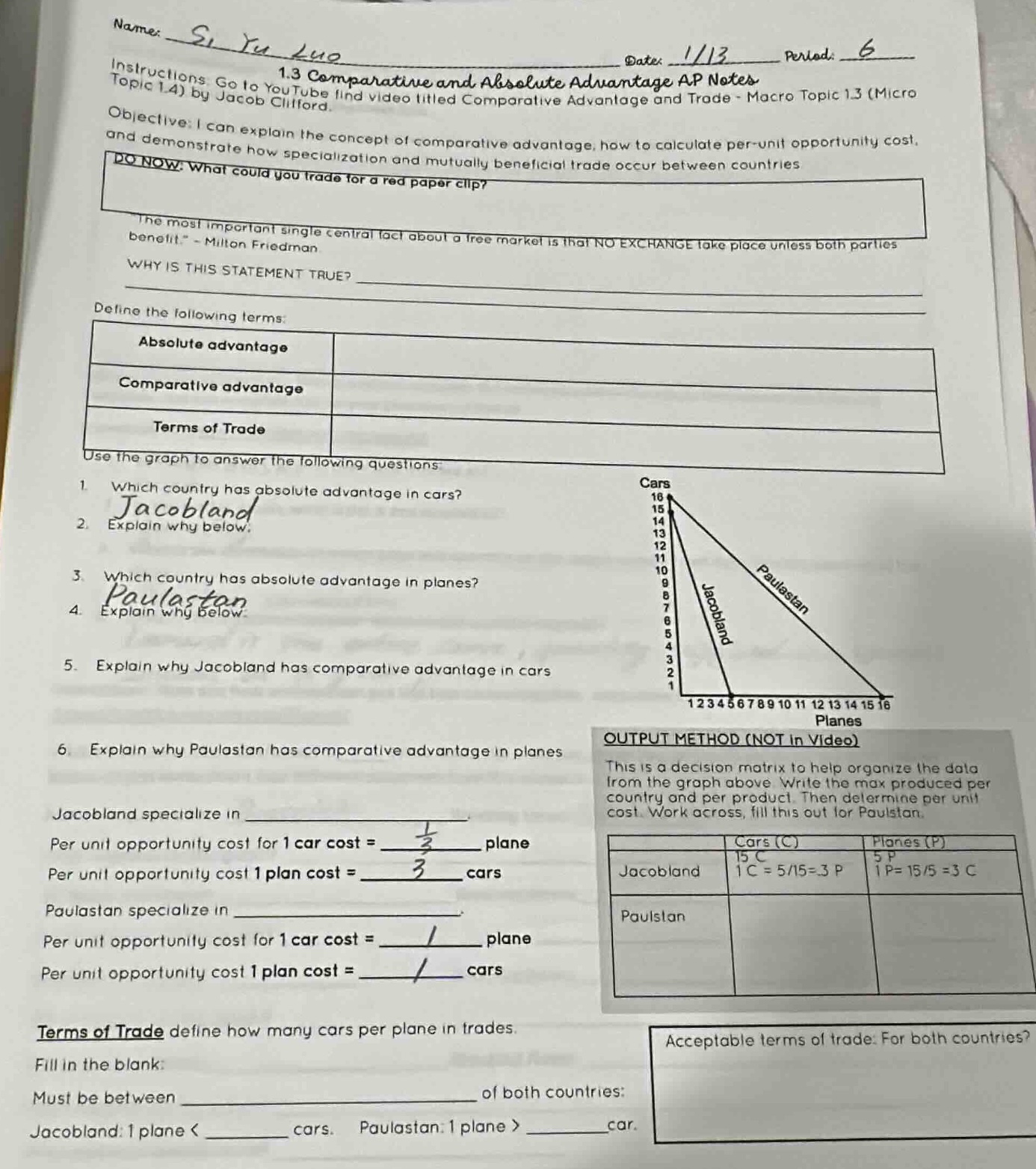
use the graph to answer the following questions:
- which country has absolute advantage in cars? jacobland
- explain why below.
- which country has absolute advantage in planes? paulastan
- explain why below.
- explain why jacobland has comparative advantage in cars
- explain why paulastan has comparative advantage in planes
jacobland specialize in.
per unit opportunity cost for 1 car cost = 1/3 plane
per unit opportunity cost 1 plan cost = 3 cars
paulastan specialize in.
per unit opportunity cost for 1 car cost = 1 plane
per unit opportunity cost 1 plan cost = 1 cars
output method (not in video)
this is a decision matrix to help organize the data from the graph above. write the max produced per country and per product. then determine per unit cost. work across, fill this out for paulstan.
| cars (c) | planes (p) | |
| jacobland | 15 c 1 c = 5/15 = 0.3 p | 5 p 1 p = 15/5 = 3 c |
| paulstan |
terms of trade define how many cars per plane in trades.
fill in the blank:
must be between of both countries:
jacobland: 1 plane < cars. paulastan: 1 plane > car.
1. Defining Terms (Answer-Explanation Format)
- Absolute advantage: The ability of an entity (country, individual, firm) to produce a good or service using fewer resources (or in less time) than another entity. For example, if Country A can produce 10 cars in an hour and Country B can produce 8 cars in the same hour, Country A has an absolute advantage in car production.
- Comparative advantage: The ability of an entity to produce a good or service at a lower opportunity cost than another entity. Even if an entity doesn't have an absolute advantage in producing a good, it can have a comparative advantage if its opportunity cost of producing that good is lower. For instance, if Country X has to give up producing 2 planes to make 1 car, and Country Y has to give up producing 1 plane to make 1 car, Country Y has a comparative advantage in car production (lower opportunity cost).
- Terms of Trade: The rate at which one good is exchanged for another between two trading parties (e.g., how many cars are traded for one plane). It lies between the opportunity costs of the two trading entities to be mutually beneficial.
To determine absolute advantage in cars, we look at the maximum number of cars each country can produce. From the graph (and the output method table), Jacobland can produce 15 cars (when producing 0 planes), while Paulastan's maximum car production (from the graph's intercept? Wait, the graph's vertical axis is cars, horizontal is planes. Jacobland's PPF touches the cars axis at 15, Paulastan's PPF touches the cars axis at... Wait, the graph shows Jacobland's PPF: when planes = 0, cars = 15; when cars = 0, planes = 5. Paulastan's PPF: when planes = 0, cars = 15? Wait no, the graph's vertical axis (cars) has Jacobland's PPF starting at (0,15) and ending at (5,0). Paulastan's PPF starts at (0,15) and ends at (15,0)? Wait, no, the graph's cars axis: Jacobland's PPF is steeper, Paulastan's is flatter. Wait the output method table for Jacobland: 15 cars, 5 planes. So Jacobland's max cars: 15, max planes: 5. Paulastan: let's see, from the graph, when planes = 15, cars = 0; when cars = 15, planes = 0? Wait no, the graph's horizontal axis is planes (0 - 15), vertical is cars (0 - 16? Wait the top of cars axis is 16? Wait the user's graph: Jacobland's PPF: (0,15) to (5,0). Paulastan's PPF: (0,15) to (15,0). Wait, so Jacobland can produce 15 cars (when planes = 0), Paulastan can also produce 15 cars? But that can't be. Wait no, maybe the vertical axis is cars, so Jacobland's PPF: when planes = 0, cars = 15; when cars = 0, planes = 5. Paulastan's PPF: when planes = 0, cars = 15; when cars = 0, planes = 15. Wait, but that would mean both can produce 15 cars. But the question 1's answer is Jacobland. Wait the user's answer for question 1 is Jacobland. Wait maybe I misread. Wait the output method table: Jacobland has 15 C, 5 P. So Jacobland's max cars: 15, max planes: 5. Paulastan: let's calculate. If Paulastan's PPF is from (0,15) to (15,0), then max cars: 15, max planes: 15. But the graph's Jacobland's PPF is steeper, so when producing cars, Jacobland can produce 15 cars, same as Paulastan? But the user's answer for 1 is Jacobland. Wait maybe the graph's vertical axis (cars) for Jacobland is higher? Wait the graph shows Jacobland's PPF starting at (0,16) or 15? Wait the user's handwritten answer for 1 is Jacobland. So the reasoning is: Absolute advantage is who can produce more of a good with the same resources (or in the same time). From the output method, Jacobland can produce 15 cars, and Paulastan: let's see, if Paulastan's max cars is also 15, but maybe the time or resources? Wait no, the PPF shows the maximum output combinations. Wait maybe the graph's vertical axis (cars) for Jacobland is 15, and Paulastan's is less? Wait the user's graph: Jacobland's PPF is from (0,15) to (5,0), Paulastan's from (0,15) to (15,0). Wait, so both can produce 15 cars, but Jacobland can produce more cars per plane? No, absolute advantage is about total output. Wait maybe the question is based on the graph's intercept: Jacobland's cars intercept is 15, Paulastan's is also 15? But the user's answer is Jacobland. Maybe there's a typo, but according to the user's handwritten answer, Jacobland has absolute advantage in cars. The explanation is: Jacobland can produce more cars than Paulastan? Wait no, if both can produce 15 cars, but maybe the graph's vertical axis for Jacobland is higher (like 16 vs 15). Alternatively, from the output method, Jacobland's max cars is 15, Paulastan's max cars: let's calculate. If Paulastan's PPF is (0, C) to (P, 0), and from the graph, when P = 15, C = 0; when C = 0, P = 15. So max cars for Paulastan is 15? But Jacobland's max cars…
To determine absolute advantage in planes, we look at the maximum number of planes each country can produce. From the graph, Paulastan’s PPF touches the planes axis at 15 (when producing 0 cars), while Jacobland’s PPF touches the planes axis at 5 (when producing 0 cars). So Paulastan can produce more planes (15) than Jacobland (5), hence has absolute advantage in planes.

Snap & solve any problem in the app
Get step-by-step solutions on Sovi AI
Photo-based solutions with guided steps
Explore more problems and detailed explanations
- Absolute advantage: The ability to produce a good/service with fewer resources (or less time) than others.
- Comparative advantage: The ability to produce a good/service at a lower opportunity cost than others.
- Terms of Trade: The rate at which one good is exchanged for another in trade, between the opportunity costs of the traders.