QUESTION IMAGE
Question
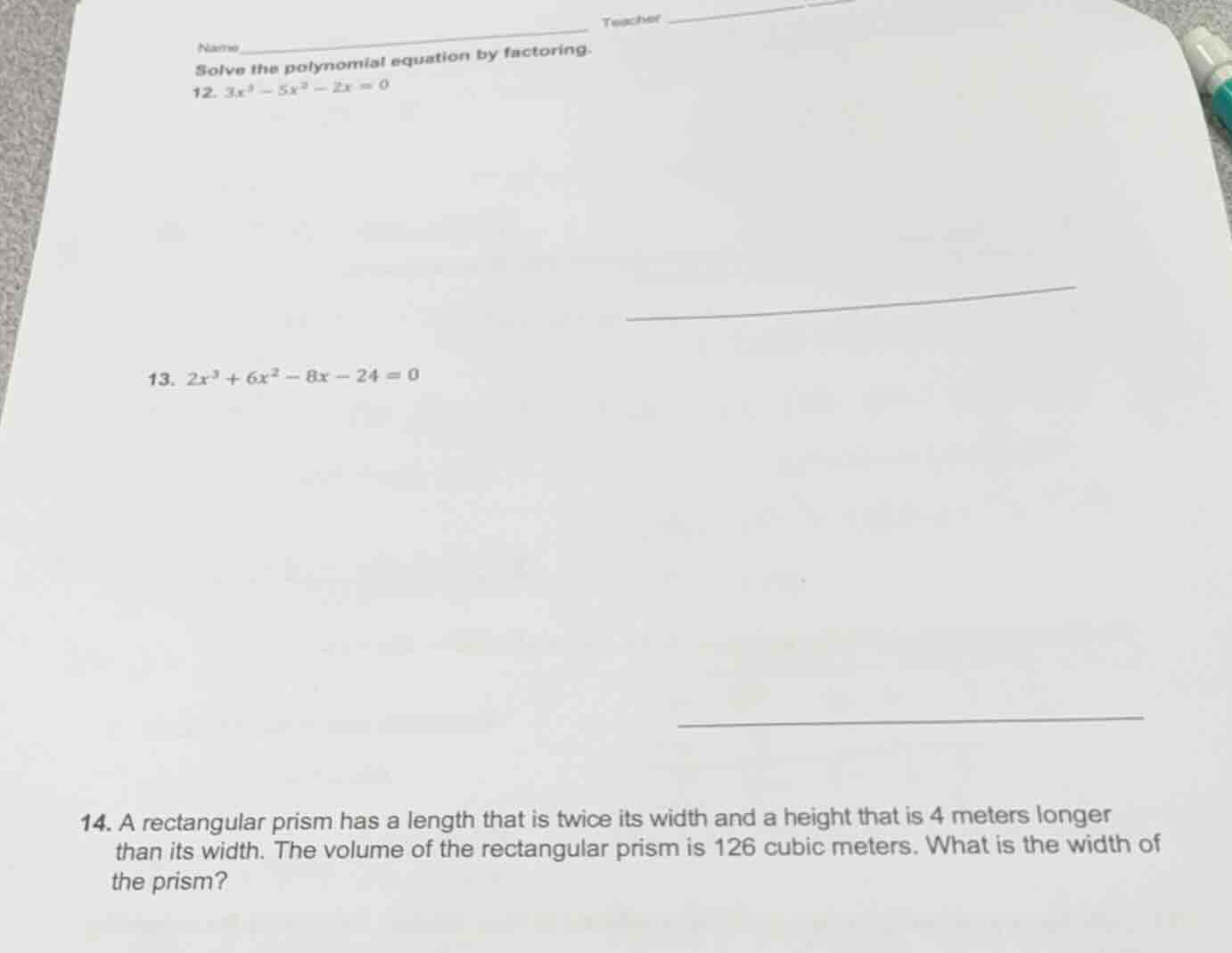
name teacher solve the polynomial equation by factoring. 12. $3x^3 - 5x^2 - 2x = 0$ 13. $2x^3 + 6x^2 - 8x - 24 = 0$ 14. a rectangular prism has a length that is twice its width and a height that is 4 meters longer than its width. the volume of the rectangular prism is 126 cubic meters. what is the width of the prism?
Problem 12: \( 3x^3 - 5x^2 - 2x = 0 \)
Step 1: Factor out the GCF
Factor out \( x \) from each term:
\( x(3x^2 - 5x - 2) = 0 \)
Step 2: Factor the quadratic
Factor \( 3x^2 - 5x - 2 \). Find two numbers that multiply to \( 3(-2) = -6 \) and add to \( -5 \). These numbers are \( -6 \) and \( 1 \).
Rewrite the middle term: \( 3x^2 - 6x + x - 2 \)
Group and factor:
\( 3x(x - 2) + 1(x - 2) = (3x + 1)(x - 2) \)
Step 3: Apply the Zero Product Property
Set each factor equal to zero:
\( x = 0 \), \( 3x + 1 = 0 \) (so \( x = -\frac{1}{3} \)), or \( x - 2 = 0 \) (so \( x = 2 \))
Step 1: Factor by grouping
Group the first two and last two terms:
\( (2x^3 + 6x^2) + (-8x - 24) = 0 \)
Factor out the GCF from each group:
\( 2x^2(x + 3) - 8(x + 3) = 0 \)
Step 2: Factor out the common binomial
Factor out \( (x + 3) \):
\( (x + 3)(2x^2 - 8) = 0 \)
Step 3: Simplify the quadratic factor
Factor out 2 from \( 2x^2 - 8 \):
\( (x + 3) \cdot 2(x^2 - 4) = 0 \)
Factor \( x^2 - 4 \) (difference of squares):
\( (x + 3) \cdot 2(x - 2)(x + 2) = 0 \)
Step 4: Apply the Zero Product Property
Set each factor equal to zero:
\( x + 3 = 0 \) (so \( x = -3 \)), \( x - 2 = 0 \) (so \( x = 2 \)), or \( x + 2 = 0 \) (so \( x = -2 \))
Step 1: Define variables
Let \( w \) = width (in meters). Then:
- Length \( l = 2w \)
- Height \( h = w + 4 \)
Step 2: Volume formula for a rectangular prism
Volume \( V = l \cdot w \cdot h \). Substitute \( l \), \( w \), \( h \):
\( 126 = (2w) \cdot w \cdot (w + 4) \)
Simplify: \( 2w^2(w + 4) = 126 \)
Divide both sides by 2: \( w^2(w + 4) = 63 \)
Expand: \( w^3 + 4w^2 - 63 = 0 \)
Step 3: Test integer roots (Rational Root Theorem)
Possible roots: \( \pm1, \pm3, \pm7, \pm9, \pm21, \pm63 \). Test \( w = 3 \):
\( 3^3 + 4(3)^2 - 63 = 27 + 36 - 63 = 0 \). So \( w - 3 \) is a factor.
Step 4: Factor the cubic
Divide \( w^3 + 4w^2 - 63 \) by \( w - 3 \) (or use synthetic division). The cubic factors as \( (w - 3)(w^2 + 7w + 21) = 0 \). The quadratic \( w^2 + 7w + 21 \) has no real roots (discriminant \( 49 - 84 = -35 < 0 \)). Thus, \( w = 3 \).

Snap & solve any problem in the app
Get step-by-step solutions on Sovi AI
Photo-based solutions with guided steps
Explore more problems and detailed explanations
\( x = 0 \), \( x = -\frac{1}{3} \), \( x = 2 \)