QUESTION IMAGE
Question
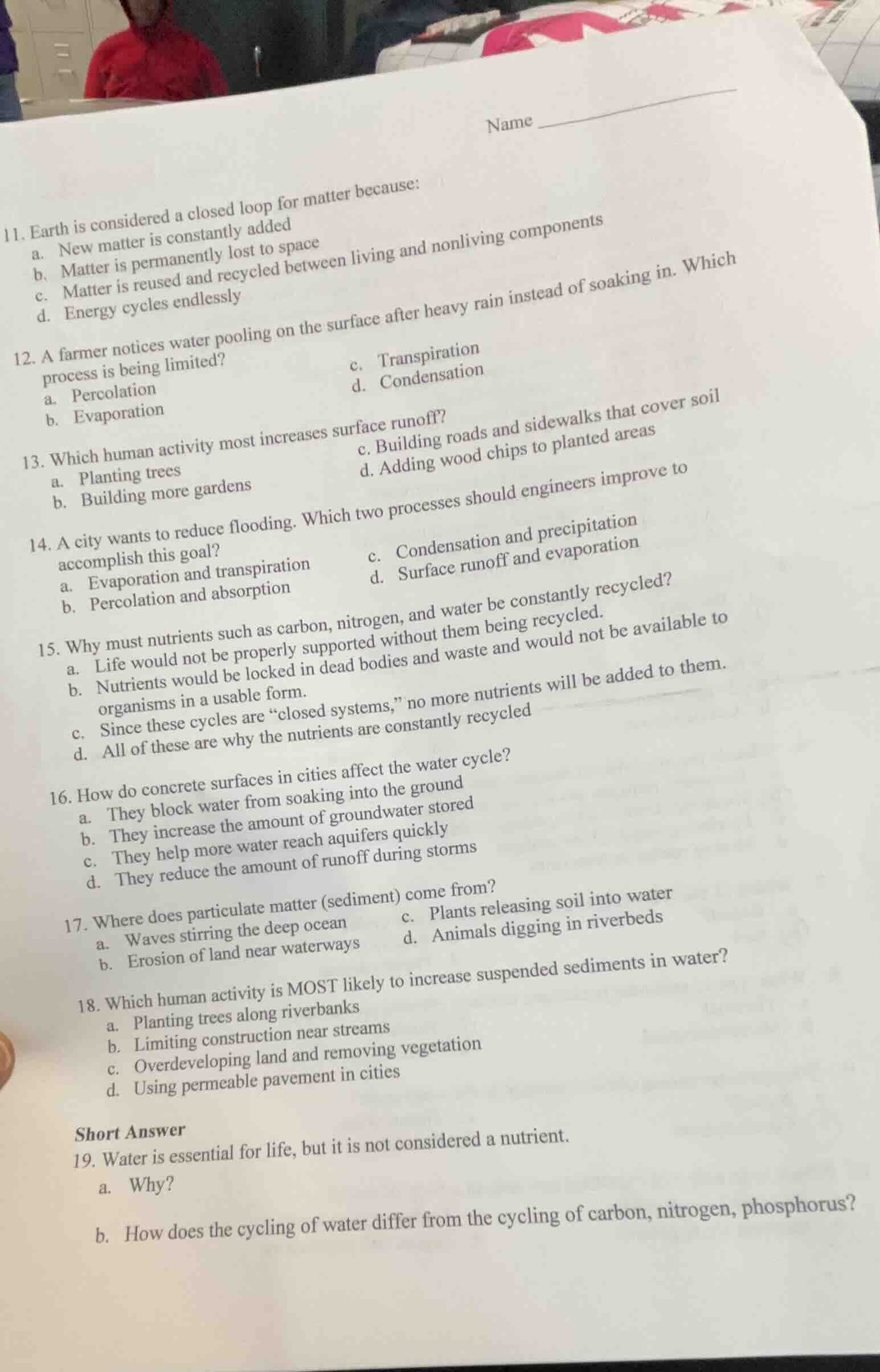
name11. earth is considered a closed loop for matter because:a. new matter is constantly addedb. matter is permanently lost to spacec. matter is reused and recycled between living and nonliving componentsd. energy cycles endlessly12. a farmer notices water pooling on the surface after heavy rain instead of soaking in. which process is being limited?a. percolationb. evaporationc. transpirationd. condensation13. which human activity most increases surface runoff?a. planting treesb. building more gardensc. building roads and sidewalks that cover soild. adding wood chips to planted areas14. a city wants to reduce flooding. which two processes should engineers improve to accomplish this goal?a. evaporation and transpirationb. percolation and absorptionc. condensation and precipitationd. surface runoff and evaporation15. why must nutrients such as carbon, nitrogen, and water be constantly recycled?a. life would not be properly supported without them being recycled.b. nutrients would be locked in dead bodies and waste and would not be available to organisms in a usable form.c. since these cycles are “closed systems,” no more nutrients will be added to them.d. all of these are why the nutrients are constantly recycled16. how do concrete surfaces in cities affect the water cycle?a. they block water from soaking into the groundb. they increase the amount of groundwater storedc. they help more water reach aquifers quicklyd. they reduce the amount of runoff during storms17. where does particulate matter (sediment) come from?a. waves stirring the deep oceanb. erosion of land near waterwaysc. plants releasing soil into waterd. animals digging in riverbeds18. which human activity is most likely to increase suspended sediments in water?a. planting trees along riverbanksb. limiting construction near streamsc. overdeveloping land and removing vegetationd. using permeable pavement in citiesshort answer19. water is essential for life, but it is not considered a nutrient.a. why?b. how does the cycling of water differ from the cycling of carbon, nitrogen, phosphorus?
- Earth as a closed matter loop means matter is recycled between biotic and abiotic components, not added/lost, and energy flows (doesn't cycle like matter).
- Percolation is water soaking into soil; pooling means this process is limited.
- Impervious surfaces like roads/sidewalks prevent water absorption, increasing runoff.
- Percolation (water into soil) and absorption (by plants/soil) reduce surface water, cutting flooding.
- Nutrient recycling sustains life, unlocks trapped nutrients, and Earth's closed system means no new nutrients enter.
- Concrete is impermeable, blocking water from infiltrating the ground.
- Land erosion near waterways washes sediment into bodies of water, the main source of particulate matter.
- Removing vegetation and overdeveloping land loosens soil, which runs into water, increasing suspended sediment.
19a. Nutrients are used to build body structures and are broken down for energy; water is a solvent/medium, not used for structural building or energy in the same way.
19b. Water cycles primarily between the atmosphere, land, and oceans, with a large atmospheric component. Carbon, nitrogen, and phosphorus cycle more extensively through biotic organisms, soil, and sediment, with smaller atmospheric reservoirs (except nitrogen).

Snap & solve any problem in the app
Get step-by-step solutions on Sovi AI
Photo-based solutions with guided steps
Explore more problems and detailed explanations
- c. Matter is reused and recycled between living and nonliving components
- a. Percolation
- c. Building roads and sidewalks that cover soil
- b. Percolation and absorption
- d. All of these are why the nutrients are constantly recycled
- a. They block water from soaking into the ground
- b. Erosion of land near waterways
- c. Overdeveloping land and removing vegetation
19a. Water is a medium/solvent for life processes but does not provide structural building blocks or energy like nutrients do; it is not incorporated into organic molecules for growth in the same way nutrients are.
19b. Water has a large, rapid atmospheric phase of its cycle, while carbon, nitrogen, and phosphorus spend more time in biotic, soil, or sediment reservoirs, with nitrogen being the only other nutrient with a significant atmospheric phase (but it is not as rapidly cycled between air and surface as water). Water also does not get incorporated into the molecular structure of organisms for growth in the same core way that carbon, nitrogen, and phosphorus do.