QUESTION IMAGE
Question
national origins act of 1924 - u.s. restricting immigration from \undesirable\ countries
europe
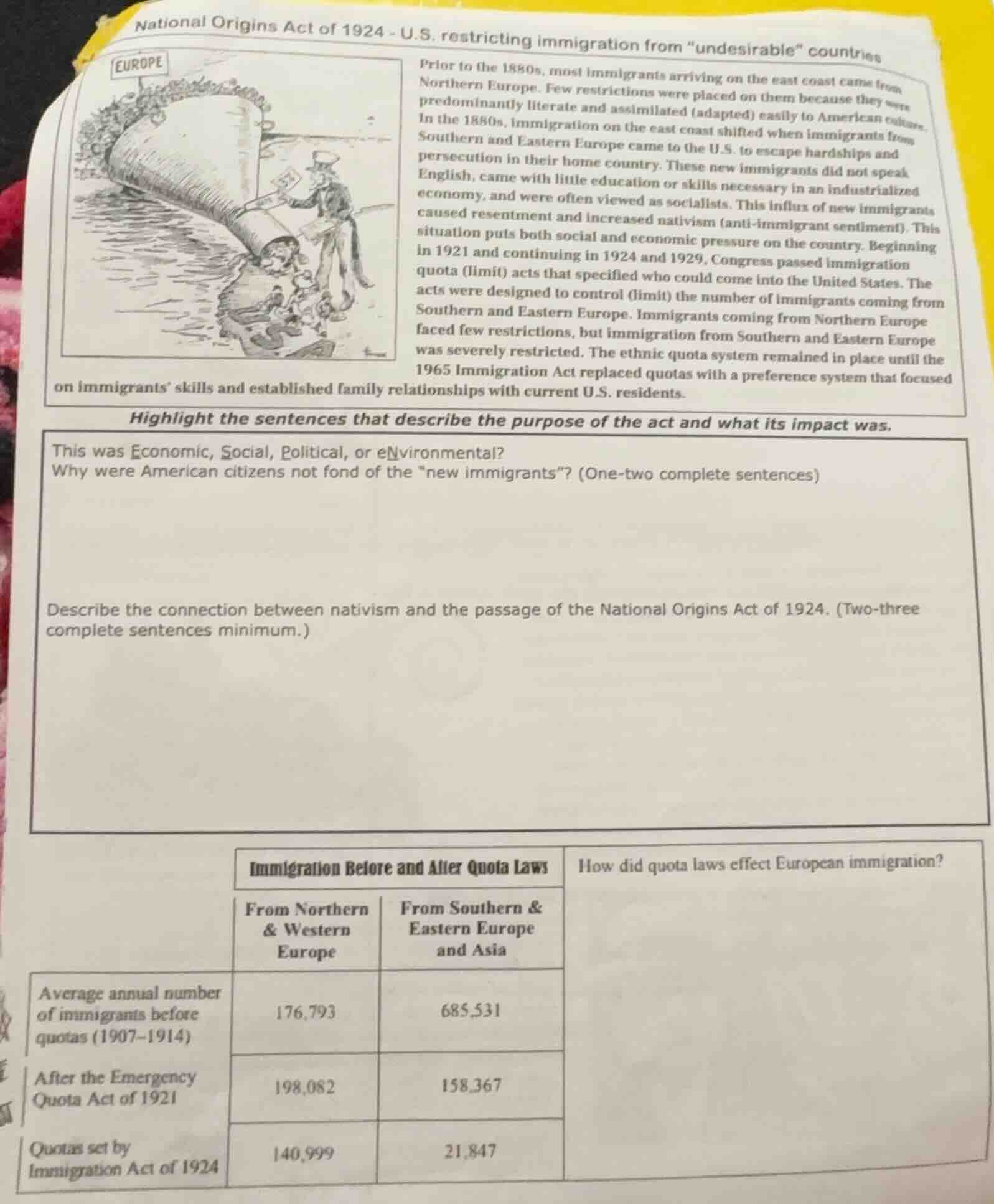
prior to the 1880s, most immigrants arriving on the east coast came from northern europe. few restrictions were placed on them because they were predominantly literate and assimilated (adapted) easily to american culture. in the 1880s, immigration on the east coast shifted when immigrants from southern and eastern europe came to the u.s. to escape hardships and persecution in their home country. these new immigrants did not speak english, came with little education or skills necessary in an industrialized economy, and were often viewed as socialists. this influx of new immigrants caused resentment and increased nativism (anti-immigrant sentiment). this situation puts both social and economic pressure on the country. beginning in 1921 and continuing in 1924 and 1929, congress passed immigration quota (limit) acts that specified who could come into the united states. the acts were designed to control (limit) the number of immigrants coming from southern and eastern europe. immigrants coming from northern europe faced few restrictions, but immigration from southern and eastern europe was severely restricted. the ethnic quota system remained in place until the 1965 immigration act replaced quotas with a preference system that focused on immigrants skills and established family relationships with current u.s. residents.
highlight the sentences that describe the purpose of the act and what its impact was.
this was economic, social, political, or environmental?
why were american citizens not fond of the
ew immigrants\? (one-two complete sentences)
describe the connection between nativism and the passage of the national origins act of 1924. (two-three complete sentences minimum.)
immigration before and after quota laws
how did quota laws effect european immigration?
| from northern & western europe | from southern & eastern europe and asia | |
|---|---|---|
| after the emergency quota act of 1921 | 198,082 | 158,367 |
| quotas set by immigration act of 1924 | 140,999 | 21,847 |
1. Purpose & Impact Sentences
- Purpose: "Beginning in 1921 and continuing in 1924 and 1929, Congress passed immigration quota (limit) acts that specified who could come into the United States. The acts were designed to control (limit) the number of immigrants coming from Southern and Eastern Europe."
- Impact: "Immigrants coming from Northern Europe faced few restrictions, but immigration from Southern and Eastern Europe was severely restricted. The ethnic quota system remained in place until the 1965 Immigration Act replaced quotas with a preference system that focused on immigrants' skills and established family relationships with current U.S. residents."
2. Category & Anti-Immigrant Sentiment
- This was Social and Economic.
- American citizens disliked the new immigrants because these arrivals often lacked English proficiency, education, and industrial skills, and were viewed as socialists, creating resentment and nativist sentiment.
3. Nativism & National Origins Act Connection
The influx of Southern and Eastern European immigrants sparked nativism (anti-immigrant sentiment) among U.S. citizens, who resented the newcomers' perceived lack of skills and cultural differences. This widespread nativist pressure pushed Congress to pass the National Origins Act of 1924, which was explicitly designed to severely restrict immigration from these "undesirable" regions while favoring Northern European immigrants.
4. Quota Laws' Effect on European Immigration
Quota laws had an unequal effect: immigration from Northern and Western Europe remained relatively stable (with only a small decrease after the 1924 act), while immigration from Southern and Eastern Europe was drastically reduced, falling from an average of 685,531 annual immigrants (1907-1914) to just 21,847 after the 1924 act.

Snap & solve any problem in the app
Get step-by-step solutions on Sovi AI
Photo-based solutions with guided steps
Explore more problems and detailed explanations
- Purpose sentences: "Beginning in 1921 and continuing in 1924 and 1929, Congress passed immigration quota (limit) acts that specified who could come into the United States. The acts were designed to control (limit) the number of immigrants coming from Southern and Eastern Europe."
Impact sentences: "Immigrants coming from Northern Europe faced few restrictions, but immigration from Southern and Eastern Europe was severely restricted. The ethnic quota system remained in place until the 1965 Immigration Act replaced quotas with a preference system that focused on immigrants' skills and established family relationships with current U.S. residents."
- Category: Social and Economic.
American citizens disliked new immigrants because they lacked English, education, industrial skills, and were seen as socialists, stoking resentment.
- Nativism (anti-immigrant sentiment) grew from the influx of Southern/Eastern European immigrants, who were viewed as unskilled and culturally incompatible. This public pressure led Congress to pass the 1924 National Origins Act, which enforced strict quotas to limit immigration from these regions while allowing more Northern European immigrants.
- Quota laws allowed Northern and Western European immigration to stay relatively steady, but they caused a massive, drastic decline in immigration from Southern and Eastern Europe, cutting annual arrivals from over 685,000 to just 21,847.