QUESTION IMAGE
Question
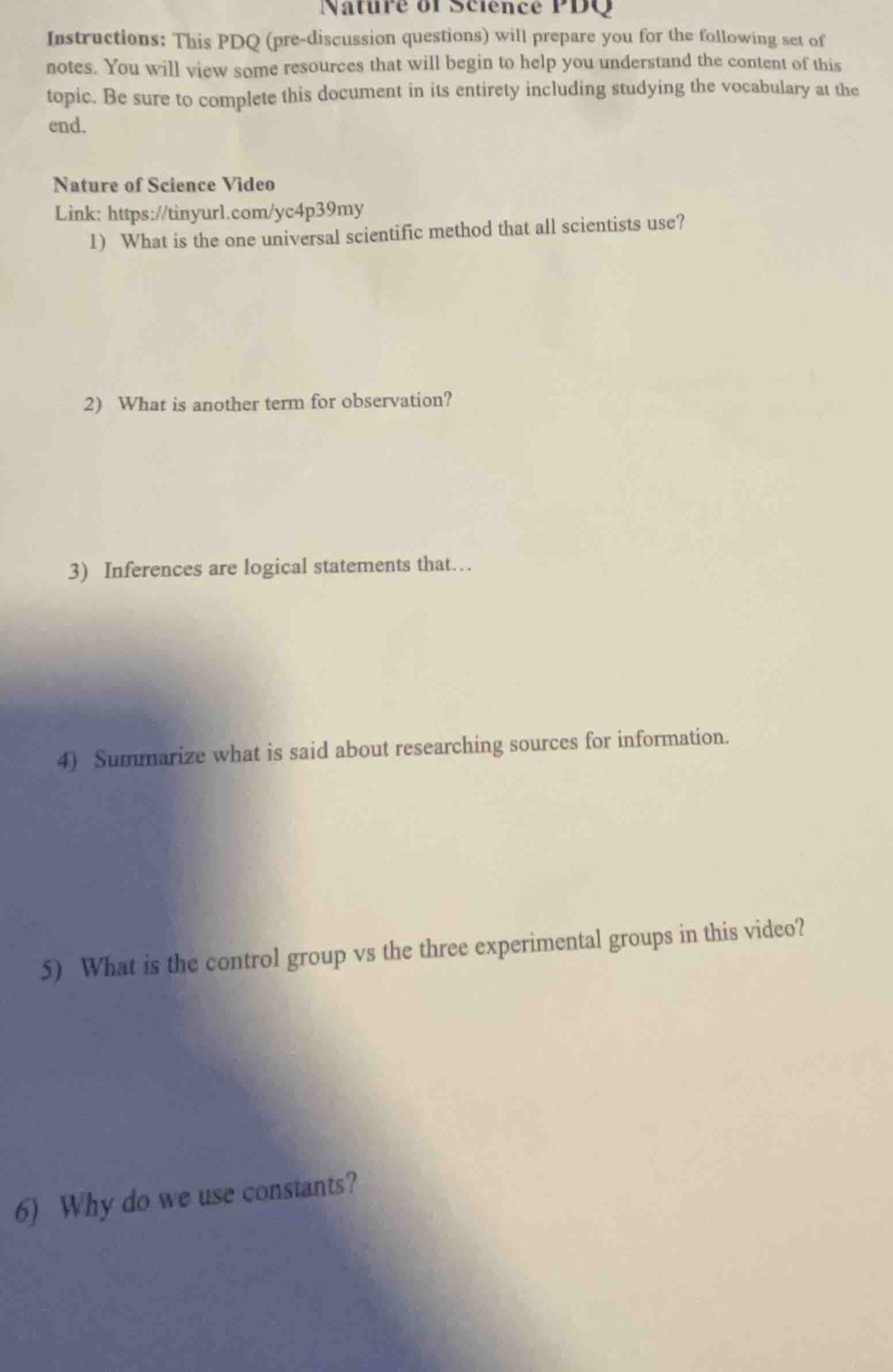
nature of science pdq
instructions: this pdq (pre - discussion questions) will prepare you for the following set of
notes. you will view some resources that will begin to help you understand the content of this
topic. be sure to complete this document in its entirety including studying the vocabulary at the
end.
nature of science video
link: https://tinyurl.com/yc4p39my
- what is the one universal scientific method that all scientists use?
- what is another term for observation?
- inferences are logical statements that...
- summarize what is said about researching sources for information.
- what is the control group vs the three experimental groups in this video?
- why do we use constants?
To answer these questions, you need to watch the provided "Nature of Science" video (link: https://tinyurl.com/yc4p39my) and extract the relevant information:
Question 1: What is the one universal scientific method that all scientists use?
Watch the video to identify the core, universal process scientists follow (e.g., observation, hypothesis, experiment, analysis, conclusion—though the video may frame it uniquely).
Question 2: What is another term for observation?
The video will likely provide a synonym for "observation" (e.g., "data collection" or a specific scientific term).
Question 3: Inferences are logical statements that…
The video will define inferences (e.g., conclusions drawn from observations or data).
Question 4: Summarize what is said about researching sources for information.
Note how the video describes evaluating or using research sources (e.g., credibility, peer review, types of sources).
Question 5: What is the control group vs the three experimental groups in this video?
Identify the control group (standard for comparison) and experimental groups (test groups with variables) from the video’s example.
Question 6: Why do we use constants?
The video will explain constants (factors kept the same to ensure a fair test and isolate the independent variable’s effect).
If you need help interpreting the video or clarifying concepts, share specific details from the video, and I can assist with analysis!

Snap & solve any problem in the app
Get step-by-step solutions on Sovi AI
Photo-based solutions with guided steps
Explore more problems and detailed explanations
To answer these questions, you need to watch the provided "Nature of Science" video (link: https://tinyurl.com/yc4p39my) and extract the relevant information:
Question 1: What is the one universal scientific method that all scientists use?
Watch the video to identify the core, universal process scientists follow (e.g., observation, hypothesis, experiment, analysis, conclusion—though the video may frame it uniquely).
Question 2: What is another term for observation?
The video will likely provide a synonym for "observation" (e.g., "data collection" or a specific scientific term).
Question 3: Inferences are logical statements that…
The video will define inferences (e.g., conclusions drawn from observations or data).
Question 4: Summarize what is said about researching sources for information.
Note how the video describes evaluating or using research sources (e.g., credibility, peer review, types of sources).
Question 5: What is the control group vs the three experimental groups in this video?
Identify the control group (standard for comparison) and experimental groups (test groups with variables) from the video’s example.
Question 6: Why do we use constants?
The video will explain constants (factors kept the same to ensure a fair test and isolate the independent variable’s effect).
If you need help interpreting the video or clarifying concepts, share specific details from the video, and I can assist with analysis!