QUESTION IMAGE
Question
necessary. figures are not necessarily drawn to scale.
answer
rs
Step1: Recall triangle angle sum
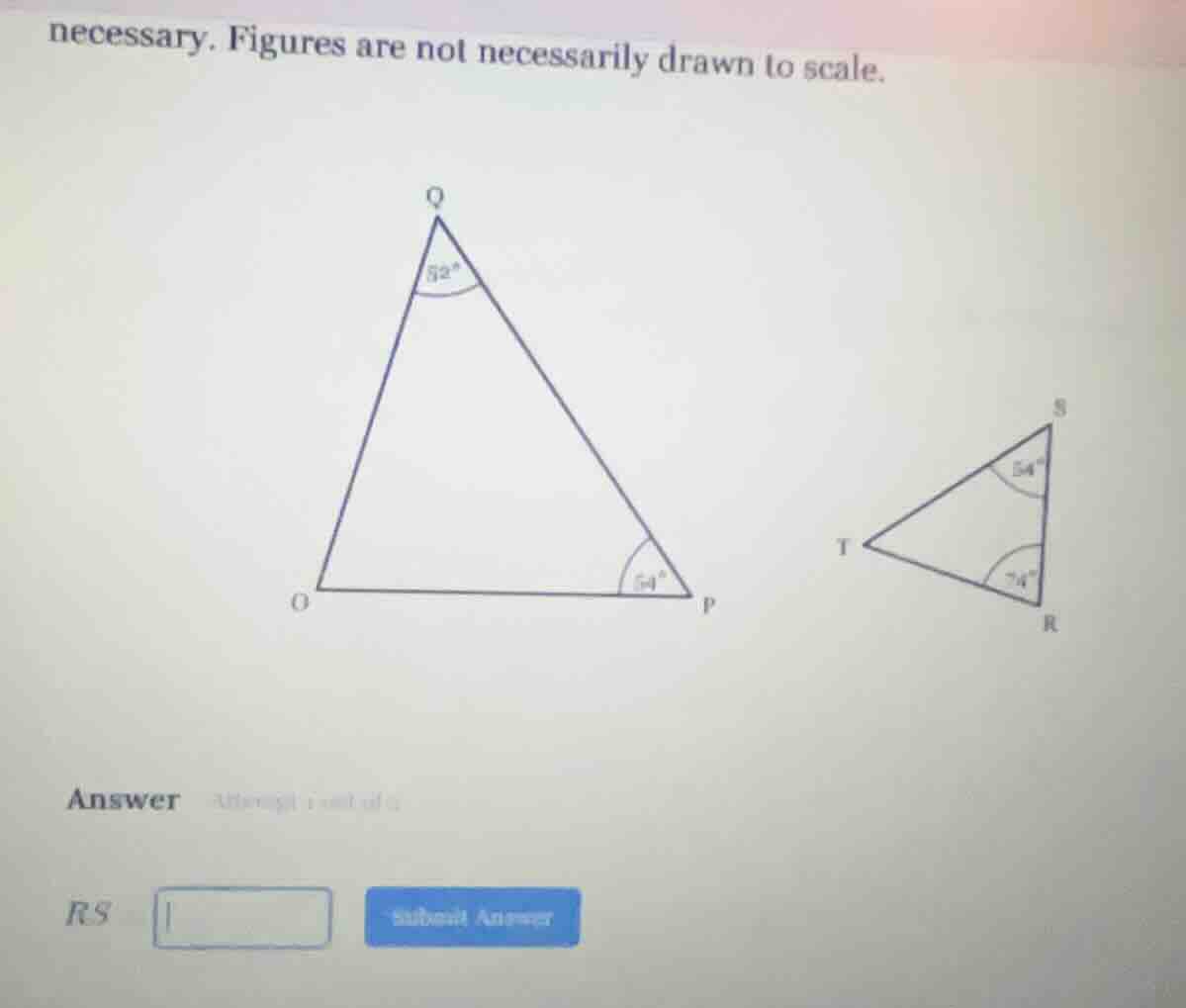
The sum of angles in a triangle is \(180^\circ\). For \(\triangle QOP\), we know two angles: \(\angle Q = 52^\circ\) and \(\angle P = 54^\circ\).
Step2: Calculate \(\angle O\)
\(\angle O = 180^\circ - 52^\circ - 54^\circ = 74^\circ\). Now, looking at \(\triangle RST\), we see \(\angle S = 54^\circ\) and \(\angle R = 74^\circ\), so it should be similar to \(\triangle QOP\) (by AA similarity). The side \(RS\) should correspond to a side in \(\triangle QOP\), but since we need to find \(n\) (wait, maybe the question is to find \(n\) where \(\angle R = n^\circ\), but from \(\triangle QOP\), \(\angle O = 74^\circ\), so \(n = 74\)? Wait, maybe the triangles are similar, so corresponding angles are equal. Wait, the first triangle: \(\angle Q = 52\), \(\angle P = 54\), so \(\angle O = 180 - 52 - 54 = 74\). The second triangle: \(\angle S = 54\), \(\angle R = n\), so \(n = 74\) (since the triangles are similar, so corresponding angles match). Wait, maybe the problem is to find \(n\) (the measure of \(\angle R\)), so using triangle angle sum for the second triangle: \(\angle T + 54^\circ + n^\circ = 180^\circ\), but also, since \(\triangle QOP\) and \(\triangle RST\) have two angles equal (54° and 74°), so \(n = 74\).

Snap & solve any problem in the app
Get step-by-step solutions on Sovi AI
Photo-based solutions with guided steps
Explore more problems and detailed explanations
\(74\)