QUESTION IMAGE
Question
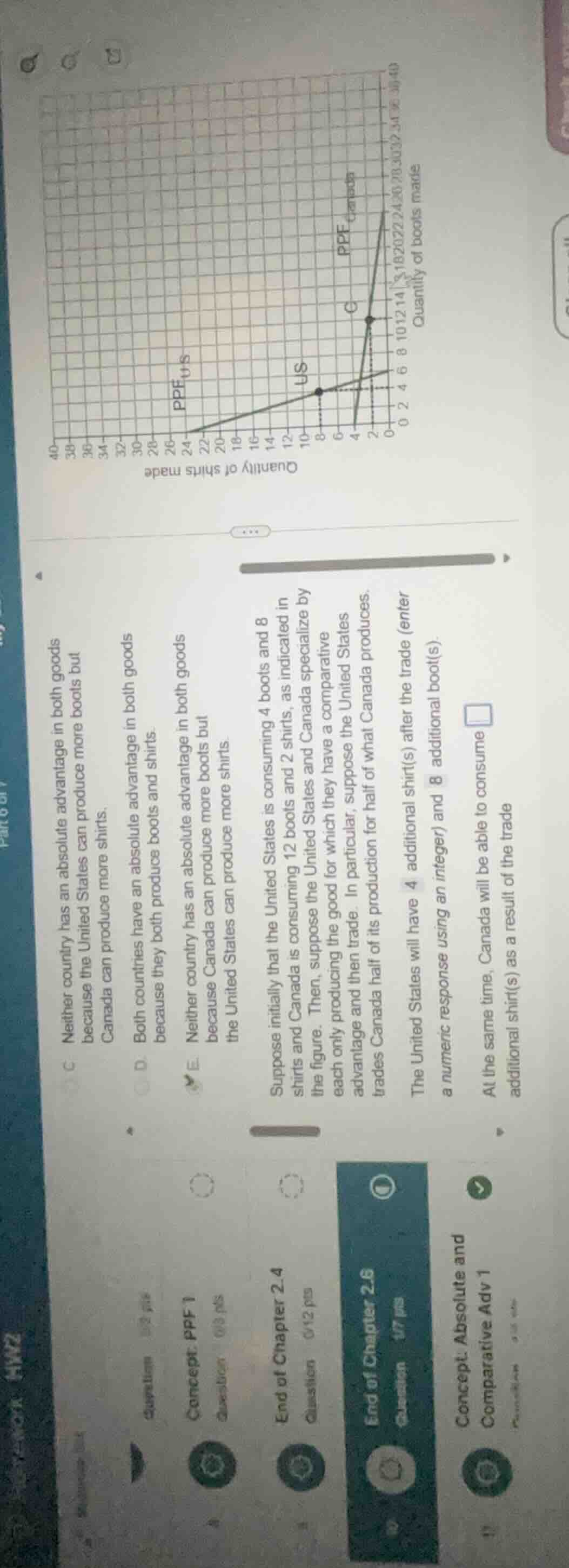
neither country has an absolute advantage in both goods because the united states can produce more boats but canada can produce more shirts. c neither countries have an absolute advantage in both goods because they both produce boats and shirts. d neither country has an absolute advantage in both goods because canada can produce more boats but the united states can produce more shirts. e suppose initially that the united states is consuming 4 boats and 8 shirts and canada is consuming 12 boats and 2 shirts, as indicated by the figure. then, suppose the united states and canada specialize by each only producing the good for which they have a comparative advantage and then trade. in particular, suppose the united states trades canada half of its production for half of what canada produces. the united states will have 4 additional shirt(s) after the trade (enter a numeric response using an integer) and 8 additional boot(s). at the same time, canada will be able to consume additional shirt(s) as a result of the trade
To solve for the additional shirts Canada can consume after trade, we analyze the production and trade:
Step 1: Determine Canada's Initial and Specialized Production
- Initially, Canada consumes 12 boats and 2 shirts.
- When specializing, Canada focuses on the good with comparative advantage (boats, from the PPF). Assume Canada’s total boat production capacity (from PPF) is, say, 24 boats (from the graph’s grid). If it specializes in boats, it produces 24 boats. But it trades half of its production: \( \frac{24}{2} = 12 \) boats traded.
Step 2: Analyze Trade and Consumption of Shirts
- The US trades 4 shirts (given) and 8 boats (given). Canada receives 4 shirts from the US.
- Initially, Canada consumed 2 shirts. After trade, it consumes \( 2 + 4 = 6 \)? Wait, no—wait, the problem says “additional shirts.” Wait, maybe Canada’s production of shirts when not specializing: from the PPF, if Canada’s PPF for shirts (when producing 0 boats) is, say, 12 shirts (from the grid: when boats=0, shirts=12? Wait, the graph’s Canada PPF: when boats=0, shirts=12? Wait, the US PPF: when boats=0, shirts=24? Wait, maybe re-express:
Wait, the problem states: “the United States will have 4 additional shirt(s) after the trade... and 8 additional boats... At the same time, Canada will be able to consume additional shirt(s) as a result of the trade”
Wait, let's re-express:
- US initially consumes 4 boats, 8 shirts. After trade, US has 4 additional shirts (so total shirts: \( 8 + 4 = 12 \)) and 8 additional boats (total boats: \( 4 + 8 = 12 \)).
- Canada initially consumes 12 boats, 2 shirts. After trade, Canada trades half its production. Suppose Canada specializes in boats: total boats produced = 24 (from PPF: when shirts=0, boats=24? Wait, the Canada PPF on the graph: when shirts=0, boats=24? When boats=0, shirts=12? Let’s check the grid:
Looking at the graph:
- PPF_US: when boats=0, shirts=24; when shirts=0, boats=4? No, wait the axes: x-axis: Quantity of shirts made (0 to 40), y-axis: Quantity of boats made (0 to 40). Wait, PPF_US: a line from (24, 0) to (0, 4)? No, the US dot is at (10, 4) maybe? Wait, the problem says “the United States is consuming 4 boats and 8 shirts, as indicated in the figure. Then, suppose the United States and Canada specialize by each producing the good for which they have a comparative advantage and then trade. In particular, suppose the United States trades half of its production for half of what Canada produces.”
Wait, maybe simpler:
- US initially: 4 boats, 8 shirts. After trade, US has 4 additional shirts (so 8 + 4 = 12 shirts) and 8 additional boats (4 + 8 = 12 boats).
- Canada initially: 12 boats, 2 shirts. Canada specializes in boats: produces, say, 24 boats (from PPF: when shirts=0, boats=24). Trades half: 12 boats to US. In return, Canada receives half of US’s production. US specializes in shirts: produces, say, 24 shirts (from PPF: when boats=0, shirts=24). Trades half: 12 shirts to Canada. Wait, but the problem says US trades 4 shirts and 8 boats? Wait, the problem states: “the United States will have 4 additional shirt(s) after the trade (enter a numeric response using an integer) and 8 additional boats(s). At the same time, Canada will be able to consume additional shirt(s) as a result of the trade”
Wait, the key is: Canada initially consumes 2 shirts. After trade, it receives 4 shirts from the US (since US has 4 additional shirts, meaning it traded 4 shirts to Canada). So Canada’s additional shirts = \( 4 - 2 \)? No, “additional” means the increase from initial. Initial shirts: 2. After tra…

Snap & solve any problem in the app
Get step-by-step solutions on Sovi AI
Photo-based solutions with guided steps
Explore more problems and detailed explanations
4