QUESTION IMAGE
Question
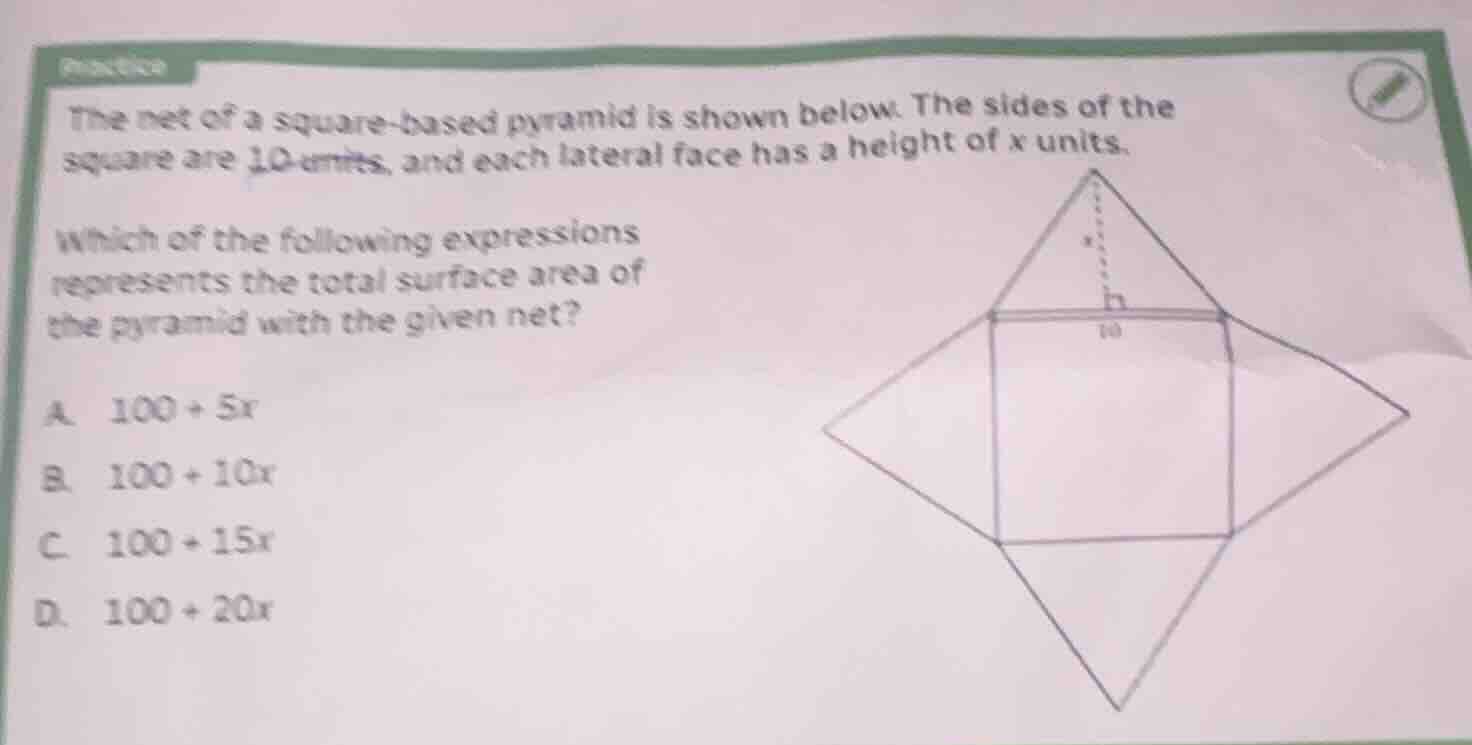
the net of a square - based pyramid is shown below. the sides of the square are 10 units, and each lateral face has a height of x units. which of the following expressions represents the total surface area of the pyramid with the given net? a. 100 + 5x b. 100 + 10x c. 100 + 15x d. 100 + 20x
Step1: Calculate area of square base
The base is a square with side 10, so area is \(10\times10 = 100\).
Step2: Calculate area of one lateral face
Each lateral face is a triangle with base 10 and height \(x\). Area of a triangle is \(\frac{1}{2}\times base\times height=\frac{1}{2}\times10\times x = 5x\).
Step3: Calculate total area of lateral faces
There are 4 lateral faces, so total lateral area is \(4\times5x = 20x\)? Wait, no, wait. Wait, no, wait: Wait, no, each lateral face area is \(\frac{1}{2}\times10\times x = 5x\), and there are 4 lateral faces? Wait, no, the net of a square - based pyramid has 4 triangular lateral faces. Wait, but wait, let's re - check. Wait, the square has side 10, so each triangular face has base 10 and height \(x\). The area of one triangle is \(\frac{1}{2}\times10\times x=5x\). There are 4 triangular faces? Wait, no, looking at the net, the square is in the middle, and there are 4 triangles? Wait, no, the net shown: the square is surrounded by 4 triangles? Wait, no, the problem says "each lateral face has a height of \(x\) units". Wait, maybe I made a mistake. Wait, no, let's re - calculate.
Wait, the base area: square with side 10, so \(A_{base}=10\times10 = 100\).
Each lateral face is a triangle. The formula for the area of a triangle is \(A=\frac{1}{2}bh\), where \(b = 10\) (base) and \(h=x\) (height of the lateral face). So area of one lateral face is \(\frac{1}{2}\times10\times x = 5x\).
Now, how many lateral faces does a square - based pyramid have? 4. Wait, but wait, the net: if the base is a square, there are 4 triangular lateral faces. So total lateral surface area is \(4\times5x=20x\)? But that can't be, because the options are \(100 + 5x\), \(100+10x\), \(100 + 15x\), \(100+20x\). Wait, maybe I miscounted the number of lateral faces. Wait, looking at the diagram, maybe there are 4 lateral faces? Wait, no, maybe the net has 4 triangular faces? Wait, no, let's re - read the problem.
Wait, the problem says "the net of a square - based pyramid". A square - based pyramid has a square base and 4 triangular lateral faces. So each triangular face has base 10 and height \(x\). Area of one triangle: \(\frac{1}{2}\times10\times x = 5x\). Four triangles: \(4\times5x=20x\). Then total surface area is base area plus lateral area: \(100 + 20x\)? But wait, that's option D. Wait, but let's check again.
Wait, no, maybe the diagram shows that there are 4 triangular faces? Wait, no, maybe I made a mistake in the number of lateral faces. Wait, no, a square - based pyramid has 4 lateral faces. So base area is \(10\times10 = 100\). Each lateral face area: \(\frac{1}{2}\times10\times x = 5x\). Four lateral faces: \(4\times5x = 20x\). So total surface area is \(100+20x\), which is option D.
Wait, but let's check the options again. The options are:
A. \(100 + 5x\)
B. \(100+10x\)
C. \(100 + 15x\)
D. \(100+20x\)
So according to the calculation, the total surface area is base area (\(100\)) plus the sum of the areas of the 4 lateral faces. Each lateral face has area \(\frac{1}{2}\times10\times x = 5x\), and 4 of them give \(4\times5x=20x\). So total surface area is \(100 + 20x\), which is option D.

Snap & solve any problem in the app
Get step-by-step solutions on Sovi AI
Photo-based solutions with guided steps
Explore more problems and detailed explanations
D. \(100 + 20x\)