QUESTION IMAGE
Question
new industry and a changing society, 1865–1914
lesson 5 | big business and united workers
review questions
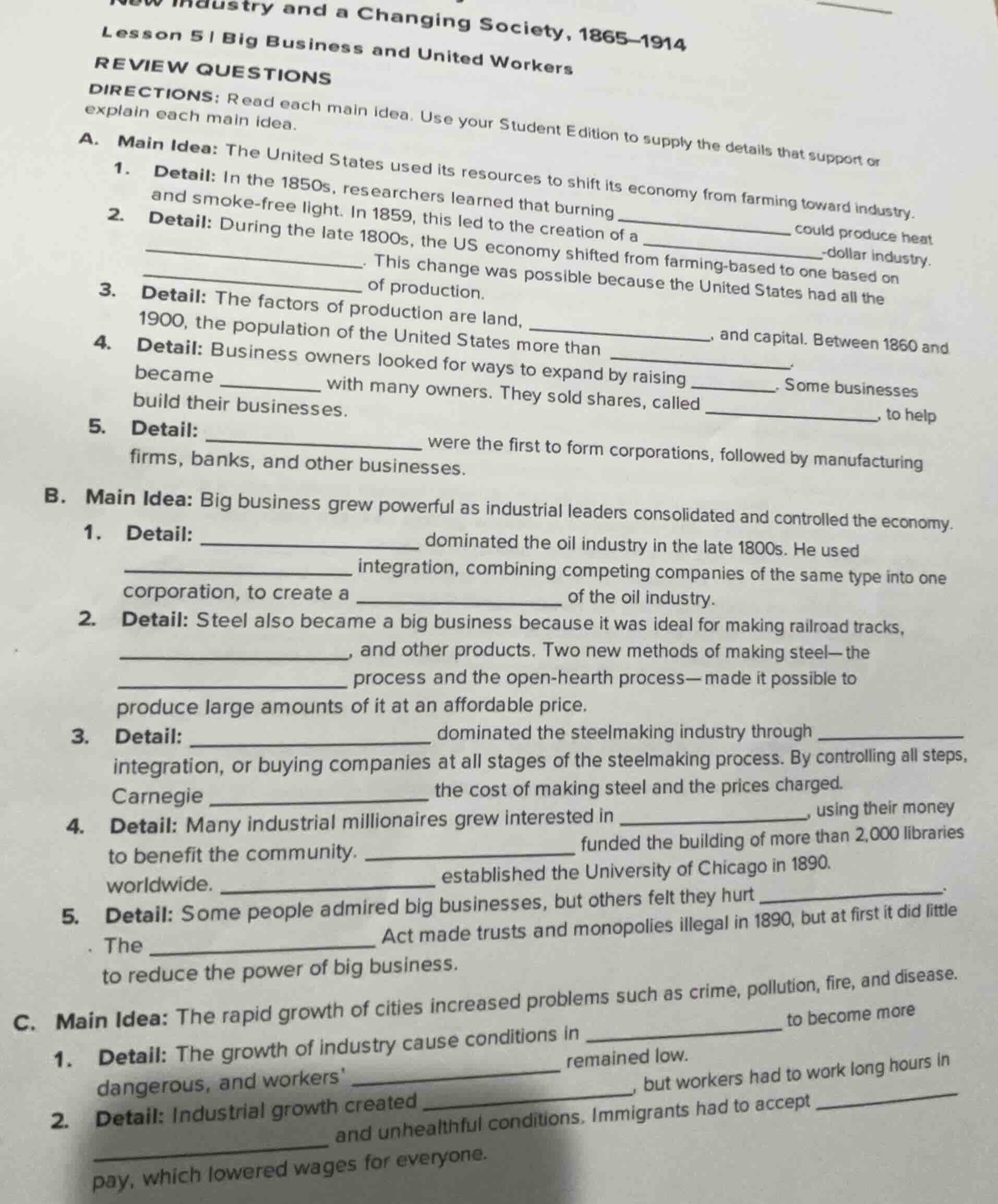
directions: read each main idea. use your student edition to supply the details that support or explain each main idea.
a. main idea: the united states used its resources to shift its economy from farming toward industry.
- detail: in the 1850s, researchers learned that burning ____________ could produce heat and smoke - free light. in 1859, this led to the creation of a ____________ - dollar industry.
- detail: during the late 1800s, the us economy shifted from farming - based to one based on ____________. this change was possible because the united states had all the ____________ of production.
- detail: the factors of production are land, ____________, and capital. between 1860 and 1900, the population of the united states more than ____________.
- detail: business owners looked for ways to expand by raising _______. some businesses became ____ with many owners. they sold shares, called ____________, to help build their businesses.
- detail: ______________ were the first to form corporations, followed by manufacturing firms, banks, and other businesses.
b. main idea: big business grew powerful as industrial leaders consolidated and controlled the economy.
- detail: ____________ dominated the oil industry in the late 1800s. he used __________ integration, combining competing companies of the same type into one corporation, to create a ____________ of the oil industry.
- detail: steel also became a big business because it was ideal for making railroad tracks, ____________, and other products. two new methods of making steel—the ____________ process and the open - hearth process—made it possible to produce large amounts of it at an affordable price.
- detail: ____________ dominated the steelmaking industry through __________ integration, or buying companies at all stages of the steelmaking process. by controlling all steps, carnegie ____________ the cost of making steel and the prices charged.
- detail: many industrial millionaires grew interested in ____________, using their money to benefit the community. __________ funded the building of more than 2,000 libraries worldwide. ____________ established the university of chicago in 1890.
- detail: some people admired big businesses, but others felt they hurt ____________. the ____________ act made trusts and monopolies illegal in 1890, but at first it did little to reduce the power of big business.
c. main idea: the rapid growth of cities increased problems such as crime, pollution, fire, and disease.
- detail: the growth of industry cause conditions in ____________ to become more dangerous, and workers ____________ remained low.
- detail: industrial growth created ____________, but workers had to work long hours in __________ and unhealthful conditions. immigrants had to accept ____________ pay, which lowered wages for everyone.
Response
Part A
- Detail 1
- The 1850s research was about burning oil (specifically, the process related to oil for heat and light), and in 1859, this led to the creation of a billion-dollar industry (the oil industry).
- So the blanks are: oil; billion.
- Detail 2
- During the late 1800s, the US economy shifted from farming - based to one based on industry. This change was possible because the United States had all the factors of production.
- So the blanks are: industry; factors.
- Detail 3
- The factors of production are land, labor, and capital. Between 1860 and 1900, the population of the United States more than doubled.
- So the blanks are: labor; doubled.
- Detail 4
- Business owners looked for ways to expand by raising capital. Some businesses became corporations with many owners. They sold shares, called stocks, to help build their businesses.
- So the blanks are: capital; corporations; stocks.
- Detail 5
- Railroad companies were the first to form corporations, followed by manufacturing firms, banks, and other businesses.
- So the blank is: Railroad companies.
Part B
- Detail 1
- John D. Rockefeller dominated the oil industry in the late 1800s. He used horizontal integration, combining competing companies of the same type into one corporation, to create a monopoly of the oil industry.
- So the blanks are: John D. Rockefeller; horizontal; monopoly.
- Detail 2
- Steel also became a big business because it was ideal for making railroad tracks, bridges, and other products. Two new methods of making steel—the Bessemer process and the open - hearth process—made it possible to produce large amounts of it at an affordable price.
- So the blanks are: bridges; Bessemer.
- Detail 3
- Andrew Carnegie dominated the steelmaking industry through vertical integration, or buying companies at all stages of the steelmaking process. By controlling all steps, Carnegie reduced the cost of making steel and the prices charged.
- So the blanks are: Andrew Carnegie; vertical; reduced.
- Detail 4
- Many industrial millionaires grew interested in philanthropy, using their money to benefit the community. Andrew Carnegie funded the building of more than 2,000 libraries worldwide. John D. Rockefeller established the University of Chicago in 1890.
- So the blanks are: philanthropy; Andrew Carnegie; John D. Rockefeller.
- Detail 5
- Some people admired big businesses, but others felt they hurt consumers. The Sherman Antitrust Act made trusts and monopolies illegal in 1890, but at first it did little to reduce the power of big business.
- So the blanks are: consumers; Sherman Antitrust.
Part C
- Detail 1
- The growth of industry caused conditions in factories to become more dangerous, and workers' wages remained low.
- So the blanks are: factories; wages.
- Detail 2
- Industrial growth created jobs, but workers had to work long hours in crowded and unhealthful conditions. Immigrants had to accept low pay, which lowered wages for everyone.
- So the blanks are: jobs; crowded; low.

Snap & solve any problem in the app
Get step-by-step solutions on Sovi AI
Photo-based solutions with guided steps
Explore more problems and detailed explanations
s (filled blanks)
Part A
- oil; billion
- industry; factors
- labor; doubled
- capital; corporations; stocks
- Railroad companies
Part B
- John D. Rockefeller; horizontal; monopoly
- bridges; Bessemer
- Andrew Carnegie; vertical; reduced
- philanthropy; Andrew Carnegie; John D. Rockefeller
- consumers; Sherman Antitrust
Part C
- factories; wages
- jobs; crowded; low