QUESTION IMAGE
Question
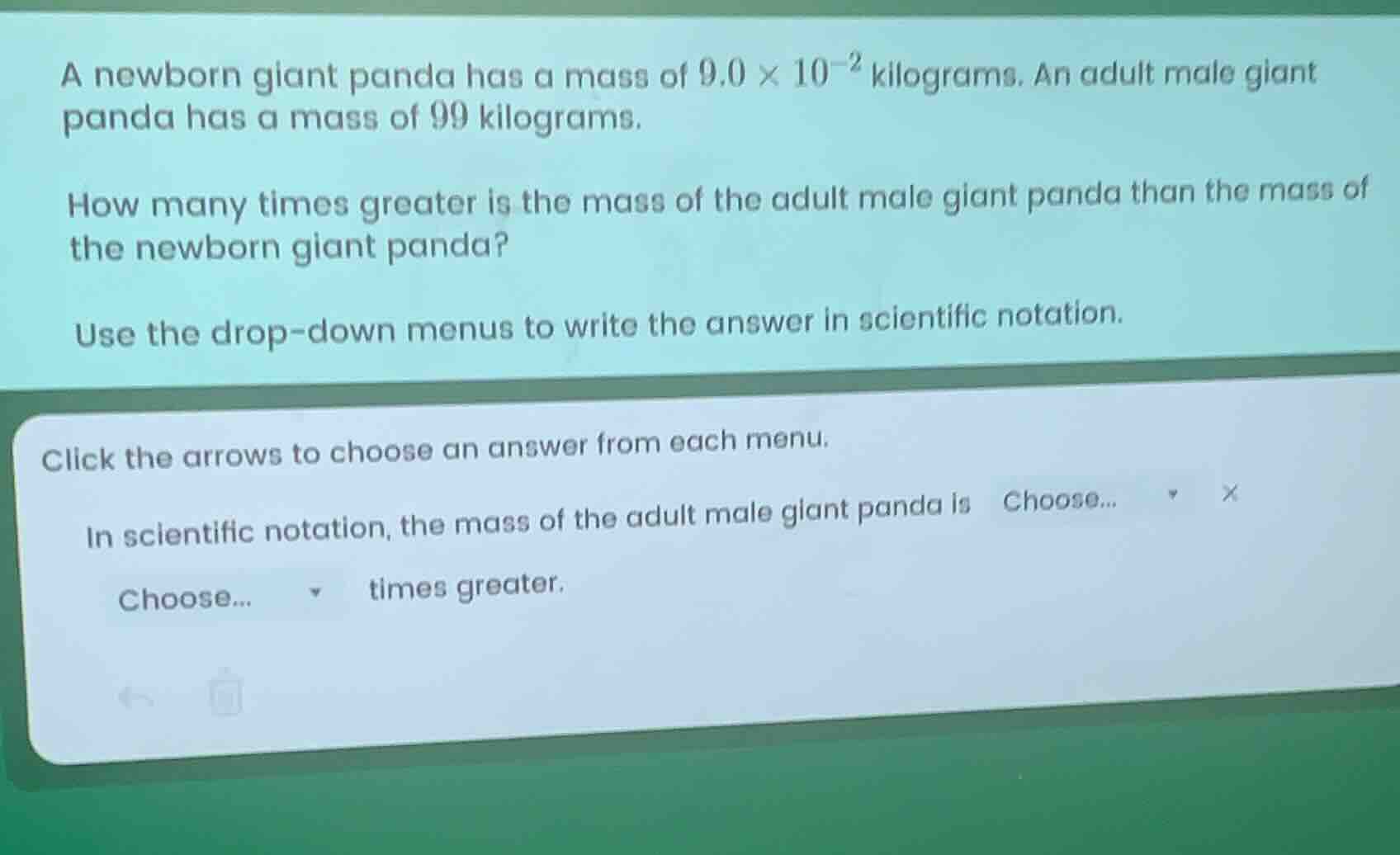
a newborn giant panda has a mass of $9.0 \times 10^{-2}$ kilograms. an adult male giant panda has a mass of 99 kilograms.
how many times greater is the mass of the adult male giant panda than the mass of the newborn giant panda?
use the drop - down menus to write the answer in scientific notation.
click the arrows to choose an answer from each menu.
in scientific notation, the mass of the adult male giant panda is choose... $\times$ choose... times greater.
Step1: Convert 99 to scientific notation
To convert 99 to scientific notation, we can write it as \(9.9\times10^{1}\) (since \(99 = 9.9\times10\) and \(10 = 10^{1}\)).
Step2: Divide the adult mass by the newborn mass
We know the newborn mass is \(9.0\times10^{-2}\) kg and the adult mass (in scientific notation) is \(9.9\times10^{1}\) kg. To find how many times greater the adult mass is, we divide the adult mass by the newborn mass:
\[
\frac{9.9\times10^{1}}{9.0\times10^{-2}}=\frac{9.9}{9.0}\times\frac{10^{1}}{10^{-2}}
\]
First, calculate \(\frac{9.9}{9.0}=1.1\). Then, using the rule of exponents \(\frac{10^{a}}{10^{b}} = 10^{a - b}\), we have \(\frac{10^{1}}{10^{-2}}=10^{1-(-2)}=10^{3}\).
Multiply these two results together: \(1.1\times10^{3}\).

Snap & solve any problem in the app
Get step-by-step solutions on Sovi AI
Photo-based solutions with guided steps
Explore more problems and detailed explanations
In scientific notation, the mass of the adult male giant panda is \(1.1\) \(\times\) \(10^{3}\) times greater.