QUESTION IMAGE
Question
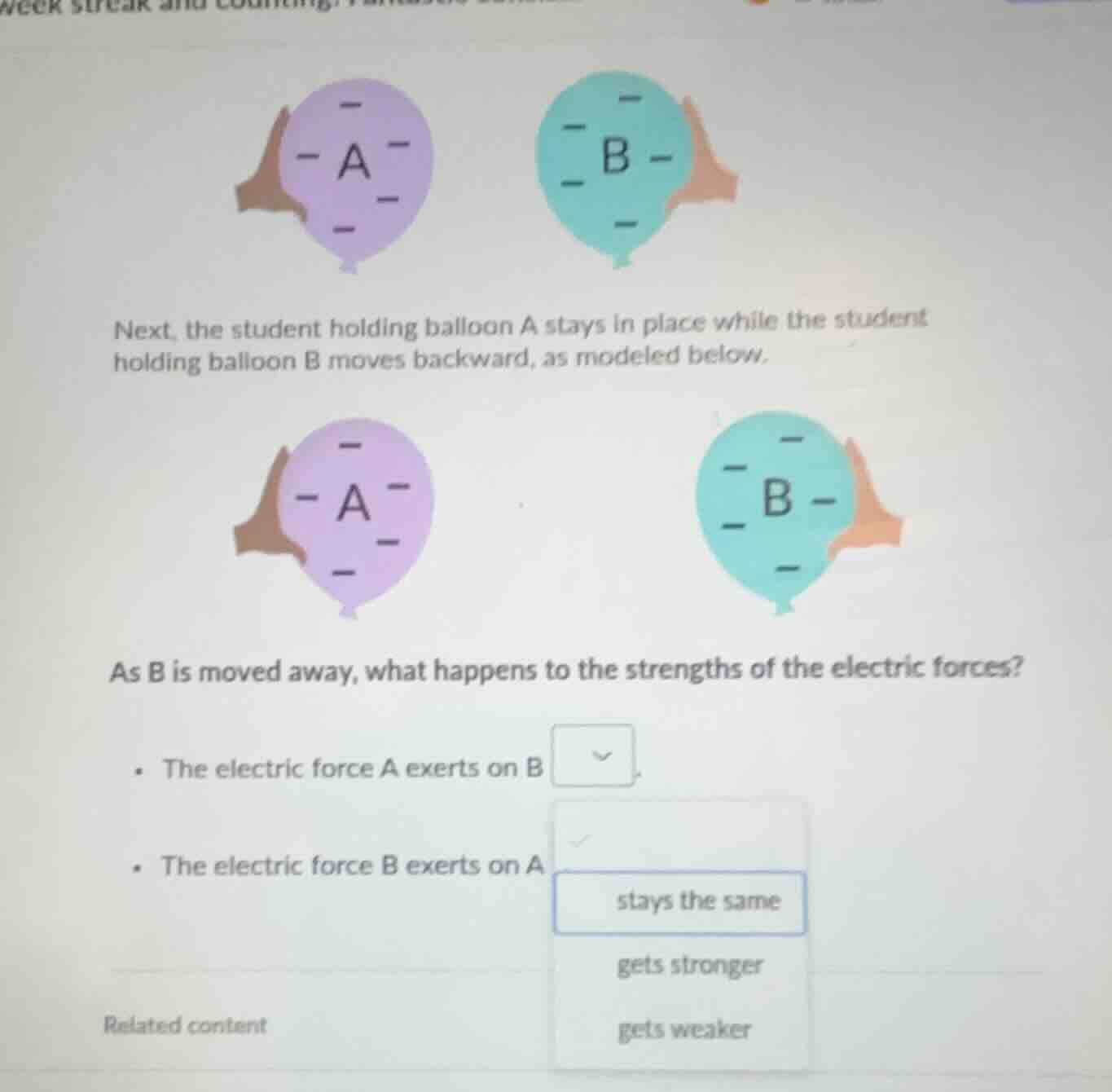
next, the student holding balloon a stays in place while the student holding balloon b moves backward, as modeled below.
as b is moved away, what happens to the strengths of the electric forces?
- the electric force a exerts on b
- the electric force b exerts on a
options: stays the same, gets stronger, gets weaker
Brief Explanations
- First, recall Coulomb's Law: The magnitude of the electric force between two charged objects is given by \( F = k\frac{|q_1q_2|}{r^2} \), where \( k \) is Coulomb's constant, \( q_1 \) and \( q_2 \) are the charges of the two objects, and \( r \) is the distance between them.
- Both balloons A and B have negative charges (as indicated by the negative signs on them), so they repel each other.
- When balloon B is moved away from A, the distance \( r \) between them increases.
- From Coulomb's Law, since \( F \) is inversely proportional to \( r^2 \) (when charges are constant), as \( r \) increases, the magnitude of the electric force decreases.
- Also, by Newton's third law, the force that A exerts on B is equal in magnitude and opposite in direction to the force that B exerts on A. So both forces will change in the same way.
For the first dropdown (The electric force A exerts on B) and the second dropdown (The electric force B exerts on A), as the distance between A and B increases, the electric force gets weaker.

Snap & solve any problem in the app
Get step-by-step solutions on Sovi AI
Photo-based solutions with guided steps
Explore more problems and detailed explanations
- The electric force A exerts on B: gets weaker
- The electric force B exerts on A: gets weaker