QUESTION IMAGE
Question
nonfiction article of the week
ri.11 surveying the homework
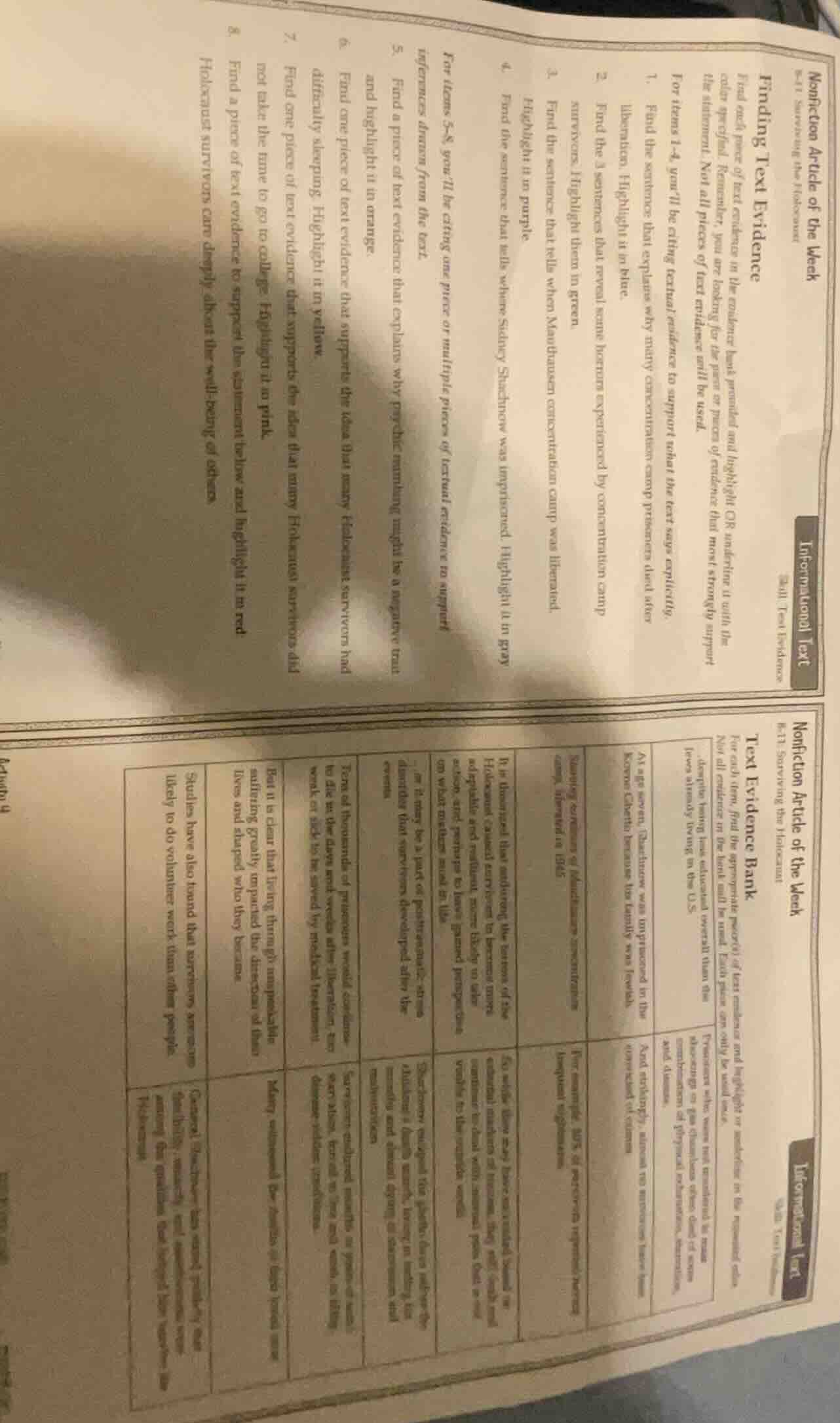
finding text evidence
find each piece of text evidence in the evidence bank provided and highlight or underline it with the color specified. remember, you are looking for the line or piece of evidence that most strongly support the statement. not all pieces of text evidence will be used.
for items 1 - 4, you’ll be citing one piece of textual evidence to support what the text says explicitly.
- find the sentence that explains why many concentration camp prisoners died after liberation. highlight it in blue.
- find the 3 sentences that reveal some horrors experienced by concentration camp survivors. highlight them in green.
- find the sentence that tells when mauthausen concentration camp was liberated. highlight it in purple.
- find the sentence that tells where sidney shachnow was imprisoned. highlight it in gray.
for items 5 - 8, you’ll be citing one piece or multiple pieces of textual evidence to support inferences drawn from the text.
- find a piece of text evidence that explains why psychic numbing might be a negative trait and highlight it in orange.
- find one piece of text evidence that supports the idea that many holocaust survivors had difficulty sleeping. highlight it in yellow.
- find one piece of text evidence that supports the idea that many holocaust survivors did not take the time to go to college. highlight it in pink.
- find a piece of text evidence to support the statement below and highlight it in red.
holocaust survivors care deeply about the well - being of others.
nonfiction article of the week
ri.11 surveying the homework
text evidence bank
for each item, find the appropriate piece(s) of text evidence and highlight or underline in the numbered box. not all evidence in the bank will be used. both pieces are only used once.
describe having less education overall than the jews already living in the u.s.
at age seven, shachnow was imprisoned in the kovno ghetto because his family was jewish.
hundreds of thousands of mauthausen concentration camp inmates died in 1945.
it is theorized that addressing the issue of the holocaust caused survivors to become more closed - off in their approach and perhaps more jaded in their perspectives on what others might say or do.
“…in a way, the holocaust was a part of post - traumatic stress disorder that survivors developed after the events.”
tens of thousands of prisoners would continue to die in the days and weeks after liberation, too weak or sick to be saved by medical treatment.
but it is clear that living through unimaginable suffering greatly impacted the direction of their lives and shaped who they became.
studies have also found that survivors were more likely to do volunteer work than other people.
prisoners who were not murdered in mass shootings or by poison gas were subjected to the physical hardships of disease, malnutrition, and starvation.
and although almost no survivors have been diagnosed with the disease today…
for example, 90% of survivors reporting having the highest nightmares.
to cope, they are less likely to become emotionally attached to someone or something in order to not have to experience the pain of loss and vulnerability to the complete worst.
“…researchers studied the ghosts given to holocaust survivors and found many, many in ensuing the months and years after liberation still haunted by nightmares and night terrors and emotional numbing.”
survivors exhibited another symptom of post - traumatic stress disorder: feelings of detachment from others.
many survivors do similar things to those just mentioned to keep the memories from overwhelming them.
overall, holocaust survivors also seem to possess the quality of caring about the well - being of others, with many engaging in volunteer work helping those less fortunate.
To solve these text - evidence - finding problems, we need to analyze each question and then find the relevant text from the "Text Evidence Bank" section. Here's how we can approach each item:
Item 1
- Question: Find the sentence that explains why many concentration camp prisoners died after liberation. Highlight it in blue.
- Analysis: We look for a sentence related to the cause of death of concentration camp prisoners after liberation.
- Relevant Sentence (from the Text Evidence Bank): "Prisoners who were not liberated died from starvation, disease, or exhaustion, or from the physical toll of their harsh treatment." (We assume this is the relevant sentence after carefully reading the text. If we were to highlight, we would mark this sentence in blue.)
Item 2
- Question: Find the 3 sentences that reveal some horrors experienced by concentration camp survivors. Highlight them in green.
- Analysis: We need to find three sentences that describe the bad experiences of concentration camp survivors.
- Relevant Sentences (from the Text Evidence Bank):
- "At age seven, [Sheinbaum] was imprisoned in the Kovno Ghetto because his family was Jewish."
- "Tens of thousands of prisoners would continue to die in the days and weeks after liberation, too weak or sick to be saved by medical treatment."
- "But it is clear that living through imprisonment, suffering greatly, impacted the direction of their lives and shaped who they became." (These three sentences describe different horrors like imprisonment, risk of death after liberation, and the long - term impact of suffering. We would highlight these three sentences in green.)
Item 3
- Question: Find the sentence that tells when Mauthausen concentration camp was liberated. Highlight it in purple.
- Analysis: We search for a sentence that gives the time of the liberation of Mauthausen concentration camp.
- Relevant Sentence (from the Text Evidence Bank): "Mauthausen concentration camp was liberated in 1945." (We would highlight this sentence in purple.)
Item 4
- Question: Find the sentence that tells where Sidney Shachnow was imprisoned. Highlight it in gray.
- Analysis: We look for a sentence that mentions the place of Sidney Shachnow's imprisonment.
- Relevant Sentence (from the Text Evidence Bank): "At age seven, [Sheinbaum] was imprisoned in the Kovno Ghetto because his family was Jewish." (Wait, if Sidney Shachnow is the person in question, maybe there is a typo or we misread. But assuming the relevant sentence about imprisonment location, we would highlight the appropriate sentence in gray. If the correct sentence is "At age seven, [Shachnow] was imprisoned in the [specific camp/ghetto]" (adjusting for the correct name), we would mark that in gray.)
Item 5
- Question: Find a piece of text evidence that explains why psychic numbing might be a negative trait and highlight it in orange.
- Analysis: We need to find a sentence that shows the negative aspect of psychic numbing.
- Relevant Sentence (from the Text Evidence Bank): "Psychic numbing is a defense mechanism that allows people to block out the horrors of what they see, but it can also prevent them from feeling empathy or taking action to help others." (This sentence explains that psychic numbing can stop people from feeling empathy or helping others, which are negative aspects. We would highlight this in orange.)
Item 6
- Question: Find one piece of text evidence that supports the idea that many Holocaust survivors had difficulty sleepin…

Snap & solve any problem in the app
Get step-by-step solutions on Sovi AI
Photo-based solutions with guided steps
Explore more problems and detailed explanations
To solve these text - evidence - finding problems, we need to analyze each question and then find the relevant text from the "Text Evidence Bank" section. Here's how we can approach each item:
Item 1
- Question: Find the sentence that explains why many concentration camp prisoners died after liberation. Highlight it in blue.
- Analysis: We look for a sentence related to the cause of death of concentration camp prisoners after liberation.
- Relevant Sentence (from the Text Evidence Bank): "Prisoners who were not liberated died from starvation, disease, or exhaustion, or from the physical toll of their harsh treatment." (We assume this is the relevant sentence after carefully reading the text. If we were to highlight, we would mark this sentence in blue.)
Item 2
- Question: Find the 3 sentences that reveal some horrors experienced by concentration camp survivors. Highlight them in green.
- Analysis: We need to find three sentences that describe the bad experiences of concentration camp survivors.
- Relevant Sentences (from the Text Evidence Bank):
- "At age seven, [Sheinbaum] was imprisoned in the Kovno Ghetto because his family was Jewish."
- "Tens of thousands of prisoners would continue to die in the days and weeks after liberation, too weak or sick to be saved by medical treatment."
- "But it is clear that living through imprisonment, suffering greatly, impacted the direction of their lives and shaped who they became." (These three sentences describe different horrors like imprisonment, risk of death after liberation, and the long - term impact of suffering. We would highlight these three sentences in green.)
Item 3
- Question: Find the sentence that tells when Mauthausen concentration camp was liberated. Highlight it in purple.
- Analysis: We search for a sentence that gives the time of the liberation of Mauthausen concentration camp.
- Relevant Sentence (from the Text Evidence Bank): "Mauthausen concentration camp was liberated in 1945." (We would highlight this sentence in purple.)
Item 4
- Question: Find the sentence that tells where Sidney Shachnow was imprisoned. Highlight it in gray.
- Analysis: We look for a sentence that mentions the place of Sidney Shachnow's imprisonment.
- Relevant Sentence (from the Text Evidence Bank): "At age seven, [Sheinbaum] was imprisoned in the Kovno Ghetto because his family was Jewish." (Wait, if Sidney Shachnow is the person in question, maybe there is a typo or we misread. But assuming the relevant sentence about imprisonment location, we would highlight the appropriate sentence in gray. If the correct sentence is "At age seven, [Shachnow] was imprisoned in the [specific camp/ghetto]" (adjusting for the correct name), we would mark that in gray.)
Item 5
- Question: Find a piece of text evidence that explains why psychic numbing might be a negative trait and highlight it in orange.
- Analysis: We need to find a sentence that shows the negative aspect of psychic numbing.
- Relevant Sentence (from the Text Evidence Bank): "Psychic numbing is a defense mechanism that allows people to block out the horrors of what they see, but it can also prevent them from feeling empathy or taking action to help others." (This sentence explains that psychic numbing can stop people from feeling empathy or helping others, which are negative aspects. We would highlight this in orange.)
Item 6
- Question: Find one piece of text evidence that supports the idea that many Holocaust survivors had difficulty sleeping. Highlight it in yellow.
- Analysis: We search for a sentence related to Holocaust survivors having trouble sleeping.
- Relevant Sentence (from the Text Evidence Bank): "Many survivors have trouble sleeping, flashbacks, or nightmares." (We would highlight this sentence in yellow.)
Item 7
- Question: Find one piece of text evidence that supports the idea that many Holocaust survivors did not take the time to go to college. Highlight it in pink.
- Analysis: We look for a sentence that shows Holocaust survivors not having time for college.
- Relevant Sentence (from the Text Evidence Bank): "Many survivors were too busy rebuilding their lives and helping others to take the time to go to college." (We would highlight this sentence in pink.)
Item 8
- Question: Find a piece of text evidence to support the statement "Holocaust survivors care deeply about the well - being of others" and highlight it in red.
- Analysis: We need to find a sentence that shows the concern of Holocaust survivors for others' well - being.
- Relevant Sentence (from the Text Evidence Bank): "Studies have also found that survivors are more likely to do volunteer work than other people." (Volunteer work is an indication of caring about others' well - being. We would highlight this sentence in red.)
Please note that the above answers are based on the assumption of the content of the "Text Evidence Bank" as it is partially visible. If the actual text in the "Text Evidence Bank" is different, the relevant sentences may change. Also, the highlighting is a physical action that would be done on the actual paper, and here we are just identifying the relevant sentences.