QUESTION IMAGE
Question
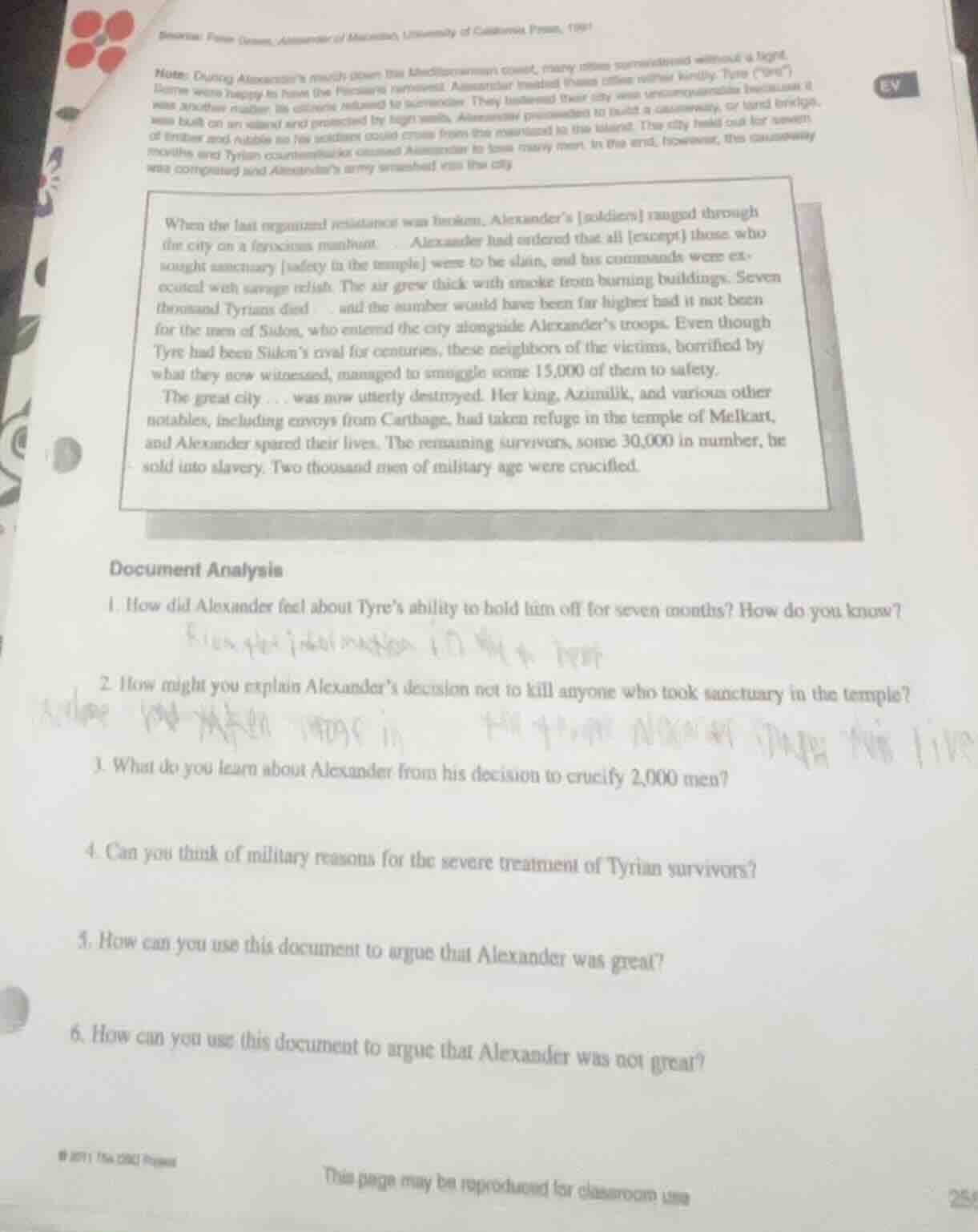
note: during alexander’s march down the mediterranean coast, many cities surrendered without a fight. some were happy to have the persians overthrown. alexander treated these cities rather kindly. tyre (\tire\) was another matter. its citizens refused to surrender. they believed their city was unconquerable because it was built on an island and protected by high walls. alexander proceeded to build a causeway, or land bridge, of timber and rubble so his soldiers could cross from the mainland to the island. the city held out for seven months and tyrian counterattacks caused alexander to lose many men. in the end, however, the causeway was completed and alexander’s army smashed into the city.
when the last organized resistance was broken, alexander’s soldiers ranged through the city on a ferocious rampage. alexander had ordered that all except those who sought sanctuary safety in the temple were to be slain, and his commands were executed with savage relish. the air grew thick with smoke from burning buildings. seven thousand tyrians died—and the number would have been far higher had it not been for the men of sidon, who entered the city alongside alexander’s troops. even though tyre had been sidon’s rival for centuries, these neighbors of the victims, horrified by what they now witnessed, managed to smuggle some 15,000 of them to safety.
the great city... was now utterly destroyed. her king, azimilch, and various other notables, including envoys from carthage, had taken refuge in the temple of melkart, and alexander spared their lives. the remaining survivors, some 30,000 in number, were sold into slavery. two thousand men of military age were crucified.
document analysis
- how did alexander feel about tyre’s ability to hold him off for seven months? how do you know?
- how might you explain alexander’s decision not to kill anyone who took sanctuary in the temple?
- what do you learn about alexander from his decision to crucify 2,000 men?
- can you think of military reasons for the severe treatment of tyrian survivors?
- how can you use this document to argue that alexander was great?
- how can you use this document to argue that alexander was not great?
To answer these document analysis questions, we analyze the text and use historical context:
Question 1
Alexander likely felt angry/frustrated. We know this because after Tyre held him off for seven months, his soldiers' rampage was "ferocious" and he ordered most to be slain, showing his rage at the resistance.
Temples were sacred in ancient times. Alexander may have respected religious customs, or wanted to show mercy in a limited way to gain favor with the gods or appear just, so he spared those in the temple.
Crucifying 2,000 men shows Alexander was ruthless and willing to use extreme, brutal punishment to assert control, instill fear, and take revenge for the resistance, demonstrating his harsh and merciless side.

Snap & solve any problem in the app
Get step-by-step solutions on Sovi AI
Photo-based solutions with guided steps
Explore more problems and detailed explanations
Alexander felt angry/frustrated. We know this from his soldiers’ ferocious rampage and his order to slay most Tyrians after the seven - month resistance, indicating his rage over the prolonged hold - off.