QUESTION IMAGE
Question
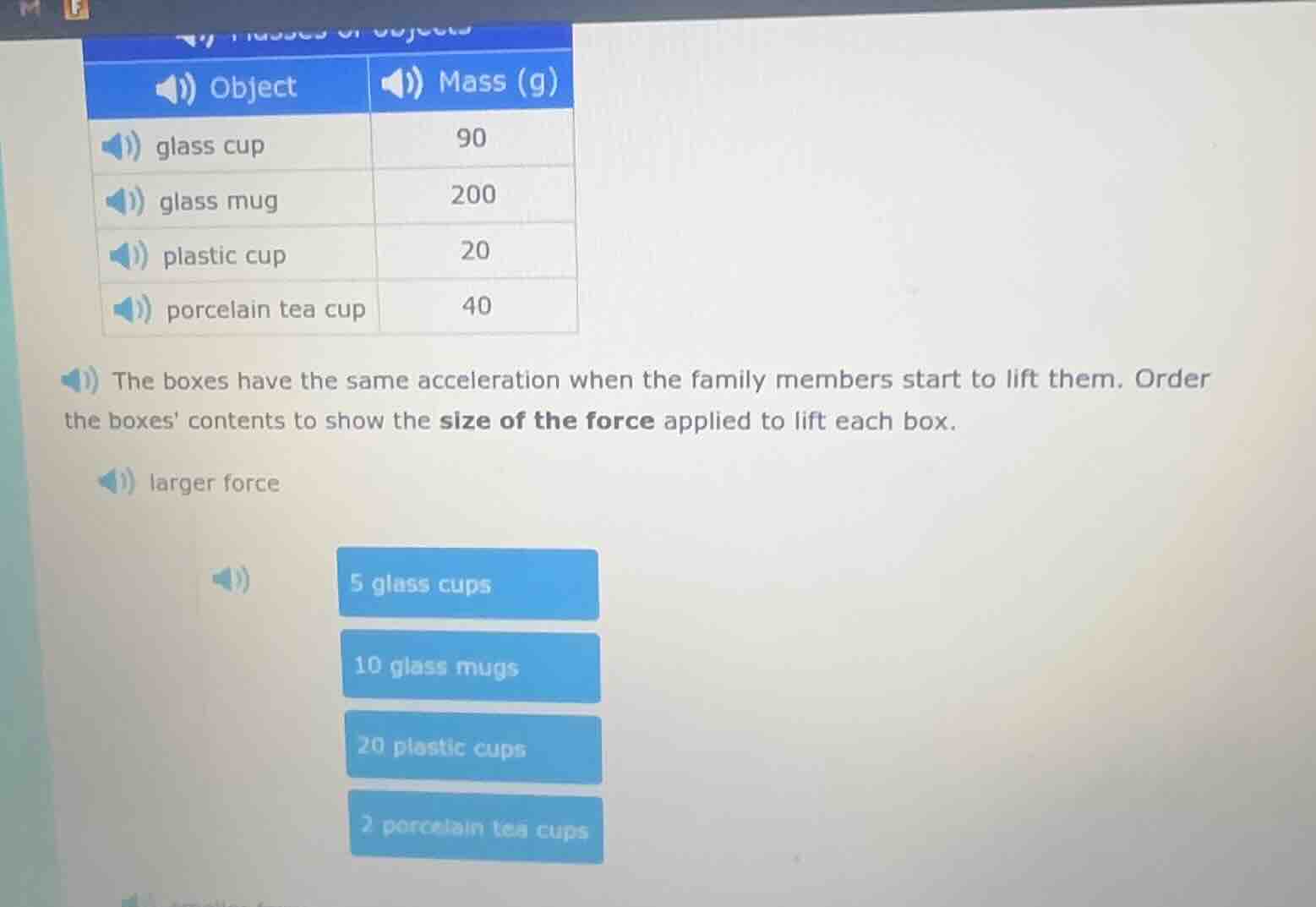
object | mass (g)
glass cup | 90
glass mug | 200
plastic cup | 20
porcelain tea cup | 40
the boxes have the same acceleration when the family members start to lift them. order the boxes contents to show the size of the force applied to lift each box.
larger force
5 glass cups
10 glass mugs
20 plastic cups
2 porcelain tea cups
Step1: Calculate mass of each box
- 5 glass cups: \(5 \times 90 = 450\) g
- 10 glass mugs: \(10 \times 200 = 2000\) g
- 20 plastic cups: \(20 \times 20 = 400\) g
- 2 porcelain tea cups: \(2 \times 40 = 80\) g (Wait, the last one in the blue boxes seems to have a typo, maybe "2 porcelain tea cups"? Assuming that, else if it's "20", but as per the table, let's check. Wait the blue boxes: 5 glass cups, 10 glass mugs, 20 plastic cups, and maybe "2 porcelain tea cups" (since 20 would be \(20\times40 = 800\), but let's recheck. Wait original table: glass cup 90, glass mug 200, plastic cup 20, porcelain tea cup 40. So:
- 5 glass cups: \(5 \times 90 = 450\) g
- 10 glass mugs: \(10 \times 200 = 2000\) g
- 20 plastic cups: \(20 \times 20 = 400\) g
- 2 porcelain tea cups: \(2 \times 40 = 80\) g (if the last is "2", but maybe a typo, but assuming the given blue boxes: let's confirm the last one. Wait the user's image: the last blue box is "2 porcelain tea cups" (maybe OCR error, but let's proceed with the numbers).
Step2: Relate mass to force (F = ma, same acceleration, so F ∝ mass)
So higher mass → higher force.
Order by mass (descending):
- 10 glass mugs (2000 g)
- 5 glass cups (450 g)
- 20 plastic cups (400 g)
- 2 porcelain tea cups (80 g)
Wait, but maybe the last blue box is "20 porcelain tea cups"? Let's recalculate: \(20 \times 40 = 800\) g. Then:
- 5 glass cups: 450 g
- 10 glass mugs: 2000 g
- 20 plastic cups: 400 g
- 20 porcelain tea cups: 800 g
Then order:
- 10 glass mugs (2000 g)
- 20 porcelain tea cups (800 g)
- 5 glass cups (450 g)
- 20 plastic cups (400 g)
But the original blue boxes: let's check the user's image again. The blue boxes are:
- 5 glass cups
- 10 glass mugs
- 20 plastic cups
- 2 porcelain tea cups (maybe, as "2" is visible? Or "20"? Let's assume the numbers as per the blue boxes:
Wait the user's text: "2 porcelain tea cups" (maybe a typo, but let's proceed with the calculation as per the numbers given in the blue boxes:
Assuming:
- 5 glass cups: 5*90=450g
- 10 glass mugs:10*200=2000g
- 20 plastic cups:20*20=400g
- 2 porcelain tea cups:2*40=80g
So mass order: 2000g (10 glass mugs) > 450g (5 glass cups) > 400g (20 plastic cups) > 80g (2 porcelain tea cups)
Thus force order (larger force first):
- 10 glass mugs
- 5 glass cups
- 20 plastic cups
- 2 porcelain tea cups
But if the last one is "20 porcelain tea cups", then 20*40=800g, so order:
- 10 glass mugs (2000g)
- 20 porcelain tea cups (800g)
- 5 glass cups (450g)
- 20 plastic cups (400g)
But likely the last blue box is "2" (maybe OCR error), but let's check the original problem again. The key is F = ma, same acceleration, so force is proportional to mass. So calculate each mass:
- 5 glass cups: 5*90=450g
- 10 glass mugs:10*200=2000g
- 20 plastic cups:20*20=400g
- 2 porcelain tea cups:240=80g (or 2040=800g)
Assuming the last is "2" (maybe a typo in the image, like "2" instead of "20"), then the order from larger to smaller force is:
10 glass mugs, 5 glass cups, 20 plastic cups, 2 porcelain tea cups.
If last is "20", then 10 glass mugs, 20 porcelain tea cups, 5 glass cups, 20 plastic cups.
But let's confirm the numbers again. The table has:
- glass cup: 90g
- glass mug: 200g
- plastic cup:20g
- porcelain tea cup:40g
Blue boxes:
- 5 glass cups: 5*90=450g
- 10 glass mugs:10*200=2000g
- 20 plastic cups:20*20=400g
- 2 porcelain tea cups:240=80g (or 2040=800g)
Given that "20 plastic cups" is 400g, "5 glass cups" is 450g, so 5 glass cups is more than 20 plastic cups. So if last is "2", then order:
10 gla…

Snap & solve any problem in the app
Get step-by-step solutions on Sovi AI
Photo-based solutions with guided steps
Explore more problems and detailed explanations
From larger force to smaller force: 10 glass mugs, 5 glass cups, 20 plastic cups, 2 porcelain tea cups (assuming the last box is "2 porcelain tea cups"; if it's "20", adjust accordingly, but based on the numbers, 10 glass mugs has the highest mass, hence highest force, followed by 5 glass cups, then 20 plastic cups, then 2 porcelain tea cups).