QUESTION IMAGE
Question
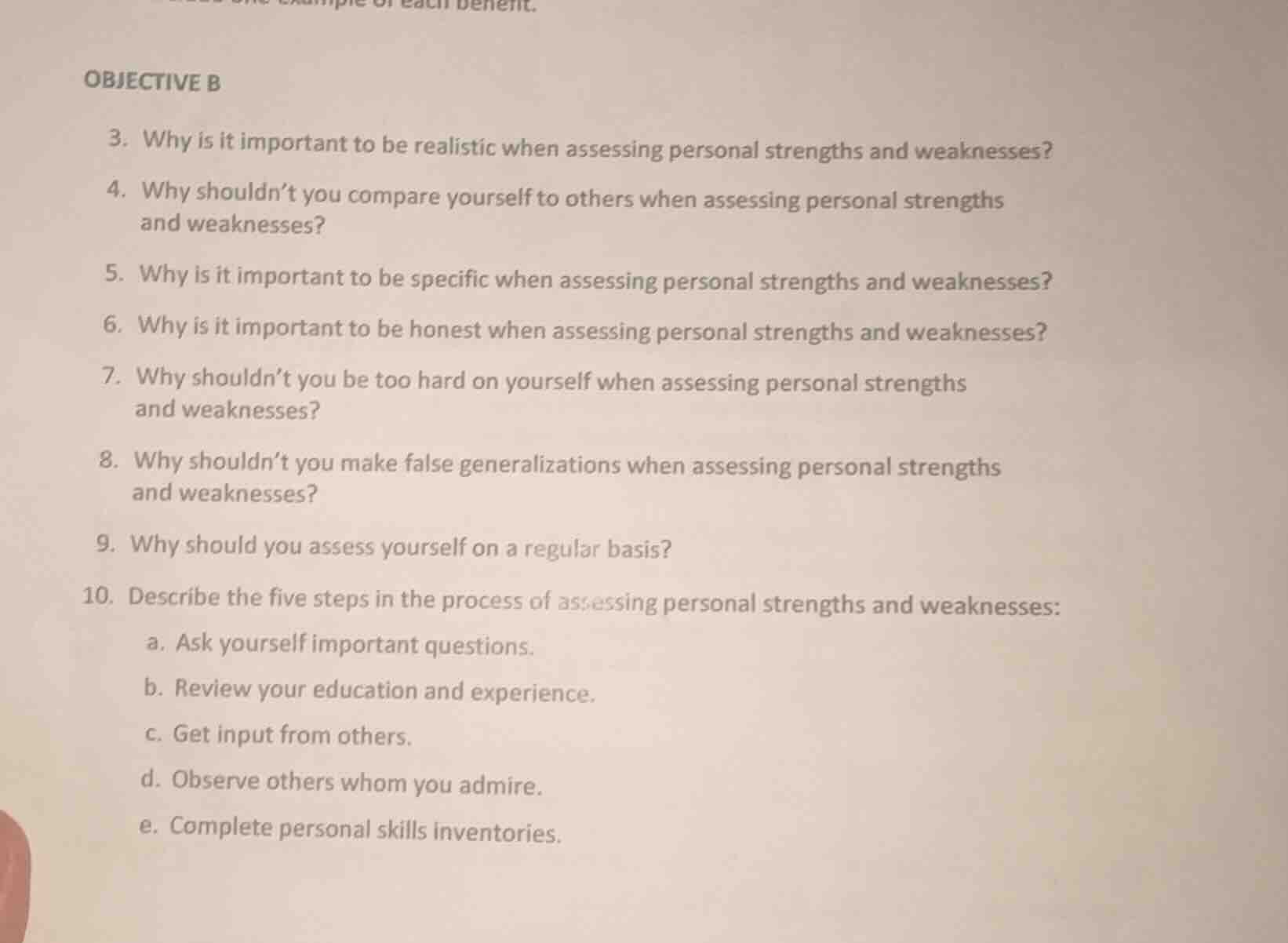
objective b
- why is it important to be realistic when assessing personal strengths and weaknesses?
- why shouldn’t you compare yourself to others when assessing personal strengths and weaknesses?
- why is it important to be specific when assessing personal strengths and weaknesses?
- why is it important to be honest when assessing personal strengths and weaknesses?
- why shouldn’t you be too hard on yourself when assessing personal strengths and weaknesses?
- why shouldn’t you make false generalizations when assessing personal strengths and weaknesses?
- why should you assess yourself on a regular basis?
- describe the five steps in the process of assessing personal strengths and weaknesses:
a. ask yourself important questions.
b. review your education and experience.
c. get input from others.
d. observe others whom you admire.
e. complete personal skills inventories.
- Realistic assessments set achievable growth goals and prevent misaligned expectations.
- Others have unique circumstances, so comparisons skew self-perception unfairly.
- Specificity lets you target exact areas for improvement or leverage.
- Honesty ensures you address actual gaps and build on true strengths.
- Over-criticism lowers motivation and distorts accurate self-view.
- False generalizations lead to incorrect self-judgments and poor goal-setting.
- Regular assessment tracks progress and adapts to changing needs.
- The steps structure self-evaluation to gather comprehensive, accurate self-data:
a. Guides focused reflection on core self-attributes.
b. Grounds assessment in tangible past experiences.
c. Adds external perspective to reduce bias.
d. Identifies transferable strengths from role models.
e. Uses structured tools for objective skill measurement.

Snap & solve any problem in the app
Get step-by-step solutions on Sovi AI
Photo-based solutions with guided steps
Explore more problems and detailed explanations
- Realistic assessments create achievable, relevant goals and avoid setting yourself up for failure or overestimating your abilities, ensuring your growth plan is grounded in what you can actually accomplish.
- Everyone has different backgrounds, resources, and life circumstances, so comparing yourself to others ignores your unique journey and leads to inaccurate, unfair self-judgment that doesn't reflect your true strengths or weaknesses.
- Specificity allows you to target exact skills or traits to improve or leverage, rather than vague labels. For example, saying "I struggle with public speaking" instead of "I'm bad at communication" lets you focus on a clear, actionable area.
- Honest assessments ensure you address genuine areas for growth and recognize authentic strengths. Dishonesty leads to unaddressed weaknesses and overconfidence or underconfidence that harms personal and professional development.
- Being too hard on yourself erodes self-esteem and motivation, making it harder to work on weaknesses. It also distorts your self-view, making you overlook valuable strengths you could use to grow.
- False generalizations (like "I'm bad at all math" after one tough test) lead to inaccurate self-perceptions, which can make you avoid areas where you could improve or ignore skills you actually possess.
- Regular self-assessment lets you track progress over time, adjust your growth goals as you develop, and identify new strengths or weaknesses that emerge as you take on new experiences.
- The five steps are:
a. Ask yourself important questions: Direct your reflection to core areas of your skills, values, and experiences.
b. Review your education and experience: Draw on past achievements and challenges to identify consistent strengths and gaps.
c. Get input from others: Gain an external perspective to reduce personal bias and uncover blind spots in your self-view.
d. Observe others whom you admire: Identify strengths in role models that you can develop or recognize similar strengths in yourself.
e. Complete personal skills inventories: Use structured, objective tools to measure your skills and traits systematically.