QUESTION IMAGE
Question
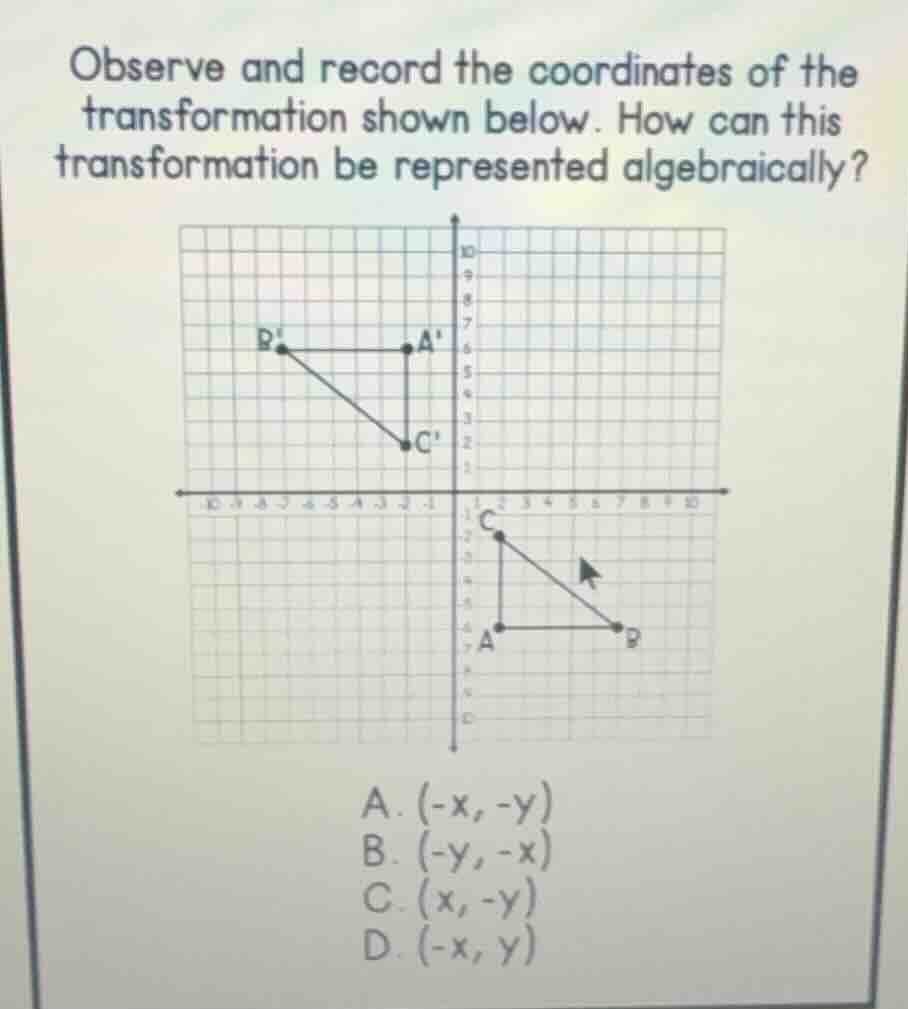
observe and record the coordinates of the transformation shown below. how can this transformation be represented algebraically?
a. $(-x, -y)$
b. $(-y, -x)$
c. $(x, -y)$
d. $(-x, y)$
Step1: Identify original coordinates
Original points: $A(2,-5)$, $B(6,-5)$, $C(2,-2)$
Step2: Identify transformed coordinates
Transformed points: $A'(-2,6)$, $B'(-6,6)$, $C'(-2,3)$
Step3: Test option A on $A$
Apply $(-x,-y)$: $(-2, 5)$ ≠ $A'(-2,6)$ → Invalid
Step4: Test option B on $A$
Apply $(-y,-x)$: $(-(-5), -2)=(5,-2)$ ≠ $A'(-2,6)$ → Invalid
Step5: Test option C on $A$
Apply $(x,-y)$: $(2,5)$ ≠ $A'(-2,6)$ → Invalid
Step6: Test option D on $A$
Apply $(-x,y)$: $(-2,-(-5))=(-2,6)=A'$
Step7: Verify option D on $B$
Apply $(-x,y)$: $(-6,-(-5))=(-6,6)=B'$
Step8: Verify option D on $C$
Apply $(-x,y)$: $(-2,-(-2))=(-2,2)=C'$

Snap & solve any problem in the app
Get step-by-step solutions on Sovi AI
Photo-based solutions with guided steps
Explore more problems and detailed explanations
D. $(-x, y)$