QUESTION IMAGE
Question
olving equations containing natural logarithms
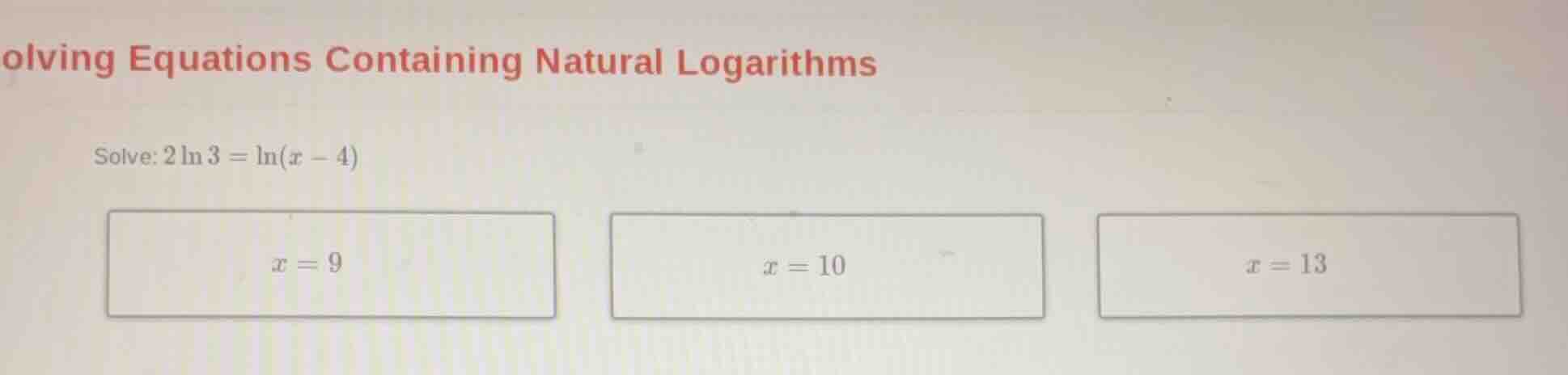
solve: $2\ln 3 = \ln(x - 4)$
$x = 9$ $x = 10$ $x = 13$
Step1: Use logarithm power rule
Recall the logarithm power rule: \( n\ln a=\ln(a^n) \). Apply it to the left - hand side of the equation \( 2\ln3=\ln(x - 4) \). We get \( \ln(3^2)=\ln(x - 4) \), and \( 3^2 = 9 \), so the equation becomes \( \ln9=\ln(x - 4) \).
Step2: Use one - to - one property of logarithms
The natural logarithm function \( y = \ln x \) is one - to - one, which means that if \( \ln a=\ln b \), then \( a = b \) (for \( a>0,b>0 \)). Since \( \ln9=\ln(x - 4) \), we can set \( 9=x - 4 \).
Step3: Solve for x
To solve for \( x \) in the equation \( 9=x - 4 \), we add 4 to both sides of the equation. So \( x=9 + 4=13 \)? Wait, no, wait. Wait, \( 3^2=9 \), then from \( \ln9=\ln(x - 4) \), we have \( 9=x - 4 \), so \( x=9 + 4=13 \)? Wait, no, wait, I made a mistake. Wait, \( 2\ln3=\ln(3^2)=\ln9 \), so \( \ln9=\ln(x - 4) \), so \( x-4 = 9 \), then \( x=9 + 4=13 \)? Wait, but let's check again. Wait, the options are \( x = 9 \), \( x = 10 \), \( x = 13 \). Wait, let's re - do the steps.
Wait, no, wait: \( 2\ln3=\ln(3^2)=\ln9 \), so the equation is \( \ln9=\ln(x - 4) \). Since the natural log function is one - to - one, we can conclude that \( 9=x - 4 \). Then, adding 4 to both sides: \( x=9 + 4=13 \)? Wait, but let's check the answer. Wait, if \( x = 13 \), then \( \ln(x - 4)=\ln(9) \), and \( 2\ln3=\ln(3^2)=\ln9 \), so it works. Wait, but wait, maybe I made a mistake in the first calculation. Wait, let's check the options again. The options are \( x = 9 \), \( x = 10 \), \( x = 13 \).
Wait, another way: Let's substitute the values.
For \( x = 9 \): Left - hand side: \( 2\ln3\approx2\times1.0986 = 2.1972 \). Right - hand side: \( \ln(9 - 4)=\ln(5)\approx1.6094 \). Not equal.
For \( x = 10 \): Right - hand side: \( \ln(10 - 4)=\ln(6)\approx1.7918 \). Not equal to \( 2\ln3\approx2.1972 \).
For \( x = 13 \): Right - hand side: \( \ln(13 - 4)=\ln(9)\approx2.1972 \), which is equal to \( 2\ln3\approx2.1972 \). So the correct answer is \( x = 13 \).
Wait, but in my first step - by - step, I think I messed up the addition. Wait, \( x-4 = 9 \), so \( x=9 + 4 = 13 \), that's correct.

Snap & solve any problem in the app
Get step-by-step solutions on Sovi AI
Photo-based solutions with guided steps
Explore more problems and detailed explanations
\( x = 13 \) (i.e., the option with \( x = 13 \))