QUESTION IMAGE
Question
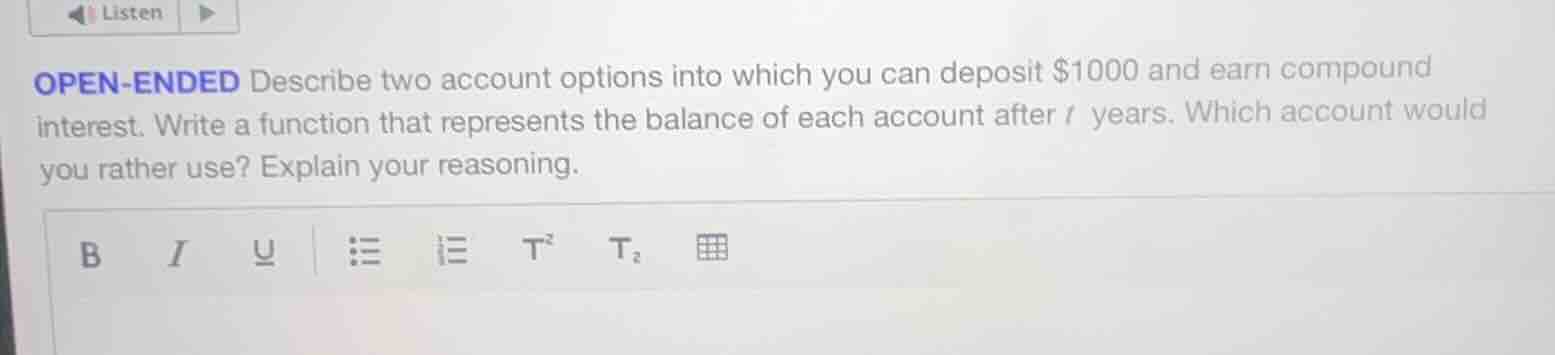
open-ended describe two account options into which you can deposit $1000 and earn compound interest. write a function that represents the balance of each account after t years. which account would you rather use? explain your reasoning.
Brief Explanations
Option 1: Savings Account (Annual Compounding)
- Description: A typical savings account with an annual interest rate, say 3% (0.03), compounded annually. The compound - interest formula for annual compounding is $A = P(1 + r)^t$, where $P$ is the principal amount, $r$ is the annual interest rate (in decimal), and $t$ is the number of years. For a deposit of $P=\$1000$ and $r = 0.03$, the function representing the balance $A_1$ after $t$ years is $A_1=1000(1 + 0.03)^t=1000(1.03)^t$.
Option 2: Certificate of Deposit (CD) with Semi - Annual Compounding
- Description: A CD with an annual interest rate of 3.2% (0.032) compounded semi - annually. The compound - interest formula for compounding $n$ times a year is $A=P(1+\frac{r}{n})^{nt}$. Here, $P = 1000$, $r=0.032$, and $n = 2$ (since it is compounded semi - annually). So the function representing the balance $A_2$ after $t$ years is $A_2 = 1000(1+\frac{0.032}{2})^{2t}=1000(1 + 0.016)^{2t}=1000(1.016)^{2t}$.
Comparison and Choice
- To compare the two accounts, we can look at the growth rate. Let's consider the effective annual rate (EAR) for each account.
- For the savings account (annual compounding), the EAR is equal to the nominal rate, so $EAR_1=0.03$ or 3%.
- For the CD (semi - annual compounding), the formula for EAR is $EAR=(1 +\frac{r}{n})^{n}-1$. Substituting $r = 0.032$ and $n = 2$, we get $EAR_2=(1+\frac{0.032}{2})^{2}-1=(1.016)^{2}-1=1.032256 - 1=0.032256$ or 3.2256%.
- Since the EAR of the CD (3.2256%) is higher than the EAR of the savings account (3%), the CD will give a higher return on the $1000$ deposit over time. So, we would rather use the CD account because it has a higher effective annual interest rate, which means our money will grow at a faster rate over the same period of time.

Snap & solve any problem in the app
Get step-by-step solutions on Sovi AI
Photo-based solutions with guided steps
Explore more problems and detailed explanations
Account 1 (Savings Account - Annual Compounding):
- Function: $A_1 = 1000(1.03)^t$ (where $t$ is in years, principal $P = 1000$, annual interest rate $r=0.03$)
Account 2 (CD - Semi - Annual Compounding):
- Function: $A_2=1000(1.016)^{2t}$ (where $t$ is in years, principal $P = 1000$, annual interest rate $r = 0.032$, compounded semi - annually with $n = 2$)
Preference:
- The CD account (Account 2) is preferred because it has a higher effective annual interest rate (3.2256% vs 3% for the savings account), so the $1000$ deposit will grow at a faster rate over time.