QUESTION IMAGE
Question
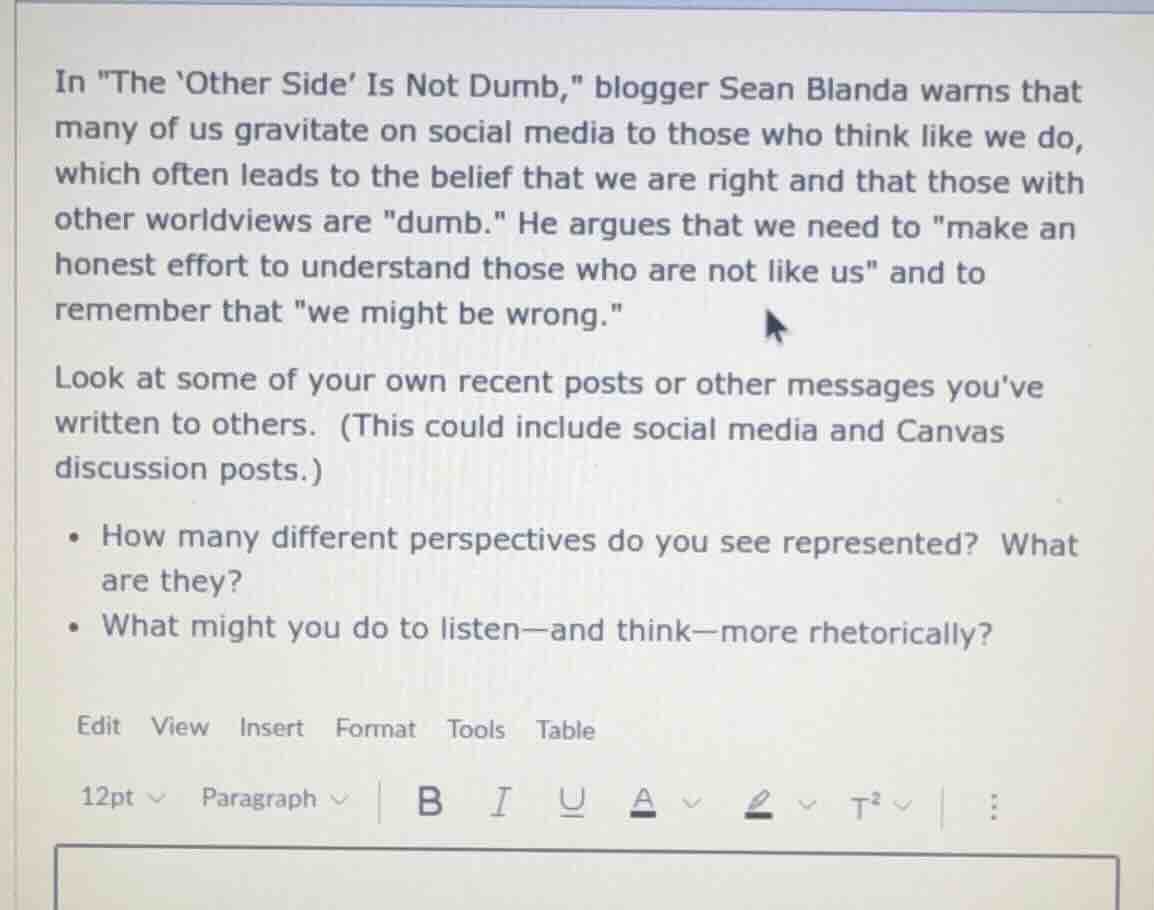
in \the other side is not dumb,\ blogger sean blanda warns that many of us gravitate on social media to those who think like we do, which often leads to the belief that we are right and that those with other worldviews are \dumb.\ he argues that we need to \make an honest effort to understand those who are not like us\ and to remember that \we might be wrong.\ look at some of your own recent posts or other messages youve written to others. (this could include social media and canvas discussion posts.) - how many different perspectives do you see represented? what are they? - what might you do to listen—and think—more rhetorically?
For the first question, this requires reflecting on your own recent posts/messages: identify distinct viewpoints you presented or engaged with, such as personal opinion, factual analysis, or empathetic consideration of others' stances. Count these unique perspectives and describe each clearly.
For the second question, rhetorical listening/thinking involves intentional, open engagement: you can seek out counterarguments to your views, ask clarifying questions to understand others' reasoning instead of debating, and pause to consider the context and motivations behind others' perspectives before responding.

Snap & solve any problem in the app
Get step-by-step solutions on Sovi AI
Photo-based solutions with guided steps
Explore more problems and detailed explanations
- (Example) I see 2 different perspectives represented:
- A critical perspective: I criticized a new local policy by pointing out its potential negative impacts on low-income residents.
- An empathetic perspective: I acknowledged the policy's intended goal of reducing municipal waste when responding to a comment supporting it.
- (Example) To listen and think more rhetorically, I can:
- Actively seek out social media accounts or discussion posts from people with opposing views to my own and read their content without immediately formulating a counterargument.
- When someone disagrees with me in a message, ask follow-up questions like "What experience led you to that view?" to better understand their reasoning instead of defending my stance right away.
- Before posting my own opinion, pause to consider how someone with a different background or belief system might interpret my words, and adjust my tone to be more open to dialogue.