QUESTION IMAGE
Question
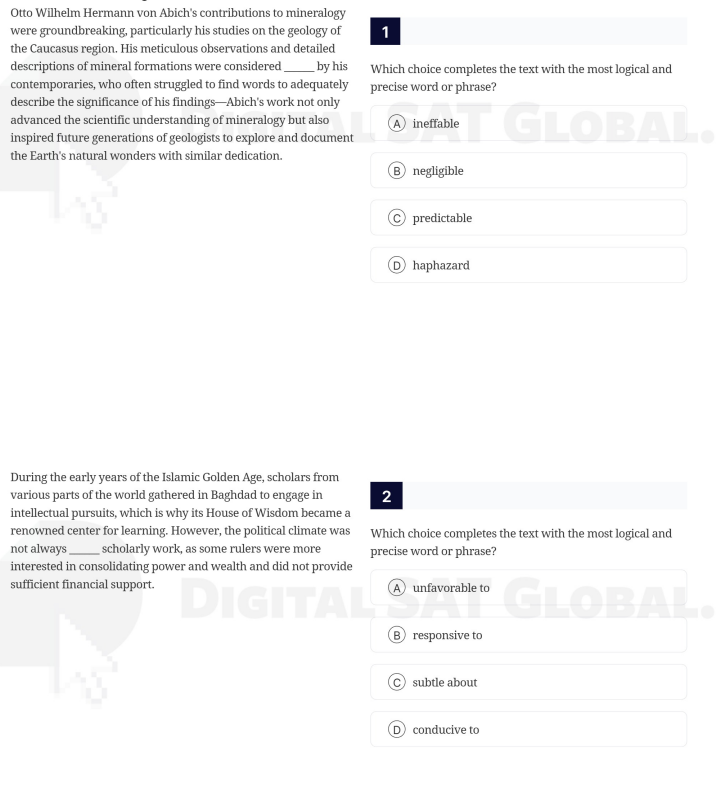
otto wilhelm hermann von abichs contributions to mineralogy were groundbreaking, particularly his studies on the geology of the caucasus region. his meticulous observations and detailed descriptions of mineral formations were considered ____ by his contemporaries, who often struggled to find words to adequately describe the significance of his findings—abich’s work not only advanced the scientific understanding of mineralogy but also inspired future generations of geologists to explore and document the earth’s natural wonders with similar dedication.
1 which choice completes the text with the most logical and precise word or phrase?
a ineffable
b negligible
c predictable
d haphazard
during the early years of the islamic golden age, scholars from various parts of the world gathered in baghdad to engage in intellectual pursuits, which is why its house of wisdom became a renowned center for learning. however, the political climate was not always ____ scholarly work, as some rulers were more interested in consolidating power and wealth and did not provide sufficient financial support.
2 which choice completes the text with the most logical and precise word or phrase?
a unfavorable to
b responsive to
c subtle about
d conducive to
Sub - Question 1
To solve this, we analyze the context. Abich's work was groundbreaking, and his contemporaries struggled to describe its significance. "Ineffable" means indescribable, which fits as they couldn't find words. "Negligible" (unimportant) is wrong, "predictable" (expected) doesn't fit, and "haphazard" (random) is incorrect.
The political climate didn't support scholarly work (rulers didn't provide funds). "Conducive to" means favorable for. "Unfavorable to" is opposite, "responsive to" (reacting to) and "subtle about" (being discreet) don't fit the context of supporting scholarly work.

Snap & solve any problem in the app
Get step-by-step solutions on Sovi AI
Photo-based solutions with guided steps
Explore more problems and detailed explanations
A. ineffable