QUESTION IMAGE
Question
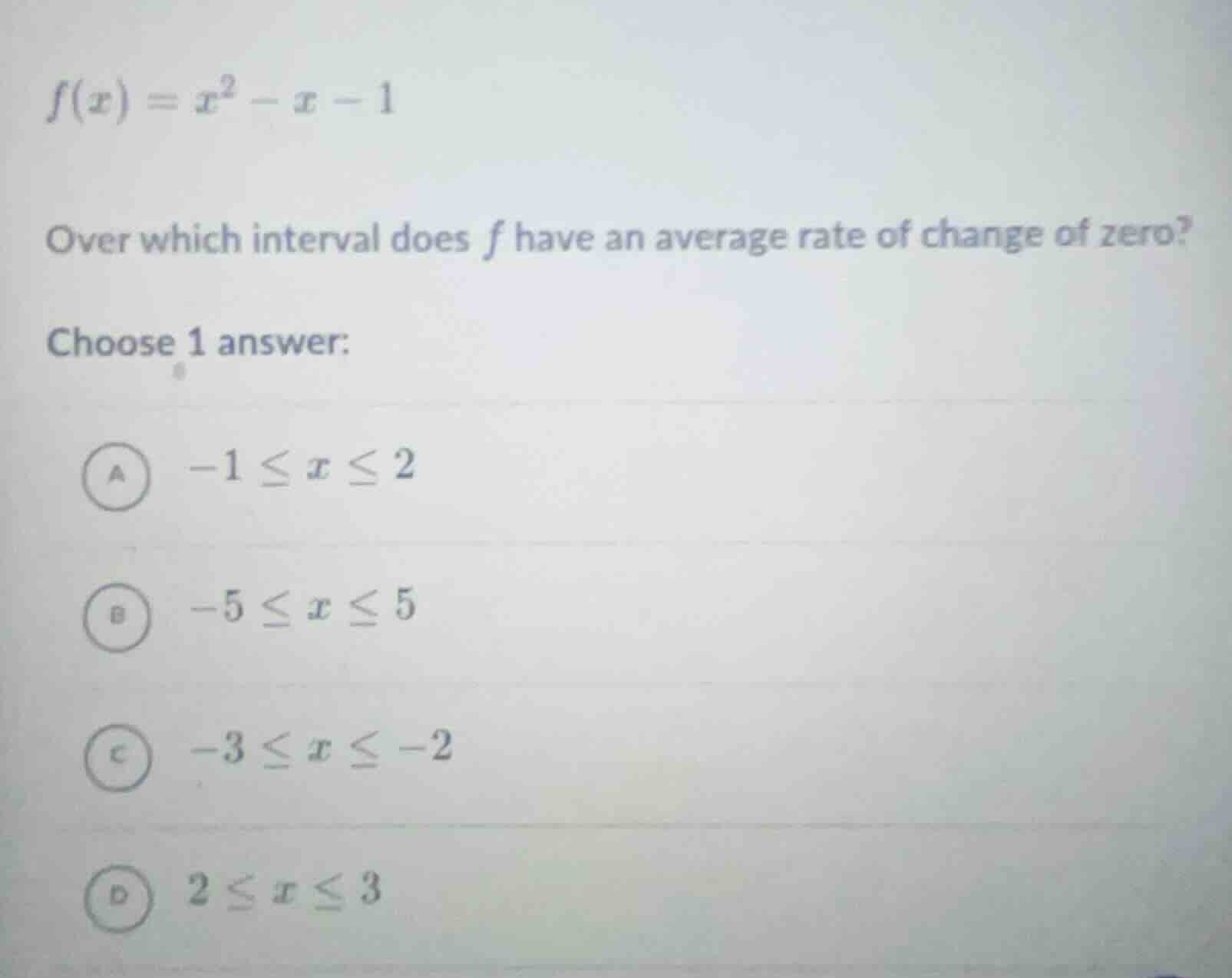
f(x) = x² - x - 1
over which interval does f have an average rate of change of zero?
choose 1 answer:
a -1 ≤ x ≤ 2
b -5 ≤ x ≤ 5
c -3 ≤ x ≤ -2
d 2 ≤ x ≤ 3
Step1: Recall the average rate of change formula
The average rate of change of a function \( f(x) \) over the interval \([a, b]\) is given by \(\frac{f(b)-f(a)}{b - a}\). We want this to be zero, so \(\frac{f(b)-f(a)}{b - a}=0\), which implies \( f(b)=f(a) \) (since \( b
eq a \)).
Step2: Analyze the function \( f(x)=x^{2}-x - 1 \)
This is a quadratic function with the form \( y = ax^{2}+bx + c \), where \( a = 1 \), \( b=- 1 \), \( c=-1 \). The axis of symmetry of a quadratic function \( y=ax^{2}+bx + c \) is given by \( x=-\frac{b}{2a} \). For \( f(x) \), the axis of symmetry is \( x =-\frac{-1}{2\times1}=\frac{1}{2}=0.5 \). A quadratic function is symmetric about its axis of symmetry, so \( f(a)=f(b) \) when \( a \) and \( b \) are equidistant from the axis of symmetry (i.e., \( \frac{a + b}{2}=\frac{1}{2} \) or \( a + b=1 \)).
Step3: Check each interval
- Option A: \(-1\leq x\leq2\)
Calculate \( a=-1 \), \( b = 2 \). Then \( a + b=-1 + 2=1 \). So we check \( f(-1) \) and \( f(2) \).
\( f(-1)=(-1)^{2}-(-1)-1=1 + 1-1 = 1 \)
\( f(2)=(2)^{2}-2-1=4-2 - 1=1 \)
Since \( f(-1)=f(2) = 1 \), the average rate of change \(\frac{f(2)-f(-1)}{2-(-1)}=\frac{1 - 1}{3}=0\).
- Option B: \(-5\leq x\leq5\)
\( a=-5 \), \( b = 5 \). \( a + b=-5 + 5=0
eq1 \).
\( f(-5)=(-5)^{2}-(-5)-1=25 + 5-1=29 \)
\( f(5)=(5)^{2}-5-1=25-5 - 1=19 \)
\(\frac{f(5)-f(-5)}{5-(-5)}=\frac{19 - 29}{10}=\frac{-10}{10}=- 1
eq0\).
- Option C: \(-3\leq x\leq-2\)
\( a=-3 \), \( b=-2 \). \( a + b=-3-2=-5
eq1 \).
\( f(-3)=(-3)^{2}-(-3)-1=9 + 3-1=11 \)
\( f(-2)=(-2)^{2}-(-2)-1=4 + 2-1=5 \)
\(\frac{f(-2)-f(-3)}{-2-(-3)}=\frac{5 - 11}{1}=-6
eq0\).
- Option D: \(2\leq x\leq3\)
\( a = 2 \), \( b=3 \). \( a + b=2 + 3=5
eq1 \).
\( f(2)=1 \) (from earlier)
\( f(3)=(3)^{2}-3-1=9-3 - 1=5 \)
\(\frac{f(3)-f(2)}{3 - 2}=\frac{5 - 1}{1}=4
eq0\).

Snap & solve any problem in the app
Get step-by-step solutions on Sovi AI
Photo-based solutions with guided steps
Explore more problems and detailed explanations
A. \(-1 \leq x \leq 2\)