QUESTION IMAGE
Question
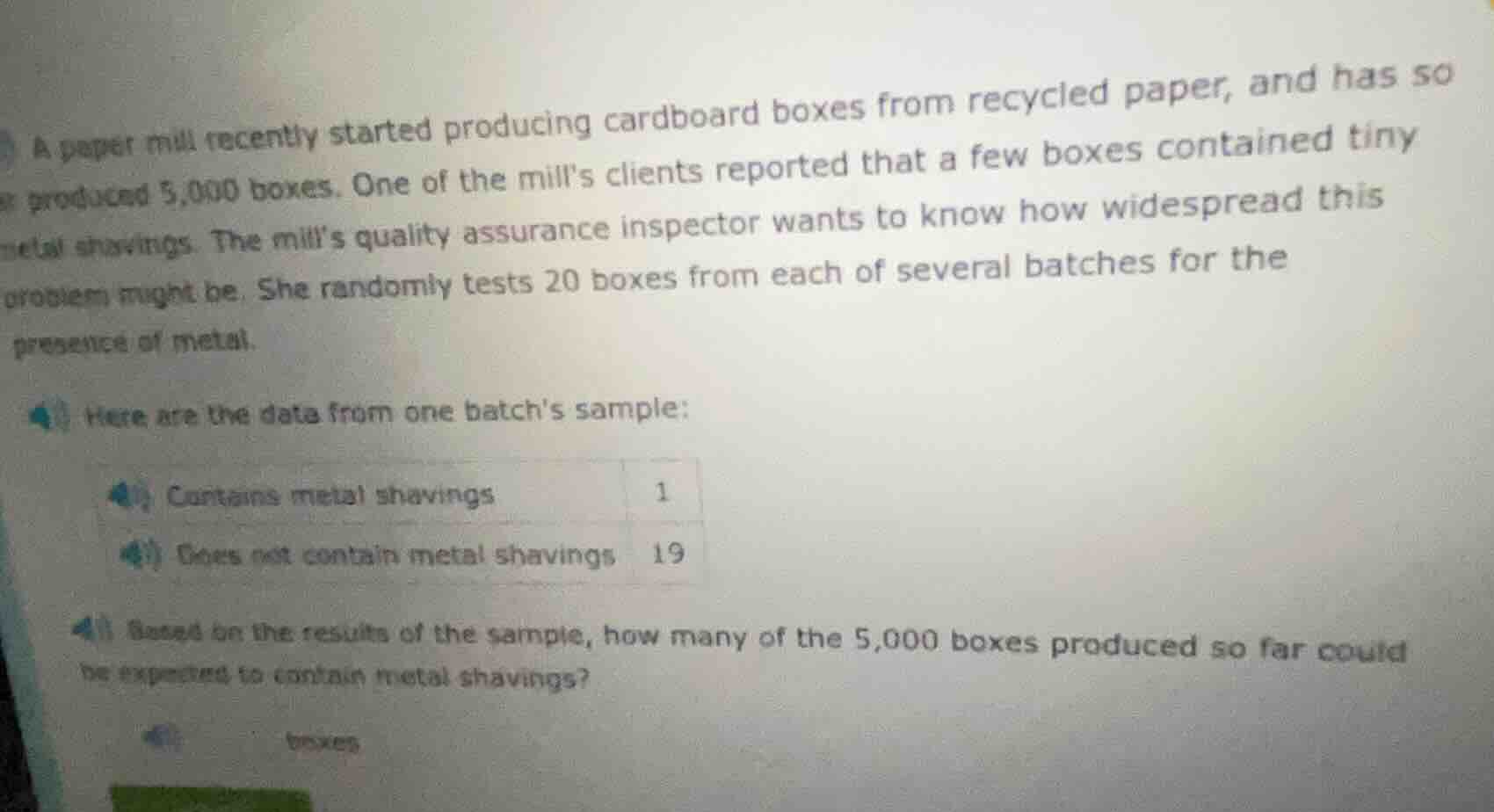
a paper mill recently started producing cardboard boxes from recycled paper, and has so produced 5,000 boxes. one of the mill’s clients reported that a few boxes contained tiny metal shavings. the mill’s quality assurance inspector wants to know how widespread this problem might be. she randomly tests 20 boxes from each of several batches for the presence of metal. here are the data from one batch’s sample: contains metal shavings: 1; does not contain metal shavings: 19. based on the results of the sample, how many of the 5,000 boxes produced so far could be expected to contain metal shavings?
Step1: Find the proportion in the sample
The sample size is \( 1 + 19 = 20 \) boxes. The number of boxes with metal shavings in the sample is 1. So the proportion of boxes with metal shavings in the sample is \( \frac{1}{20} \).
Step2: Apply the proportion to the total number of boxes
To find the expected number of boxes with metal shavings in 5000 boxes, we multiply the total number of boxes by the proportion. So we calculate \( 5000\times\frac{1}{20} \).
\( 5000\times\frac{1}{20}=\frac{5000}{20} = 250 \)

Snap & solve any problem in the app
Get step-by-step solutions on Sovi AI
Photo-based solutions with guided steps
Explore more problems and detailed explanations
250