QUESTION IMAGE
Question
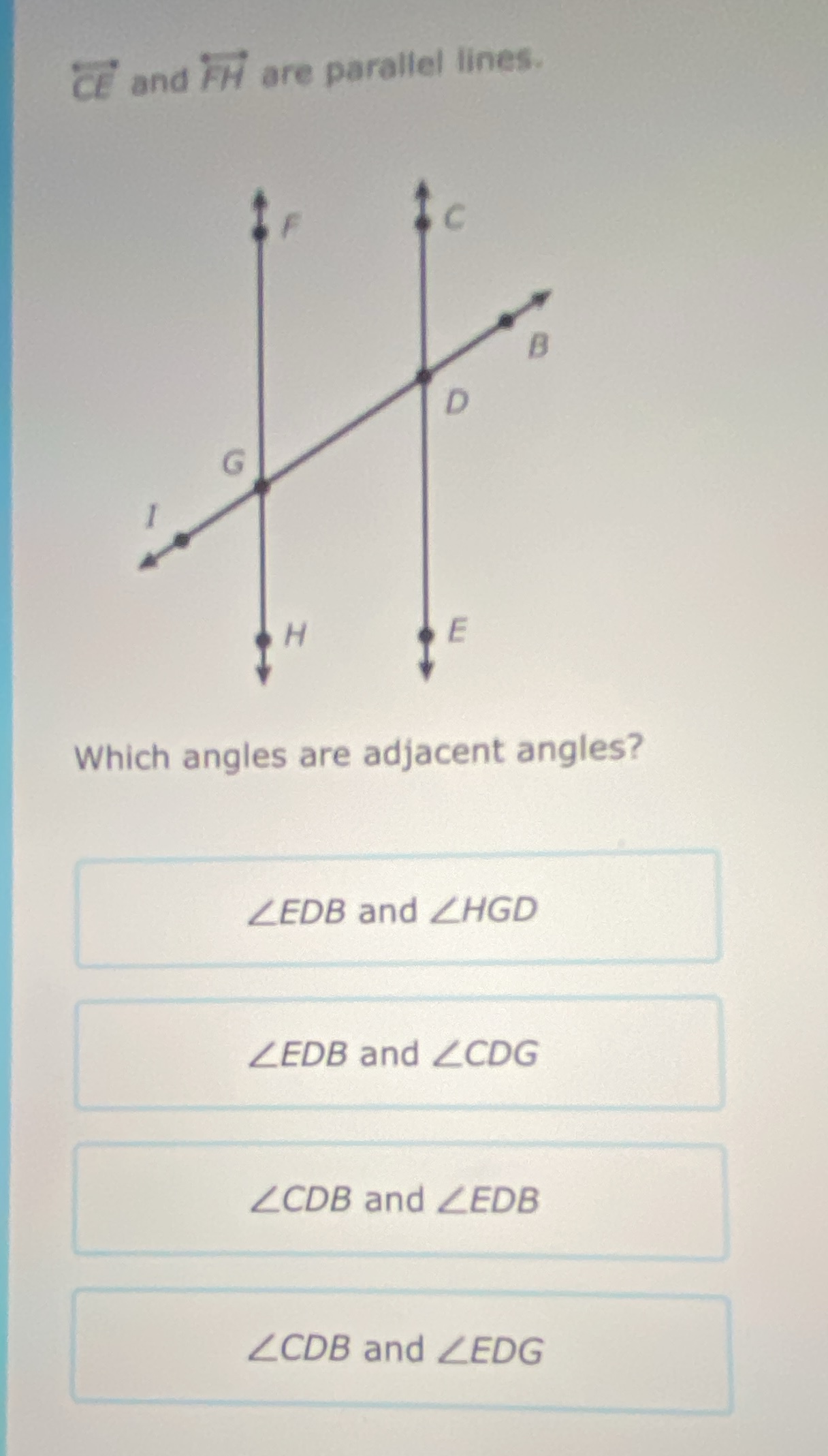
$\overleftrightarrow{ce}$ and $\overleftrightarrow{fh}$ are parallel lines.
image of two vertical parallel lines (fh and ce) and a transversal (ib) intersecting them at g and d respectively
which angles are adjacent angles?
- $\angle edb$ and $\angle hgd$
- $\angle edb$ and $\angle cdg$
- $\angle cdb$ and $\angle edb$
- $\angle cdb$ and $\angle edg$
To determine adjacent angles, we use the definition: adjacent angles share a common side and a common vertex, and their non - common sides form a linear pair (or they are next to each other).
Step 1: Analyze \(\angle EDB\) and \(\angle HGD\)
\(\angle EDB\) has vertex \(D\) and sides \(DE\) and \(DB\). \(\angle HGD\) has vertex \(G\) and sides \(HG\) and \(GD\). They do not share a common vertex, so they are not adjacent.
Step 2: Analyze \(\angle EDB\) and \(\angle CDG\)
\(\angle EDB\) has vertex \(D\) and sides \(DE\) and \(DB\). \(\angle CDG\) has vertex \(D\) and sides \(CD\) and \(DG\). The non - common sides \(DB\) and \(CD\) do not form a linear pair in the way adjacent angles require (they are not supplementary in a way that adjacent angles on a straight line are), and the common side and vertex relationship does not meet the adjacent angle criteria.
Step 3: Analyze \(\angle CDB\) and \(\angle EDB\)
\(\angle CDB\) has vertex \(D\), sides \(CD\) and \(DB\). \(\angle EDB\) has vertex \(D\), sides \(DE\) and \(DB\). They share a common vertex \(D\) and a common side \(DB\), and their non - common sides \(CD\) and \(DE\) form a straight line (since \(CE\) is a straight line, \(CD\) and \(DE\) are colinear). So they are adjacent angles.
Step 4: Analyze \(\angle CDB\) and \(\angle EDG\)
\(\angle CDB\) has vertex \(D\) and sides \(CD\) and \(DB\). \(\angle EDG\) has vertex \(D\) and sides \(DE\) and \(DG\). They do not share a common side, so they are not adjacent.

Snap & solve any problem in the app
Get step-by-step solutions on Sovi AI
Photo-based solutions with guided steps
Explore more problems and detailed explanations
\(\angle CDB\) and \(\angle EDB\) (the option with \(\angle CDB\) and \(\angle EDB\))