QUESTION IMAGE
Question
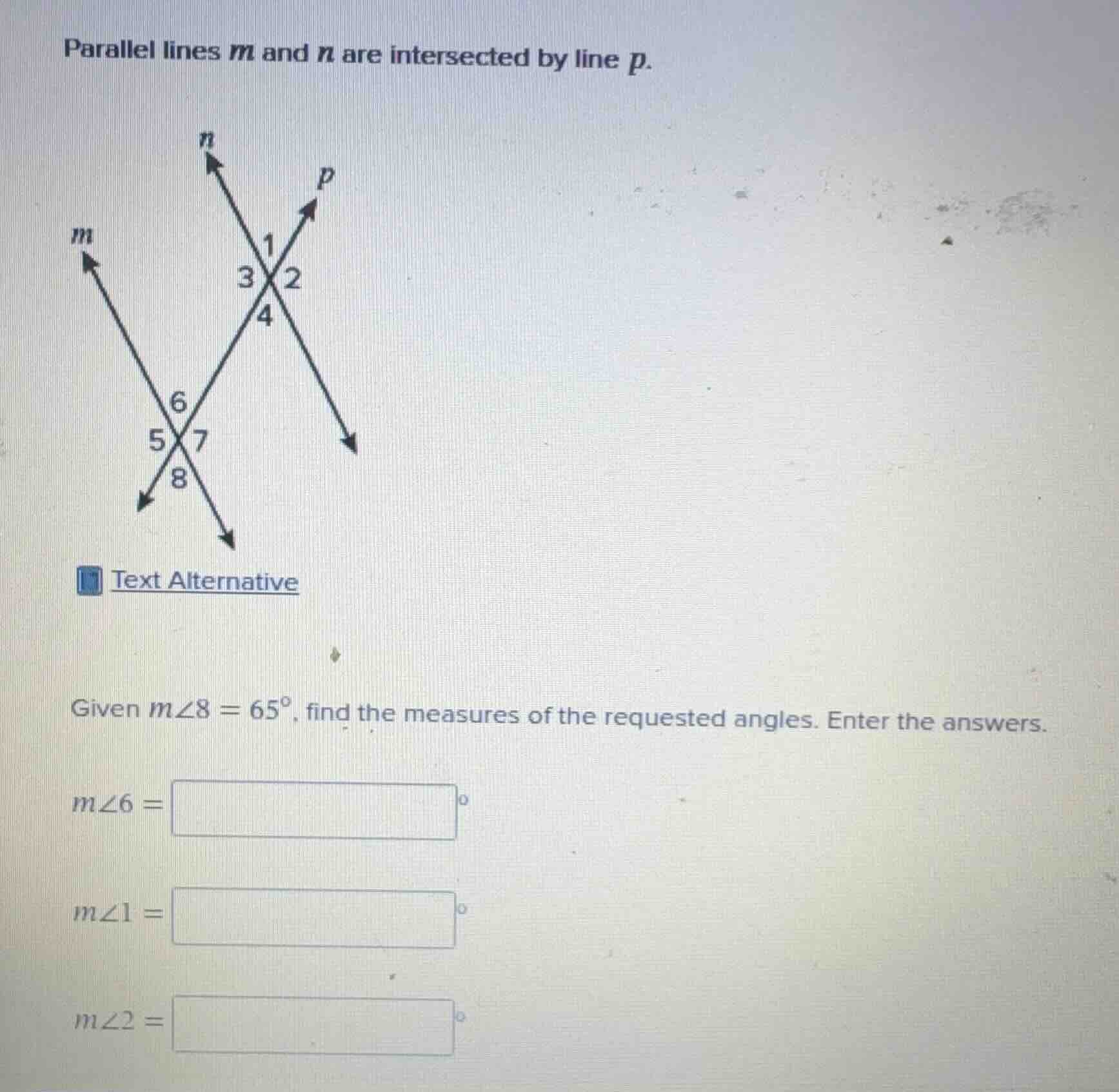
parallel lines m and n are intersected by line p. given ( mangle8 = 65^circ ), find the measures of the requested angles. enter the answers. ( mangle6 = ) (square^circ) ( mangle1 = ) (square^circ) ( mangle2 = ) (square^circ)
Step1: Find \( m\angle6 \)
\(\angle6\) and \(\angle8\) are vertical angles? No, wait, \(\angle6\) and \(\angle8\): Wait, actually, \(\angle5\), \(\angle6\), \(\angle7\), \(\angle8\) are around a transversal intersecting line \(m\). Wait, \(\angle6\) and \(\angle8\): Wait, no, \(\angle6\) and \(\angle8\) – actually, \(\angle6\) and \(\angle8\) are alternate interior? Wait, no, let's see: \(\angle8\) and \(\angle6\): Wait, \(\angle5\) and \(\angle7\) are vertical, \(\angle6\) and \(\angle8\) are vertical? Wait, no, when two lines intersect, vertical angles are equal. Wait, the lines forming \(\angle5\), \(\angle6\), \(\angle7\), \(\angle8\) – the two lines (the transversal and line \(m\)) intersect, so \(\angle6\) and \(\angle8\) are vertical angles? Wait, no, \(\angle5\) and \(\angle7\) are vertical, \(\angle6\) and \(\angle8\) are vertical? Wait, no, let's label: when two lines intersect, the opposite angles are vertical. So if we have two intersecting lines, say line \(p\) and the other line (the one with \(\angle5 - \angle8\)), then \(\angle6\) and \(\angle8\) – wait, no, \(\angle6\) and \(\angle8\): Wait, \(\angle5\) is adjacent to \(\angle6\) and \(\angle8\). Wait, actually, \(\angle6\) and \(\angle8\) are vertical angles? Wait, no, \(\angle5\) and \(\angle7\) are vertical, \(\angle6\) and \(\angle8\) are vertical? Wait, no, let's think again. Given \(m\angle8 = 65^\circ\), \(\angle6\) and \(\angle8\) – are they corresponding angles? Wait, no, lines \(m\) and \(n\) are parallel, cut by a transversal (the line with \(\angle1 - \angle4\) and the other transversal? Wait, maybe I made a mistake. Wait, \(\angle8\) and \(\angle6\): Wait, \(\angle8\) and \(\angle6\) – actually, \(\angle6\) and \(\angle8\) are alternate interior angles? No, wait, let's look at the diagram: \(\angle8\) is at the bottom, \(\angle6\) is above. Wait, maybe \(\angle6\) and \(\angle8\) are vertical angles? Wait, no, when two lines intersect, vertical angles are equal. Wait, the two lines that form \(\angle5\), \(\angle6\), \(\angle7\), \(\angle8\) – let's call them line \(A\) and line \(B\). Then \(\angle5\) and \(\angle7\) are vertical (opposite), \(\angle6\) and \(\angle8\) are vertical (opposite). So if \(\angle8 = 65^\circ\), then \(\angle6 = 65^\circ\)? Wait, no, that can't be. Wait, maybe \(\angle6\) and \(\angle8\) are supplementary? Wait, no, if they are adjacent, but if they are vertical, they are equal. Wait, maybe I messed up. Wait, let's check \(\angle1\), \(\angle2\), \(\angle3\), \(\angle4\): those are around the intersection of line \(p\) and line \(n\). Then \(\angle5\), \(\angle6\), \(\angle7\), \(\angle8\) are around the intersection of line \(p\) and line \(m\). Since \(m \parallel n\), corresponding angles are equal. Wait, \(\angle8\) and \(\angle4\) – are they corresponding? Wait, maybe \(\angle8\) and \(\angle2\) are corresponding? No, let's start over.
Wait, the problem is: lines \(m\) and \(n\) are parallel, cut by a transversal (the line with \(\angle1 - \angle4\)) and another transversal? No, actually, the diagram has two transversals? Wait, no, the diagram shows line \(p\) intersecting lines \(m\) and \(n\), and another line intersecting line \(m\) (forming \(\angle5 - \angle8\)) and line \(p\)? Wait, maybe the two lines (line \(p\) and the other line) are the transversals. Wait, maybe \(\angle8\) and \(\angle6\) are vertical angles. Wait, if two lines intersect, vertical angles are equal. So if \(\angle8 = 65^\circ\), then \(\angle6 = 65^\circ\)? Wait, no, that seems wrong. Wait, maybe \(\angle6\) and \(\angle8\) are supplementa…

Snap & solve any problem in the app
Get step-by-step solutions on Sovi AI
Photo-based solutions with guided steps
Explore more problems and detailed explanations
\( m\angle6 = \boxed{65} \)
\( m\angle1 = \boxed{115} \)
\( m\angle2 = \boxed{65} \)