QUESTION IMAGE
Question
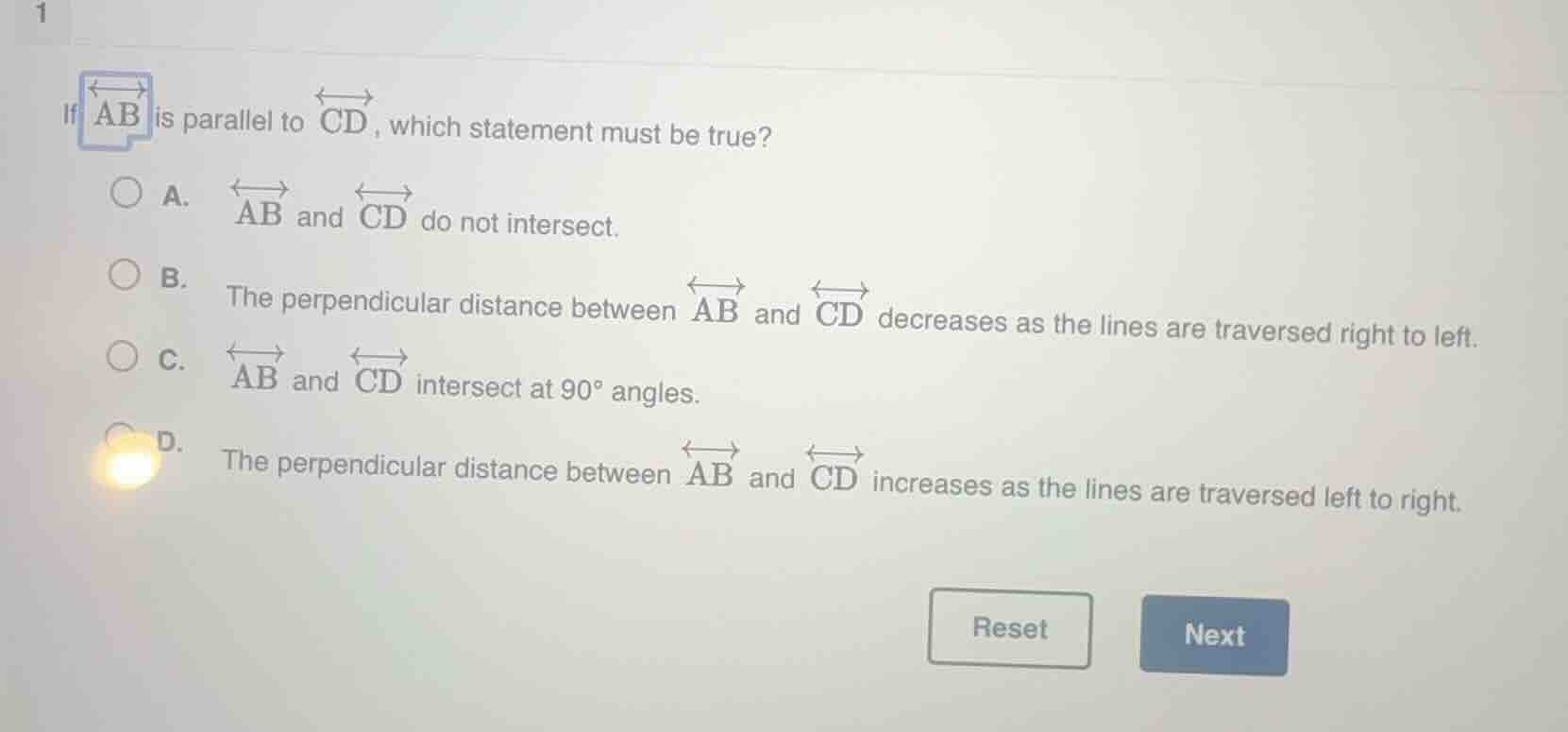
if \overleftrightarrow{ab} is parallel to \overleftrightarrow{cd}, which statement must be true? \
\bigcirc a. \overleftrightarrow{ab} and \overleftrightarrow{cd} do not intersect. \
\bigcirc b. the perpendicular distance between \overleftrightarrow{ab} and \overleftrightarrow{cd} decreases as the lines are traversed right to left. \
\bigcirc c. \overleftrightarrow{ab} and \overleftrightarrow{cd} intersect at 90° angles. \
\bigcirc d. the perpendicular distance between \overleftrightarrow{ab} and \overleftrightarrow{cd} increases as the lines are traversed left to right.
Parallel lines are defined as coplanar lines that never intersect, and their perpendicular distance remains constant at all points along the lines. Option B and D are false because the distance between parallel lines does not change. Option C describes perpendicular lines, not parallel ones. Only option A matches the definition of parallel lines.

Snap & solve any problem in the app
Get step-by-step solutions on Sovi AI
Photo-based solutions with guided steps
Explore more problems and detailed explanations
A. $\overleftrightarrow{AB}$ and $\overleftrightarrow{CD}$ do not intersect.