QUESTION IMAGE
Question
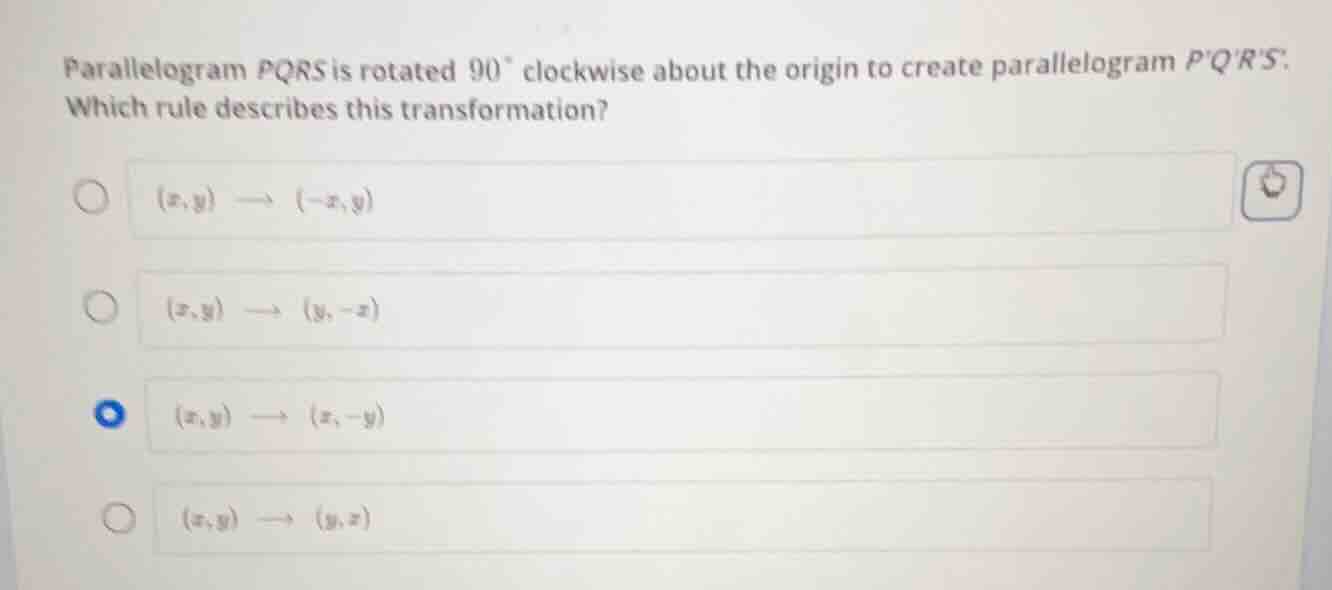
parallelogram pqrs is rotated $90^{\circ}$ clockwise about the origin to create parallelogram $pqrs$. which rule describes this transformation? \\(\bigcirc\\ (x,y)\to(-x,y)\\) \\(\bigcirc\\ (x,y)\to(y,-x)\\) \\(\bigcirc\\ (x,y)\to(x,-y)\\) \\(\bigcirc\\ (x,y)\to(y,x)\\)
Step1: Recall rotation rules
The rule for a \(90^\circ\) clockwise rotation about the origin is that a point \((x, y)\) is transformed to \((y, -x)\). Let's verify each option:
- Option 1: \((x, y)\to(-x, y)\) is a \(180^\circ\) rotation or reflection? No, it's a \(90^\circ\) counter - clockwise rotation? Wait, no. The rule \((x,y)\to(-x,y)\) is a reflection over the \(y\) - axis or a \(180^\circ\) rotation? No, for \(90^\circ\) clockwise, it's not this.
- Option 2: \((x, y)\to(y, -x)\) is the correct rule for \(90^\circ\) clockwise rotation about the origin. Let's take an example. Let \(x = 1\), \(y = 2\). After \(90^\circ\) clockwise rotation, the point \((1,2)\) should move to the fourth quadrant? Wait, no. A point \((x,y)\) in the first quadrant, after \(90^\circ\) clockwise rotation, will be in the fourth quadrant. If \(x = 1\), \(y = 2\), applying \((y,-x)\) gives \((2,-1)\), which is in the fourth quadrant. Let's think about the rotation matrix. The rotation matrix for \(90^\circ\) clockwise is \(
\). Multiplying this matrix with the vector \(
\) gives \(
\), which corresponds to the transformation \((x,y)\to(y, - x)\).
- Option 3: \((x, y)\to(x, -y)\) is a reflection over the \(x\) - axis, not a \(90^\circ\) clockwise rotation.
- Option 4: \((x, y)\to(y, x)\) is a reflection over the line \(y=x\) or a \(90^\circ\) counter - clockwise rotation? Wait, no. The rule \((x,y)\to(y,x)\) is a \(90^\circ\) counter - clockwise rotation? No, for \(90^\circ\) counter - clockwise rotation, the rule is \((x,y)\to(-y,x)\). And \((x,y)\to(y,x)\) is a reflection over \(y = x\).

Snap & solve any problem in the app
Get step-by-step solutions on Sovi AI
Photo-based solutions with guided steps
Explore more problems and detailed explanations
\((x, y)\to(y, -x)\) (the second option: \(\boldsymbol{(x,y)\to(y, -x)}\))