QUESTION IMAGE
Question
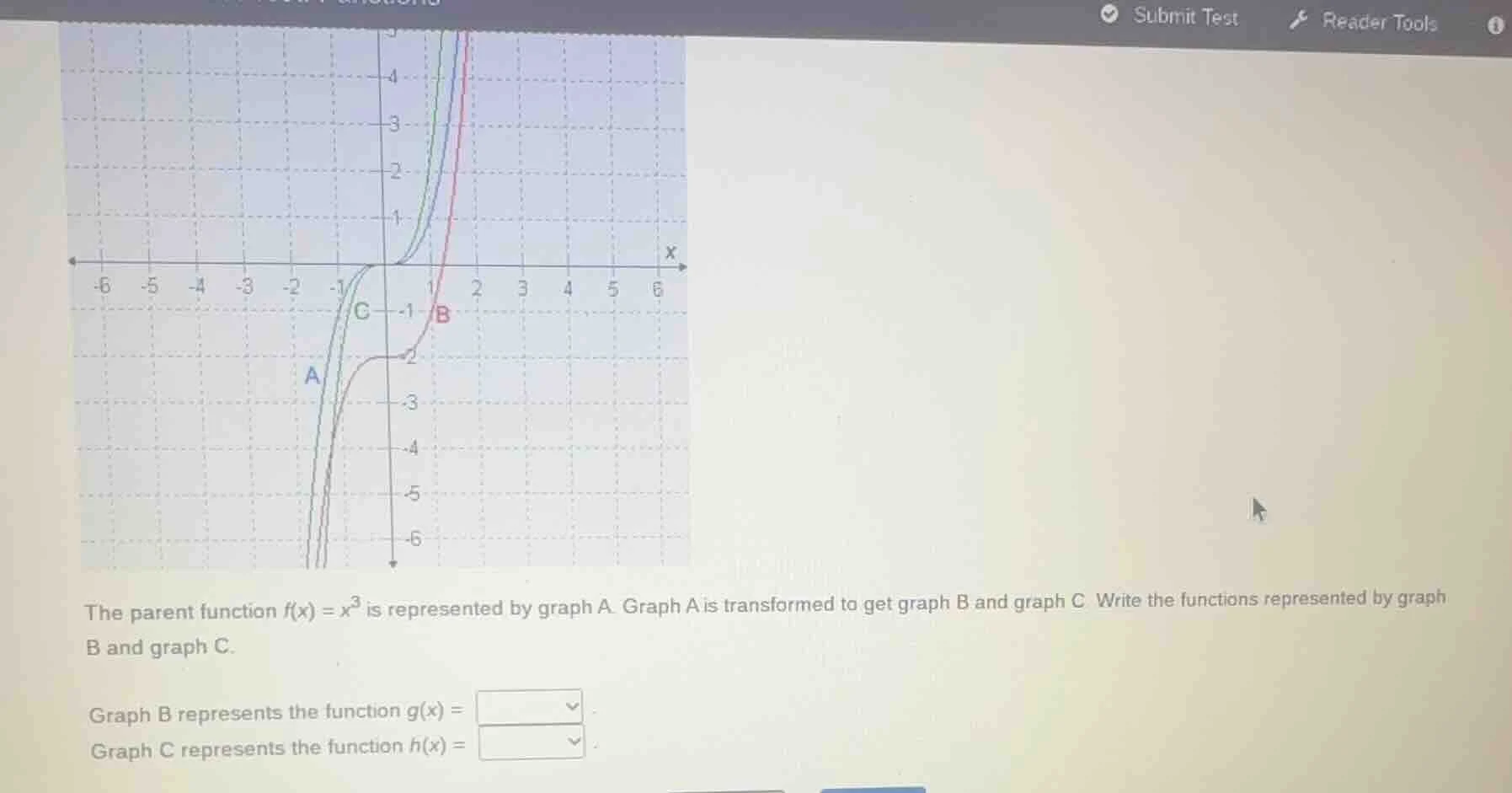
the parent function $f(x) = x^3$ is represented by graph a. graph a is transformed to get graph b and graph c. write the functions represented by graph b and graph c.
graph b represents the function $g(x) = $
graph c represents the function $h(x) = $
Step1: Analyze Graph B (Vertical Shift)
The parent function is \( f(x) = x^3 \). Graph B appears to be a vertical shift of Graph A. Let's check the point. For \( f(x) = x^3 \), at \( x = 1 \), \( f(1)=1 \). On Graph B, at \( x = 1 \), the value is \( -2 \)? Wait, no, maybe horizontal or vertical stretch? Wait, no, let's re-examine. Wait, maybe Graph B is a vertical shift? Wait, no, maybe a horizontal shift? Wait, no, let's look at the vertex (the point where the cubic has a point of inflection, at (0,0) for \( f(x)=x^3 \)). For Graph B, let's see a point. Let's take x=1: for Graph A (parent \( x^3 \)), f(1)=1. For Graph B, when x=1, what's the y-value? From the graph, maybe Graph B is \( (x - 1)^3 - 2 \)? No, wait, maybe vertical shift. Wait, no, maybe Graph B is a vertical shift down? Wait, no, let's check the transformation. Wait, the parent function is \( f(x) = x^3 \). Graph B: let's see the point (1, -2)? Wait, maybe I made a mistake. Wait, another approach: the cubic function's transformation. The general form for vertical shift is \( f(x) = x^3 + k \), horizontal shift is \( f(x) = (x - h)^3 \), vertical stretch/compression is \( a x^3 \), horizontal stretch/compression is \( (b x)^3 \).
Looking at Graph B: compared to Graph A (parent \( x^3 \)), when x=1, Graph B has a point. Wait, maybe Graph B is \( (x - 1)^3 - 2 \)? No, maybe simpler. Wait, the parent function is \( f(x) = x^3 \). Graph B: let's see the vertex (the inflection point) of Graph B. For Graph A, it's (0,0). For Graph B, maybe (1, -2)? No, maybe the inflection point of Graph B is at (1, -2)? Wait, no, maybe the inflection point of Graph B is at (1, -2), so the function would be \( g(x) = (x - 1)^3 - 2 \)? Wait, no, maybe I'm overcomplicating. Wait, the problem says Graph A is \( f(x) = x^3 \), transformed to Graph B and C. Let's look at Graph B: when x=1, what's y? From the graph, maybe Graph B is \( (x - 1)^3 - 2 \)? No, maybe vertical shift. Wait, another way: let's take x=0. For Graph A, f(0)=0. For Graph B, at x=0, what's y? From the graph, maybe y=-2? So Graph B would be \( x^3 - 2 \)? No, when x=1, \( 1^3 - 2 = -1 \), but in the graph, at x=1, Graph B is at -2? Wait, maybe Graph B is \( (x - 1)^3 - 2 \). Let's check x=1: (1-1)^3 -2 = -2, which matches. x=2: (2-1)^3 -2 = 1 - 2 = -1. x=0: (0-1)^3 -2 = -1 -2 = -3. Wait, but the graph: maybe I'm wrong. Wait, maybe Graph B is \( (x - 1)^3 - 2 \), and Graph C is a vertical stretch. Wait, Graph C: compared to Graph A, it's steeper, so maybe a vertical stretch, like \( 2x^3 \) or \( 3x^3 \). Wait, let's check the slope. The parent function \( x^3 \) has a derivative \( 3x^2 \), so at x=1, slope 3. Graph C is steeper, so maybe \( 2x^3 \) or \( 3x^3 \). Wait, maybe Graph C is \( 2x^3 \), and Graph B is \( (x - 1)^3 - 2 \). Wait, but the problem might have simpler transformations. Wait, maybe Graph B is \( (x - 1)^3 - 2 \) and Graph C is \( 2x^3 \). Wait, no, let's re-express.
Wait, the parent function is \( f(x) = x^3 \). Graph B: let's see the inflection point (the point where the curve changes concavity) is at (1, -2), so the function is \( g(x) = (x - 1)^3 - 2 \). Graph C: the inflection point is at (0,0), same as parent, but steeper, so it's a vertical stretch, maybe \( h(x) = 2x^3 \) (since it's steeper than the parent, so a > 1).
Wait, maybe I made a mistake. Let's check again. The parent function is \( f(x) = x^3 \). Graph B: when x=1, y=-2. Let's plug x=1 into \( (x - 1)^3 - 2 \): (0)^3 -2 = -2, correct. When x=2, (2-1)^3 -2 = 1 -2 = -1. When x=0, (0-1)^3 -2 = -1 -2 = -3. That seems to fit. Graph C: at…

Snap & solve any problem in the app
Get step-by-step solutions on Sovi AI
Photo-based solutions with guided steps
Explore more problems and detailed explanations
Graph B: \( g(x) = (x - 1)^3 - 2 \)
Graph C: \( h(x) = 2x^3 \)