QUESTION IMAGE
Question
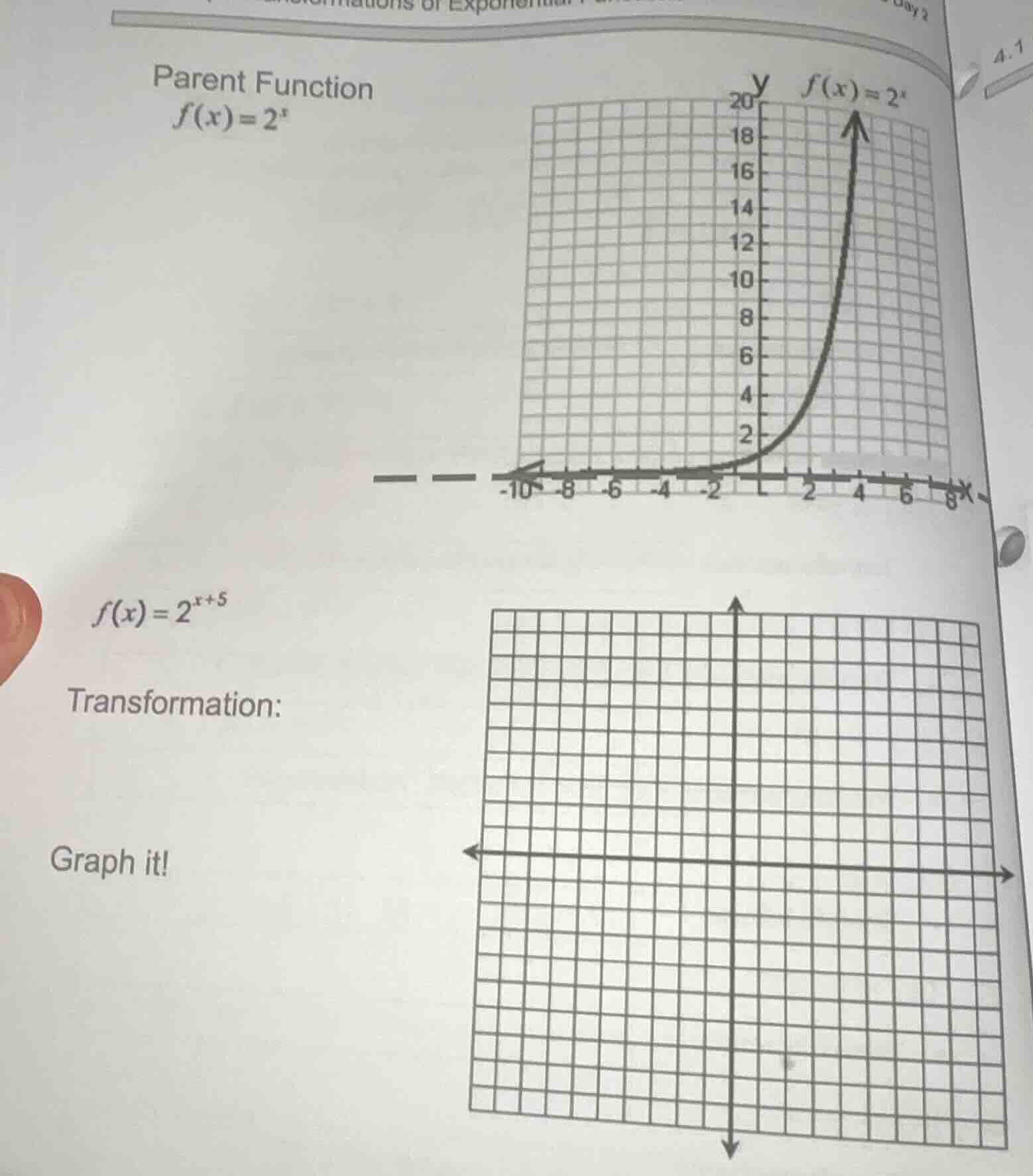
parent function
$f(x)=2^x$
$f(x)=2^{x+5}$
transformation:
graph it!
Step1: Identify Transformation Type
The parent function is \( f(x) = 2^x \), and the transformed function is \( f(x) = 2^{x + 5} \). For exponential functions of the form \( f(x)=a^{x - h}+k \), horizontal shifts are determined by \( h \). Here, we can rewrite \( 2^{x+5} \) as \( 2^{x-(-5)} \), so this is a horizontal shift.
Step2: Determine Shift Direction and Magnitude
In the horizontal shift formula \( f(x)=a^{x - h} \), if \( h\lt0 \), the graph shifts left by \( |h| \) units. Since \( h = - 5 \), the graph of \( f(x)=2^x \) shifts left by 5 units to get \( f(x)=2^{x + 5} \).
Step3: Graphing the Transformed Function
- Step 3.1: Find Key Points of Parent Function
For \( f(x)=2^x \), when \( x = 0 \), \( f(0)=1 \); when \( x = 1 \), \( f(1)=2 \); when \( x=- 1 \), \( f(-1)=\frac{1}{2} \). The horizontal asymptote is \( y = 0 \).
- Step 3.2: Apply the Shift to Key Points
For each point \( (x,y) \) on \( f(x)=2^x \), the corresponding point on \( f(x)=2^{x + 5} \) is \( (x - 5,y) \).
- For \( (0,1) \): New \( x \)-coordinate is \( 0-5=-5 \), so the point is \( (-5,1) \).
- For \( (1,2) \): New \( x \)-coordinate is \( 1 - 5=-4 \), so the point is \( (-4,2) \).
- For \( (-1,\frac{1}{2}) \): New \( x \)-coordinate is \( -1-5 = - 6 \), so the point is \( (-6,\frac{1}{2}) \).
The horizontal asymptote remains \( y = 0 \) (horizontal shifts do not affect the horizontal asymptote of exponential functions).
Plot these shifted points and draw the curve, which should have the same shape as \( f(x)=2^x \) but shifted 5 units to the left.
Transformation:
The graph of \( f(x)=2^{x+5} \) is the graph of the parent function \( f(x) = 2^x \) shifted horizontally 5 units to the left.
Graph Description:
To graph \( f(x)=2^{x + 5} \):
- Start with the key points of \( f(x)=2^x \): \( (0,1) \), \( (1,2) \), \( (-1,\frac{1}{2}) \), and the horizontal asymptote \( y = 0 \).
- Shift each \( x \)-coordinate of these points left by 5 units: \( (-5,1) \), \( (-4,2) \), \( (-6,\frac{1}{2}) \).
- Plot these new points, draw the exponential curve through them (increasing, concave up, approaching \( y = 0 \) as \( x\to-\infty \)), and include the horizontal asymptote \( y = 0 \).

Snap & solve any problem in the app
Get step-by-step solutions on Sovi AI
Photo-based solutions with guided steps
Explore more problems and detailed explanations
Step1: Identify Transformation Type
The parent function is \( f(x) = 2^x \), and the transformed function is \( f(x) = 2^{x + 5} \). For exponential functions of the form \( f(x)=a^{x - h}+k \), horizontal shifts are determined by \( h \). Here, we can rewrite \( 2^{x+5} \) as \( 2^{x-(-5)} \), so this is a horizontal shift.
Step2: Determine Shift Direction and Magnitude
In the horizontal shift formula \( f(x)=a^{x - h} \), if \( h\lt0 \), the graph shifts left by \( |h| \) units. Since \( h = - 5 \), the graph of \( f(x)=2^x \) shifts left by 5 units to get \( f(x)=2^{x + 5} \).
Step3: Graphing the Transformed Function
- Step 3.1: Find Key Points of Parent Function
For \( f(x)=2^x \), when \( x = 0 \), \( f(0)=1 \); when \( x = 1 \), \( f(1)=2 \); when \( x=- 1 \), \( f(-1)=\frac{1}{2} \). The horizontal asymptote is \( y = 0 \).
- Step 3.2: Apply the Shift to Key Points
For each point \( (x,y) \) on \( f(x)=2^x \), the corresponding point on \( f(x)=2^{x + 5} \) is \( (x - 5,y) \).
- For \( (0,1) \): New \( x \)-coordinate is \( 0-5=-5 \), so the point is \( (-5,1) \).
- For \( (1,2) \): New \( x \)-coordinate is \( 1 - 5=-4 \), so the point is \( (-4,2) \).
- For \( (-1,\frac{1}{2}) \): New \( x \)-coordinate is \( -1-5 = - 6 \), so the point is \( (-6,\frac{1}{2}) \).
The horizontal asymptote remains \( y = 0 \) (horizontal shifts do not affect the horizontal asymptote of exponential functions).
Plot these shifted points and draw the curve, which should have the same shape as \( f(x)=2^x \) but shifted 5 units to the left.
Transformation:
The graph of \( f(x)=2^{x+5} \) is the graph of the parent function \( f(x) = 2^x \) shifted horizontally 5 units to the left.
Graph Description:
To graph \( f(x)=2^{x + 5} \):
- Start with the key points of \( f(x)=2^x \): \( (0,1) \), \( (1,2) \), \( (-1,\frac{1}{2}) \), and the horizontal asymptote \( y = 0 \).
- Shift each \( x \)-coordinate of these points left by 5 units: \( (-5,1) \), \( (-4,2) \), \( (-6,\frac{1}{2}) \).
- Plot these new points, draw the exponential curve through them (increasing, concave up, approaching \( y = 0 \) as \( x\to-\infty \)), and include the horizontal asymptote \( y = 0 \).