QUESTION IMAGE
Question
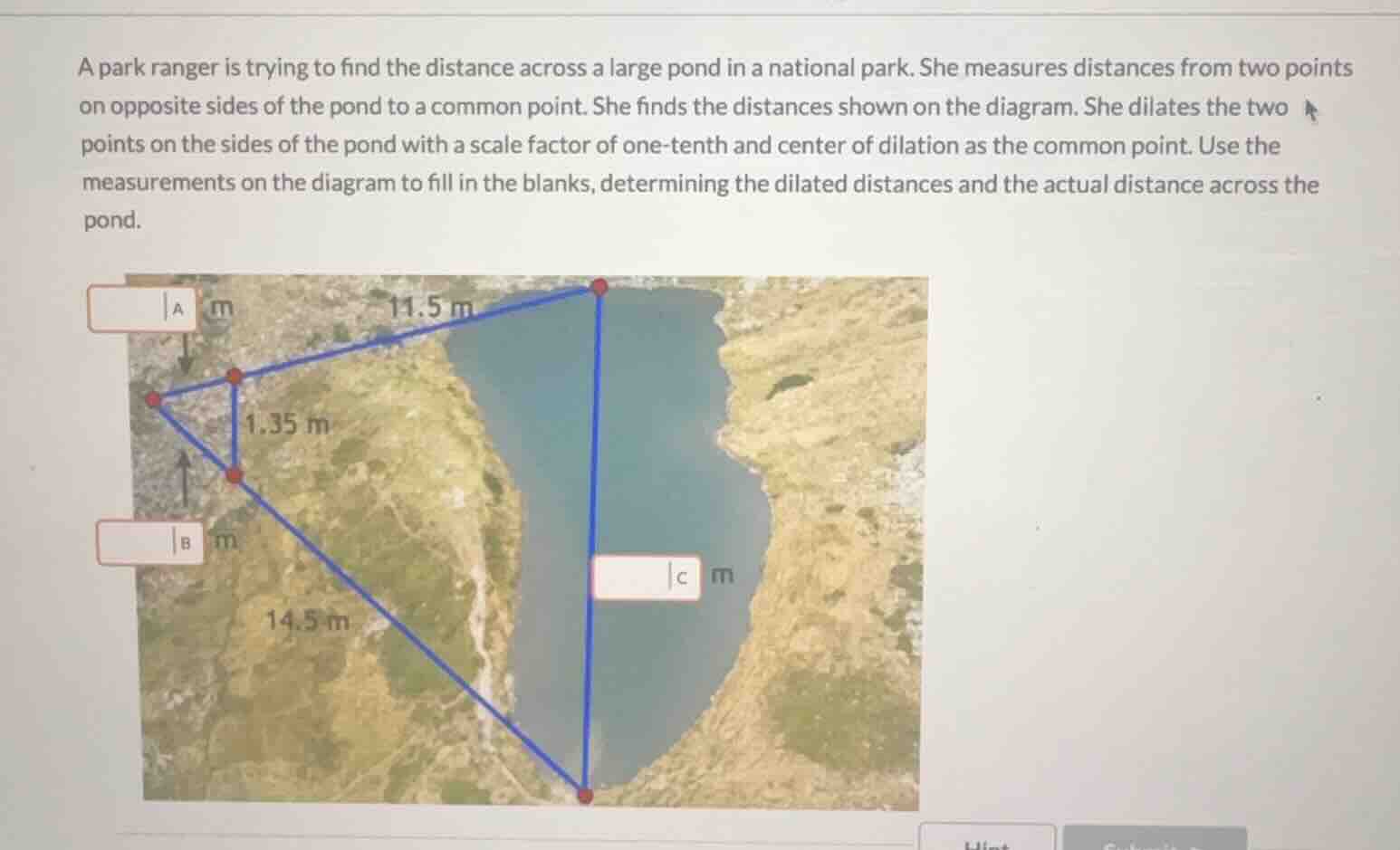
a park ranger is trying to find the distance across a large pond in a national park. she measures distances from two points on opposite sides of the pond to a common point. she finds the distances shown on the diagram. she dilates the two points on the sides of the pond with a scale factor of one - tenth and center of dilation as the common point. use the measurements on the diagram to fill in the blanks, determining the dilated distances and the actual distance across the pond. the diagram has lengths: 11.5 m, 1.35 m, 14.5 m, and blanks labeled |a| m, |b| m, |c| m.
Step1: Find Dilated Distance A
The original distance for the first side is 11.5 m. The scale factor is $\frac{1}{10}$. To find the dilated distance (A), multiply the original distance by the scale factor.
$A = 11.5\times\frac{1}{10} = 1.15$ m? Wait, no, wait. Wait, the diagram has a segment of 1.35 m which is the dilated one? Wait, maybe I misread. Wait, the problem says she dilates the two points on the sides of the pond with scale factor 1/10. So the original distances are 11.5 m and 14.5 m, and the dilated ones (the smaller segments) should be 11.5(1/10) and 14.5(1/10), and then the distance across the pond (c) would be related by similar triangles, since dilation preserves similarity. Wait, the middle segment is 1.35 m? Wait, no, let's re-express.
Wait, the two original distances from the common point to the pond sides are 11.5 m and 14.5 m. The dilated distances (A and B) are these original distances multiplied by the scale factor (1/10). Then, the distance across the pond (c) can be found by using the fact that the ratio of the dilated sides is equal to the ratio of the pond distance. Wait, the diagram shows a smaller triangle with sides A, B, and 1.35 m, and the larger triangle with sides 11.5 m, 14.5 m, and c m. Since dilation is a similarity transformation, the triangles are similar, so the ratios of corresponding sides are equal.
Wait, first, find A: original distance is 11.5 m, scale factor 1/10, so $A = 11.5\times\frac{1}{10} = 1.15$? No, wait the diagram has a segment labeled 1.35 m. Wait, maybe I got the scale factor reversed. Wait, the problem says "she dilates the two points on the sides of the pond with a scale factor of one - tenth and center of dilation as the common point". So dilation from the common point, so the original points are farther, and the dilated points are closer (since scale factor < 1). So the original distances (from common point to pond sides) are 11.5 m and 14.5 m, and the dilated distances (from common point to the dilated points) are 11.5(1/10) and 14.5(1/10). But in the diagram, there's a segment of 1.35 m. Wait, maybe the 1.35 m is the distance between the dilated points, and we need to find the distance between the original points (c) using similar triangles.
Wait, let's correct. Let's denote:
- Original distance from common point to pond side 1: 11.5 m
- Original distance from common point to pond side 2: 14.5 m
- Dilated distance (A) from common point to dilated point 1: $11.5\times\frac{1}{10} = 1.15$? No, wait the diagram has a segment of 1.35 m. Wait, maybe the 1.35 m is the length of the dilated segment between the two dilated points, and we need to find the length of the segment between the original points (c) using the ratio.
Wait, the two triangles (small and large) are similar, so the ratio of corresponding sides is equal. The ratio of the dilated sides (A and B) to the original sides (11.5 and 14.5) is 1/10, so the ratio of the pond distance (c) to the dilated pond distance (1.35 m) should also be 10 (since scale factor is 1/10, so the inverse for the pond distance). Wait, no: if the scale factor for the dilation (from original to dilated) is 1/10, then the ratio of dilated length to original length is 1/10. So if the dilated distance between the two points is 1.35 m, then the original distance (c) is 1.35 m divided by (1/10), which is 1.35*10 = 13.5 m? Wait, that makes sense. Wait, let's re - order:
- Find Dilated Distance A (from common point to first pond side, dilated):
Original distance: 11.5 m, scale factor = 1/10.
$A = 11.5\times\frac{1}{10}=1.15$? No, wait t…

Snap & solve any problem in the app
Get step-by-step solutions on Sovi AI
Photo-based solutions with guided steps
Explore more problems and detailed explanations
A = 1.15 m, B = 1.45 m, c = 13.5 m
Wait, but the user's diagram has a segment labeled 1.35 m. So the dilated distance between the two points is 1.35 m, so the actual distance (c) is 1.35 10 = 13.5 m. The dilated distances from the common point to the dilated points are 11.5 0.1 = 1.15 m (A) and 14.5 * 0.1 = 1.45 m (B). So:
A: 1.15 m
B: 1.45 m
c: 13.5 m