QUESTION IMAGE
Question
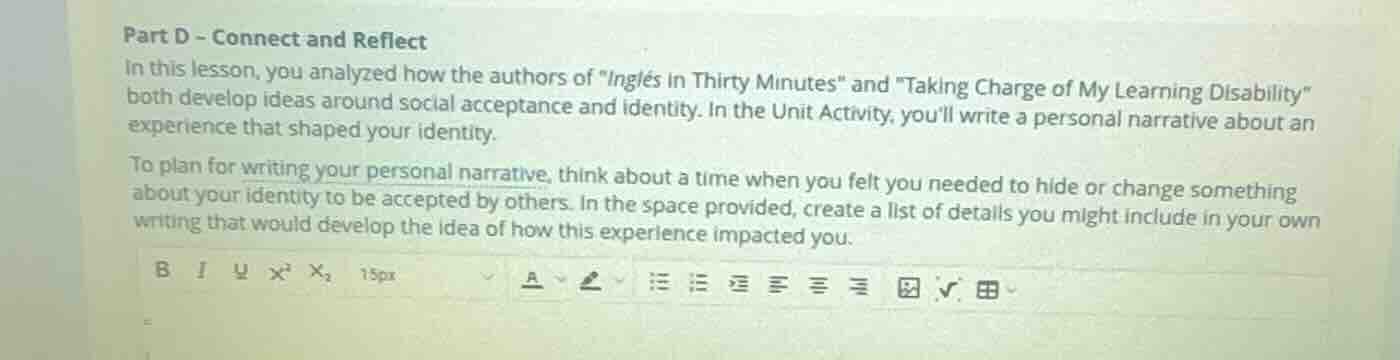
part d - connect and reflect
in this lesson, you analyzed how the authors of \inglés in thirty minutes\ and \taking charge of my learning disability\
both develop ideas around social acceptance and identity. in the unit activity, youll write a personal narrative about an
experience that shaped your identity.
to plan for writing your personal narrative, think about a time when you felt you needed to hide or change something
about your identity to be accepted by others. in the space provided, create a list of details you might include in your own
writing that would develop the idea of how this experience impacted you.
Since the problem is about planning a personal narrative related to identity and social acceptance, and involves writing details, the subfield under Arts is Writing.
The task is to plan a personal narrative, which falls under the Writing subfield of Arts. To complete this, one would list details like the specific identity aspect (e.g., cultural background, learning disability), the situation of hiding/ changing it, reactions from others, emotions during the experience, and how it impacted self - perception or actions later. For example, if the identity aspect was a regional accent:
- The setting: A new school where everyone had a standard accent.
- The action: Trying to mimic the standard accent, suppressing my natural way of speaking.
- Others' reactions: Some noticed the inconsistency and made comments, others didn't notice but I felt like an impostor.
- Emotions: Feelings of shame, anxiety, and a sense of loss of self.
- Impact: It made me question my self - worth initially, but later I realized the importance of being true to myself and started to embrace my accent, which led to more authentic connections with others.

Snap & solve any problem in the app
Get step-by-step solutions on Sovi AI
Photo-based solutions with guided steps
Explore more problems and detailed explanations
A sample list of details for a personal narrative (based on hiding a cultural identity trait like traditional clothing style in a new, more "modern" social circle):
- The specific trait: My traditional ethnic clothing (e.g., a salwar kameez or a kimono - style outfit) that I loved wearing.
- The situation: Joining a new group of friends who mostly wore Western - style, trendy clothes.
- My action: Starting to wear only jeans and t - shirts to fit in, hiding my traditional outfits in the back of my closet.
- Others' responses: My new friends praised my "cool" new look, but I felt a twinge of guilt and sadness.
- My emotions: Feelings of insecurity about my culture, a longing to wear my traditional clothes, and a sense of disconnection from my roots.
- The impact: Over time, I felt empty and unfulfilled. When I finally wore my traditional outfit to a cultural event, I received positive reactions from a wider group, which made me realize the value of embracing my identity. This experience taught me to be proud of who I am and to seek out communities that appreciate diversity.