QUESTION IMAGE
Question
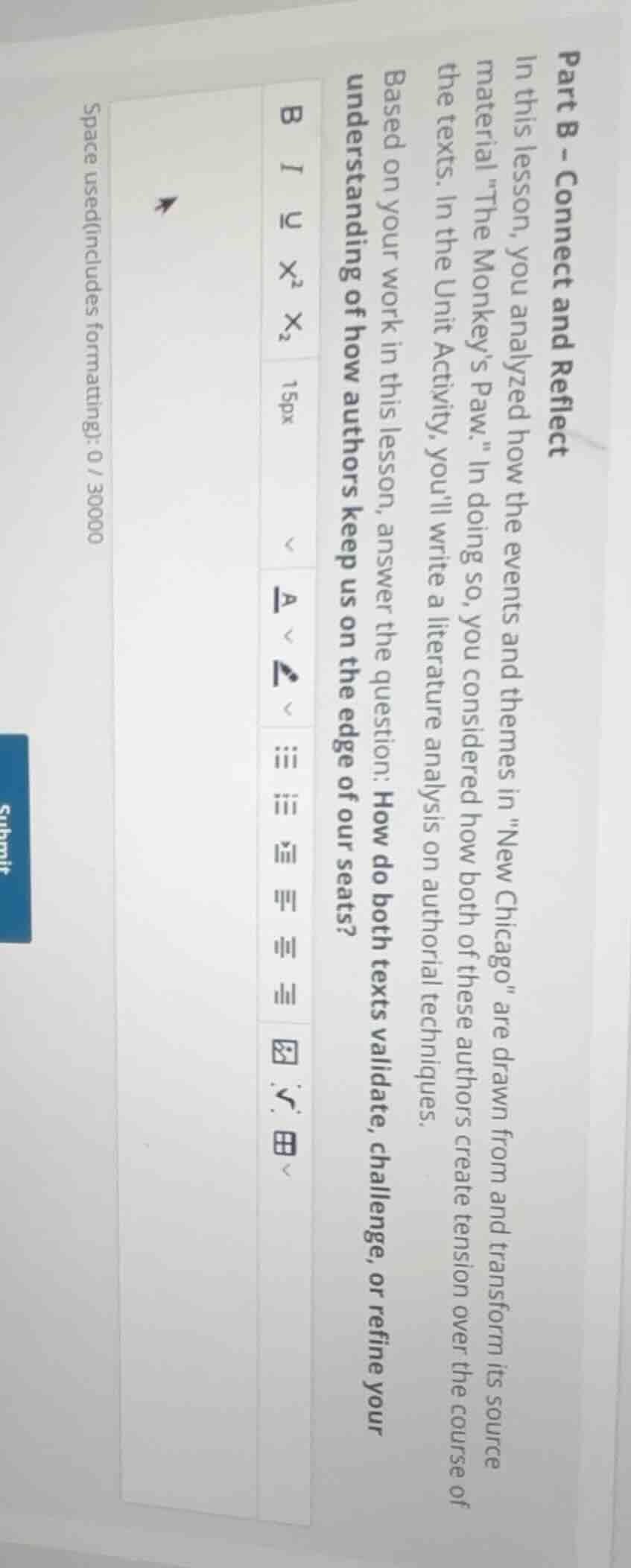
part b - connect and reflect
in this lesson, you analyzed how the events and themes in
ew chicago\ are drawn from and transform its source material \the monkey’s paw.\ in doing so, you considered how both of these authors create tension over the course of the texts. in the unit activity, you’ll write a literature analysis on authorial techniques.
based on your work in this lesson, answer the question: how do both texts validate, challenge, or refine your understanding of how authors keep us on the edge of our seats?
This analysis draws on literary techniques of pacing, information control, intertextuality, and thematic resonance. Both texts use intentional information withholding to build anxiety, but they diverge in structure (linear vs. intertextual) and focus (intimate dread vs. recontextualized stakes) to challenge and refine standard tension-building methods, while both grounding their tension in thematic weight to keep readers engaged.

Snap & solve any problem in the app
Get step-by-step solutions on Sovi AI
Photo-based solutions with guided steps
Explore more problems and detailed explanations
Both "New Chicago" and "The Monkey's Paw" validate, challenge, and refine the idea that authors build tension through deliberate control of information, subversion of expectations, and emotional stakes, as detailed below:
- Validation of the core tension-building principle:
- "The Monkey's Paw" uses deliberate withholding of information (e.g., the details of the sergeant-major's experiences with the paw, the fate of the first wish's recipient) and slow, incremental escalation of stakes (from a trivial first wish to a devastating second wish) to keep readers anxious and invested.
- "New Chicago", as a work derived from existing material, validates this by using its source's established world to hint at unseen threats or unresolved conflicts, leveraging readers' prior knowledge to create immediate tension.
- Challenge to conventional tension structures:
- "The Monkey's Paw" challenges the idea that tension requires non-stop action by building dread through quiet, intimate moments (e.g., the White family waiting for the knock at the door) rather than overt violence.
- "New Chicago" challenges linear tension building by recontextualizing familiar events from its source material, creating tension through subverted expectations (e.g., framing a previously heroic event as morally ambiguous or dangerous).
- Refinement of tension-building techniques:
- "The Monkey's Paw" refines the use of thematic tension by tying every anxious moment to the theme of greed and unintended consequences, making the tension feel thematically meaningful rather than just superficial.
- "New Chicago" refines intertextual tension by using its connection to "The Monkey's Paw" to create layered anxiety: readers familiar with the paw's curse will feel heightened tension when similar motifs appear, knowing the potential for catastrophic outcomes.