QUESTION IMAGE
Question
part a
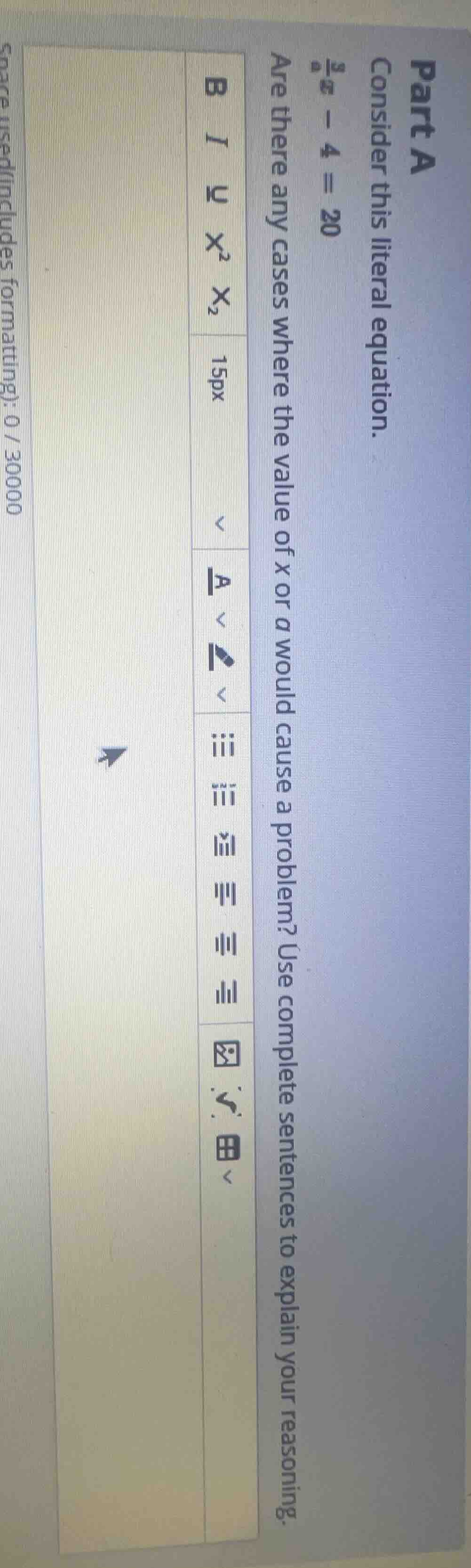
consider this literal equation.
\\(\frac{3}{a}x - 4 = 20\\)
are there any cases where the value of x or a would cause a problem? use complete sentences to explain your reasoning.
To determine if there are values of \( x \) or \( a \) that cause a problem, we analyze the equation \( \frac{3}{a}x - 4 = 20 \). First, consider the term \( \frac{3}{a} \). In mathematics, division by zero is undefined. So, if \( a = 0 \), the expression \( \frac{3}{a} \) is undefined, which would make the left - hand side of the equation undefined. For the variable \( x \), there are no restrictions on its value from a domain - of - definition perspective (since \( x \) is multiplied by \( \frac{3}{a} \), and as long as \( a
eq0 \), \( x \) can be any real number).

Snap & solve any problem in the app
Get step-by-step solutions on Sovi AI
Photo-based solutions with guided steps
Explore more problems and detailed explanations
The value \( a = 0 \) would cause a problem because division by zero (in the term \( \frac{3}{a} \)) is undefined. There are no values of \( x \) that would cause a problem as \( x \) can be any real number as long as \( a
eq0 \).