QUESTION IMAGE
Question
part a
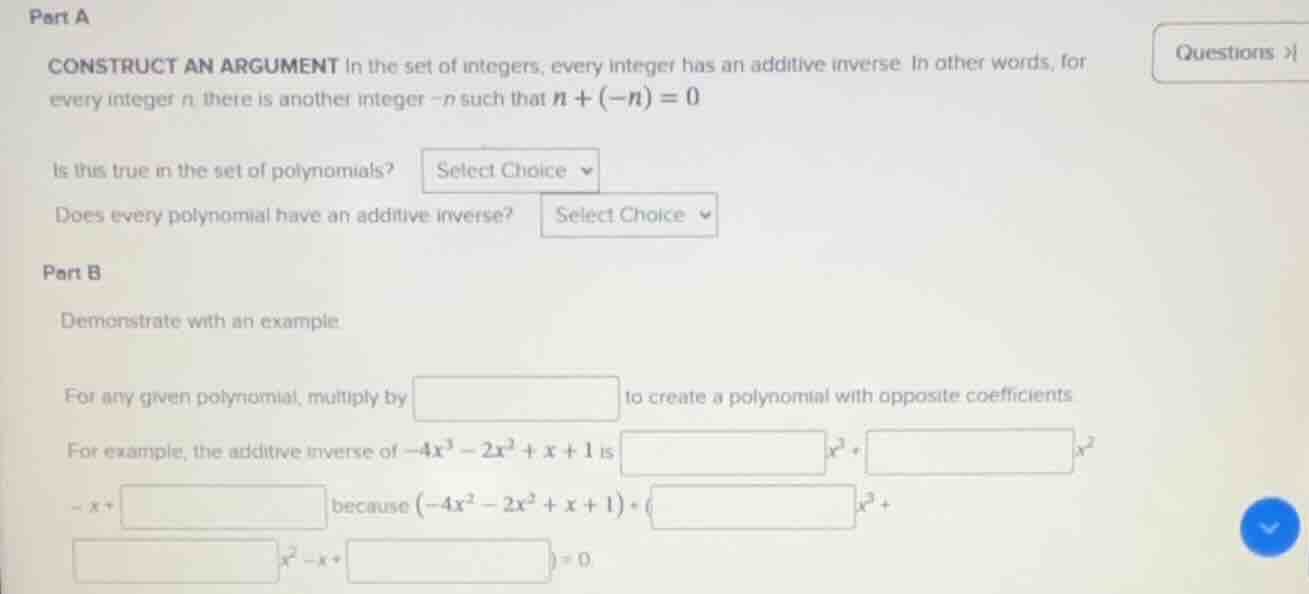
construct an argument in the set of integers, every integer has an additive inverse. in other words, for every integer ( n ) there is another integer ( -n ) such that ( n + (-n) = 0 )
is this true in the set of polynomials?
does every polynomial have an additive inverse?
part b
demonstrate with an example
for any given polynomial, multiply by to create a polynomial with opposite coefficients.
for example, the additive inverse of ( -4x^3 - 2x^2 + x + 1 ) is ( x^3 + x^2 - x + ) because ( (-4x^3 - 2x^2 + x + 1) + ( x^3 + x^2 - x + ) = 0 ).
For Part A, additive inverses exist in polynomials: adding a polynomial and its inverse (with all coefficients negated) gives the zero polynomial, following the same logic as integer additive inverses. For Part B, multiplying a polynomial by -1 flips all coefficients to get its additive inverse, and adding the original and inverse results in 0.

Snap & solve any problem in the app
Get step-by-step solutions on Sovi AI
Photo-based solutions with guided steps
Explore more problems and detailed explanations
Part A
Is this true in the set of polynomials? Yes
Does every polynomial have an additive inverse? Yes
Part B
For any given polynomial, multiply by $\boldsymbol{-1}$ to create a polynomial with opposite coefficients
For example, the additive inverse of $-4x^3 - 2x^2 + x + 1$ is $\boldsymbol{4}x^3 + \boldsymbol{2}x^2 - x + \boldsymbol{-1}$ because $(-4x^3 - 2x^2 + x + 1) + (\boldsymbol{4}x^3 + \boldsymbol{2}x^2 - x + \boldsymbol{-1}) = 0$