QUESTION IMAGE
Question
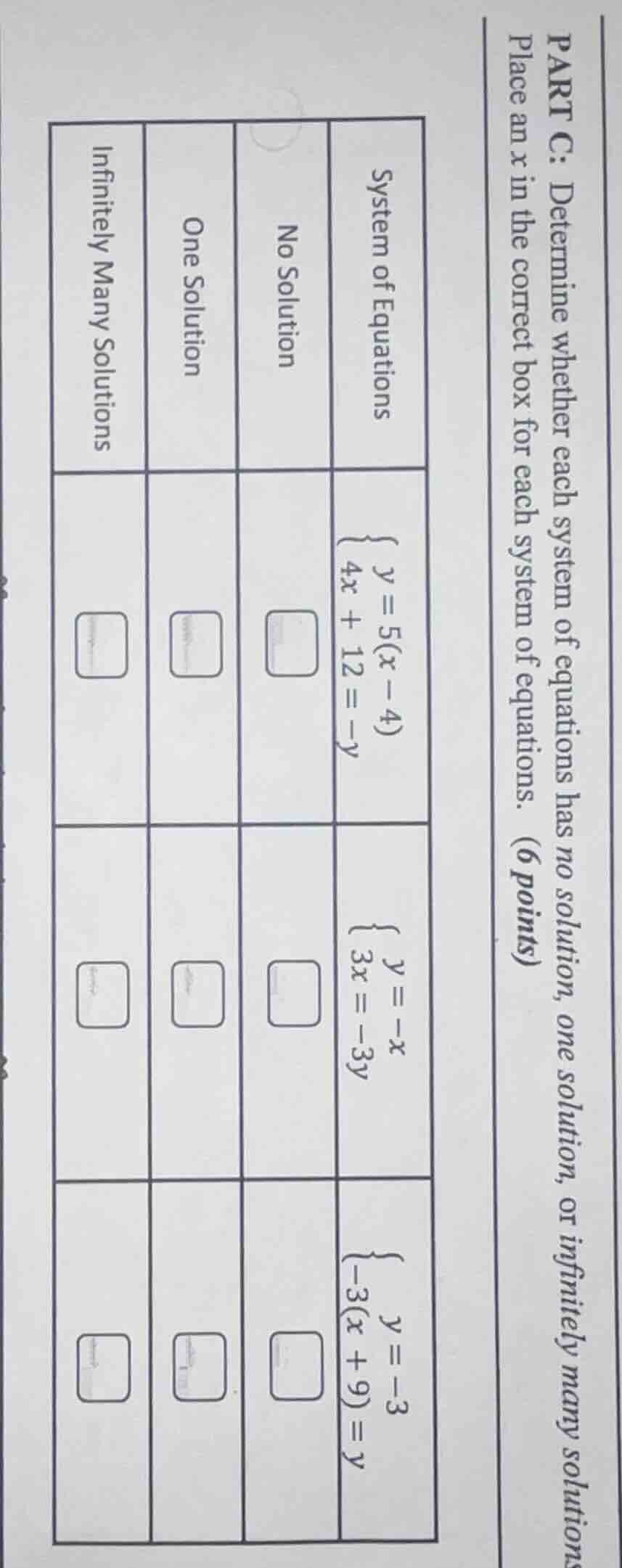
part c: determine whether each system of equations has no solution, one solution, or infinitely many solutions. place an x in the correct box for each system of equations. (6 points)
system of equations | no solution | one solution | infinitely many solutions
--- | --- | --- | ---
\\(\
\\) | | |
\\(\
\\) | | |
\\(\
\\) | | |
Step1: Simplify first system equations
First system:
$y = 5(x-4) \implies y = 5x - 20$
$4x + 12 = -y \implies y = -4x -12$
Set equal: $5x - 20 = -4x -12$
Step2: Solve for x (first system)
$5x + 4x = -12 + 20$
$9x = 8 \implies x = \frac{8}{9}$
Substitute to find y: $y = 5(\frac{8}{9}) - 20 = \frac{40}{9} - \frac{180}{9} = -\frac{140}{9}$
One unique solution.
Step3: Simplify second system equations
Second system:
$y = -x$
$3x = -3y \implies x = -y \implies y = -x$
Both equations are identical.
Step4: Classify second system
Identical linear equations mean infinitely many solutions.
Step5: Simplify third system equations
Third system:
$y = -3$
$-3(x+9) = y \implies -3x -27 = -3$
Step6: Solve third system
$-3x = -3 +27 = 24 \implies x = -8$
Unique pair $(-8, -3)$, one solution.

Snap & solve any problem in the app
Get step-by-step solutions on Sovi AI
Photo-based solutions with guided steps
Explore more problems and detailed explanations
- For
: ✅ One Solution
- For
: ✅ Infinitely Many Solutions
- For
: ✅ One Solution