QUESTION IMAGE
Question
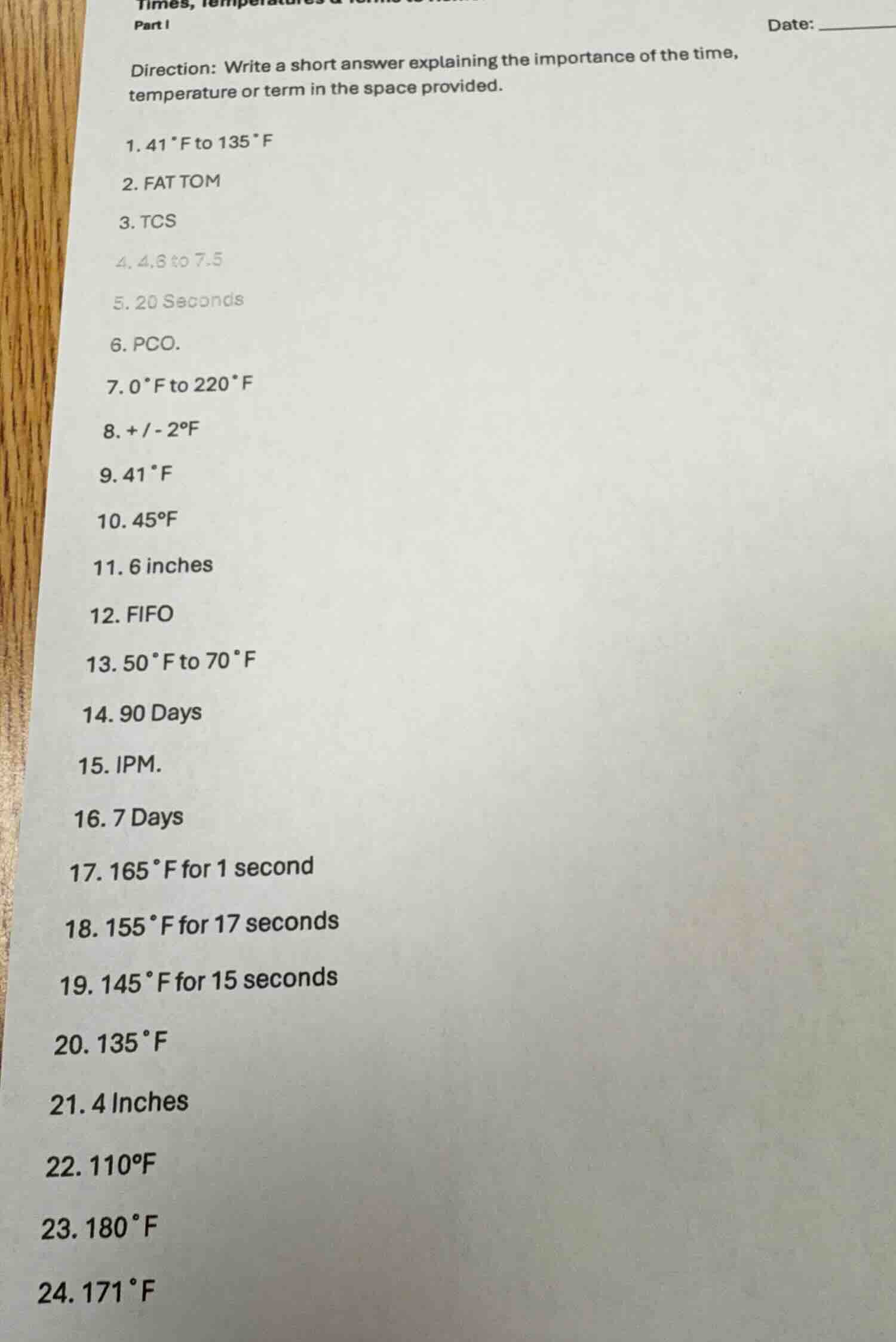
part i
direction: write a short answer explaining the importance of the time,
temperature or term in the space provided.
- 41°f to 135°f
- fat tom
- tcs
- 4.6 to 7.5
- 20 seconds
- pco.
- 0°f to 220°f
- +/- 2°f
- 41°f
- 45°f
- 6 inches
- fifo
- 50°f to 70°f
- 90 days
- ipm.
- 7 days
- 165°f for 1 second
- 155°f for 17 seconds
- 145°f for 15 seconds
- 135°f
- 4 inches
- 110°f
- 180°f
- 171°f
To answer these questions, we'll address each one by explaining the importance of the time, temperature, or term in the context of food safety (a subfield of Natural Science, specifically related to Food Science, which falls under "Others" in the Natural Science subfields or can be related to Medicine and Health for foodborne illness prevention). Here are the explanations for a few key ones (you can request more if needed):
1. \( 41^\circ\text{F to } 135^\circ\text{F} \)
This is the temperature danger zone for food. Bacteria grow rapidly in this range, so food must be kept out of it (either below \( 41^\circ\text{F} \) or above \( 135^\circ\text{F} \)) to prevent foodborne illness.
FAT TOM is an acronym for the six conditions bacteria need to grow: Food (nutrient source), Acidity (neutral pH ideal), Time (to multiply), Temperature (danger zone), Oxygen (some need it), Moisture (water activity). It helps identify how to control bacterial growth in food.
TCS stands for Time/Temperature Control for Safety foods (formerly "potentially hazardous foods"). These foods (e.g., meat, dairy, cooked rice) require strict time/temperature control to prevent bacterial growth, as they support microbial growth.

Snap & solve any problem in the app
Get step-by-step solutions on Sovi AI
Photo-based solutions with guided steps
Explore more problems and detailed explanations
This is the food temperature danger zone; bacteria multiply quickly here, so food must avoid this range to stay safe.