QUESTION IMAGE
Question
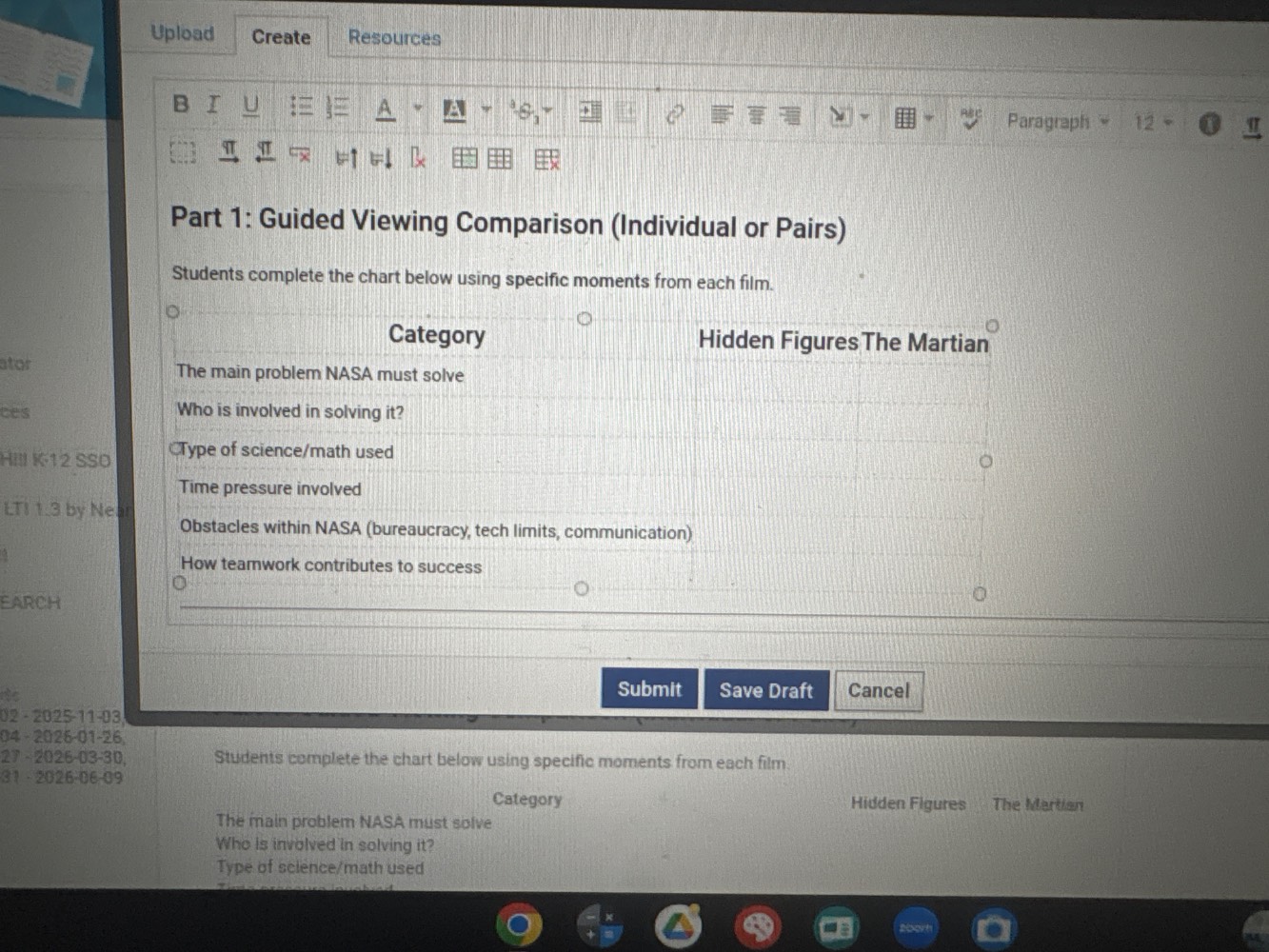
part 1: guided viewing comparison (individual or pairs)
students complete the chart below using specific moments from each film.
| category | hidden figures | the martian |
|---|---|---|
| who is involved in solving it? | ||
| type of science/math used | ||
| time pressure involved | ||
| obstacles within nasa (bureaucracy, tech limits, communication) | ||
| how teamwork contributes to success |
Response
To complete the chart, we analyze each film:
1. Hidden Figures
- Main problem NASA must solve: Successfully launch and orbit John Glenn (ensure orbital calculations for a safe mission).
- Who is involved: Katherine Johnson (mathematician), Dorothy Vaughan (computer/engineer), Mary Jackson (engineer), other NASA scientists/engineers.
- Type of science/math used: Orbital mechanics, calculus, geometry (for trajectory calculations).
- Time pressure: Tight deadline before Glenn’s launch (hours/days to verify calculations).
- Obstacles within NASA: Racial segregation (limited access to resources, bureaucratic bias), early computing tech limitations.
- How teamwork contributes: Katherine’s math, Dorothy’s programming, Mary’s engineering, and colleagues’ collaboration to integrate data.
2. The Martian
- Main problem NASA must solve: Rescue Mark Watney (stranded on Mars) by adjusting mission plans, launching a supply mission, and coordinating a return trajectory.
- Who is involved: Mark Watney (astronaut/scientist), NASA’s Jet Propulsion Lab, mission control, Ares 3 crew (later), international space agencies.
- Type of science/math used: Astrophysics, botany (Watney’s self-sustainment), orbital mechanics, calculus (trajectory optimization).
- Time pressure: Watney’s limited food/water (solves over ~500 days), rescue window tied to Mars-Earth alignment.
- Obstacles within NASA: Tech limits (launch failures, communication delays), bureaucratic debates over mission risks.
- How teamwork contributes: Watney’s ingenuity + NASA’s global collaboration (e.g., China’s rocket, crew’s orbital adjustments).
You can now fill these details into the chart for each category!

Snap & solve any problem in the app
Get step-by-step solutions on Sovi AI
Photo-based solutions with guided steps
Explore more problems and detailed explanations
To complete the chart, we analyze each film:
1. Hidden Figures
- Main problem NASA must solve: Successfully launch and orbit John Glenn (ensure orbital calculations for a safe mission).
- Who is involved: Katherine Johnson (mathematician), Dorothy Vaughan (computer/engineer), Mary Jackson (engineer), other NASA scientists/engineers.
- Type of science/math used: Orbital mechanics, calculus, geometry (for trajectory calculations).
- Time pressure: Tight deadline before Glenn’s launch (hours/days to verify calculations).
- Obstacles within NASA: Racial segregation (limited access to resources, bureaucratic bias), early computing tech limitations.
- How teamwork contributes: Katherine’s math, Dorothy’s programming, Mary’s engineering, and colleagues’ collaboration to integrate data.
2. The Martian
- Main problem NASA must solve: Rescue Mark Watney (stranded on Mars) by adjusting mission plans, launching a supply mission, and coordinating a return trajectory.
- Who is involved: Mark Watney (astronaut/scientist), NASA’s Jet Propulsion Lab, mission control, Ares 3 crew (later), international space agencies.
- Type of science/math used: Astrophysics, botany (Watney’s self-sustainment), orbital mechanics, calculus (trajectory optimization).
- Time pressure: Watney’s limited food/water (solves over ~500 days), rescue window tied to Mars-Earth alignment.
- Obstacles within NASA: Tech limits (launch failures, communication delays), bureaucratic debates over mission risks.
- How teamwork contributes: Watney’s ingenuity + NASA’s global collaboration (e.g., China’s rocket, crew’s orbital adjustments).
You can now fill these details into the chart for each category!