QUESTION IMAGE
Question
part iii
after years of bitter fighting, the conflict came to an end in february 1973 when a peace agreement was brokered between the pathet lao and the royalists. a coalition government was established and the cia began withdrawing from the country. however, the pathet lao began to gradually violate the peace agreement and overthrew the royalists from the government two years later.
while vang pao and a number of his officers and their families were airlifted by the us to thailand, tens of thousands of hmong soldiers and their dependents were left behind. some were able to sneak into thailand and large numbers eventually made it to the us and france while others kept on fighting, although a significant number were killed...
“the pathet lao promised reconciliation, but the hmong who had fought for the royal lao government feared retribution - if not mass murder along the lines of the khmer rouge, then incarceration in re - education camps,” explained stuart fox. “so many of those who stayed feared surrendering and fought on. the pathet lao in turn feared that continuing hmong insurgency would increase anti - communist support, so they were determined to suppress it.”
part iii. (summarize/quote/connection/7 wonders...)
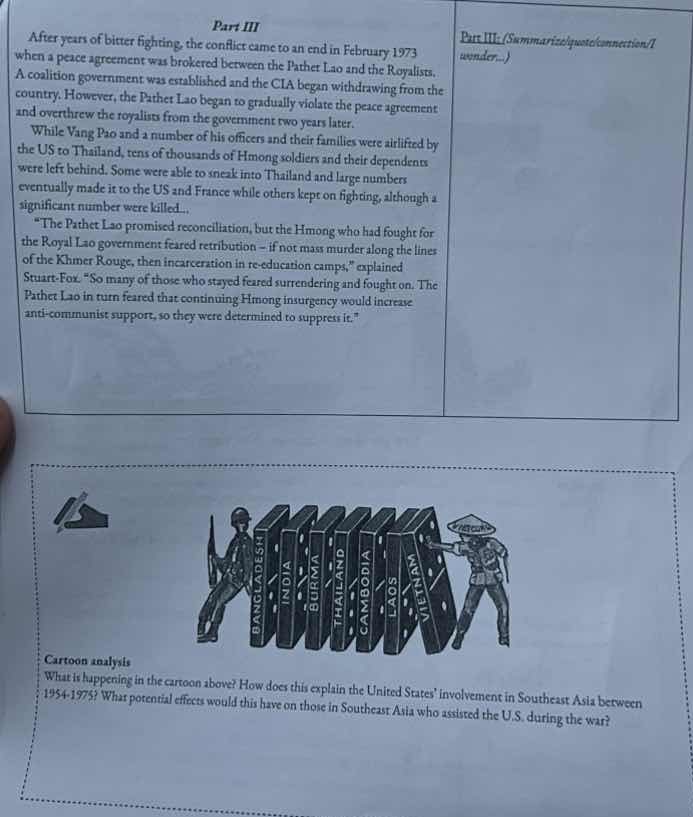
cartoon analysis
what is happening in the cartoon above? how does this explain the united states involvement in southeast asia between 1954 - 1975? what potential effects would this have on those in southeast asia who assisted the u.s. during the war?
- Cartoon Content: The cartoon depicts the "domino theory"—a soldier representing the U.S. propping up the first domino (labeled with Southeast Asian countries) while a figure representing communism pushes from the right. The dominoes symbolize Southeast Asian nations; the idea was that if one fell to communism, neighboring nations would follow.
- U.S. Involvement: This theory was the core justification for U.S. involvement in Southeast Asia (1954-1975). The U.S. intervened in Laos, Vietnam, and supported regional allies to prevent the "domino effect" of communist takeover across the region, fearing it would spread globally.
- Effects on U.S. Allies: For groups like the Hmong in Laos who assisted the U.S., the U.S. withdrawal and communist victory left them vulnerable. They faced retribution (imprisonment, violence, death) from communist governments like the Pathet Lao, as seen in the text. Many were displaced, fled as refugees, or continued fighting to avoid persecution.

Snap & solve any problem in the app
Get step-by-step solutions on Sovi AI
Photo-based solutions with guided steps
Explore more problems and detailed explanations
- The cartoon illustrates the U.S. government's domino theory: it shows a U.S. soldier trying to hold up a line of dominoes labeled with Southeast Asian countries, while a communist figure pushes the dominoes from the right. The theory argued that if one Southeast Asian nation fell to communism, all others in the region would follow, like toppling dominoes.
- This theory was the primary ideological driver of U.S. involvement in Southeast Asia between 1954-1975. The U.S. committed military forces, supported anti-communist governments, and backed local groups (like the Hmong in Laos) to prevent the spread of communism, believing it would threaten global U.S. interests and allies.
- For Southeast Asian groups that assisted the U.S. (such as the Hmong), the U.S. withdrawal and subsequent communist takeovers led to severe consequences. They faced violent retribution, imprisonment in re-education camps, and death from the new communist regimes. Many were forced to flee their homes as refugees to countries like the U.S. or France, while others continued armed resistance to avoid persecution.